Source: Medical Device Innovation Network
ChinaThe global medical device industry is experiencing a phase of rapid development.According to Sullivan and ChinaAccording to data from the IoT Medical Device Supply Chain Association, the global medical device market size is expected to reach $616 billion in 2023, with a year-on-year increase of 7.11%.Meanwhile, the scale of China's medical device market is expected to reach approximately RMB 12.5 trillion, with a year-on-year increase of 17%, which is about 2.4 times the growth rate of the global market.
However, since 2019, medical device companies have found it increasingly difficult to boost performance through organic growth alone, especially for large enterprises. To address this, many companies have begun adopting mergers and acquisitions to expand their business scope and strengthen their competitiveness.
According to incomplete statistics from relevant media, from 2024 to date, foreign-funded medical device companies have completed 12 mergers and acquisitions, with a total amount equivalent to approximately RMB 168.59 billion, involving various fields such as cardiovascular intervention, stroke prevention, and AI technology.
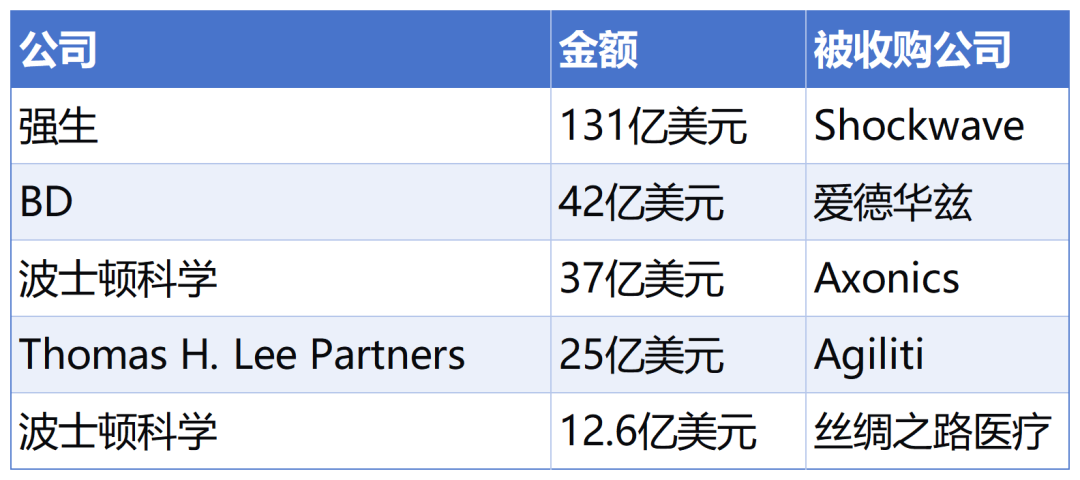
Among them, the most eye-catching is Johnson & Johnson's $13.1 billion acquisition of Shockwave Medical. Several other companies have also announced or completed their own large deals, among which there are five deals worth billions of dollars. Today, we will introduce in detail these five major acquisitions and their significance to the relevant companies.
(Chart: Medical Device Innovation Network)Johnson & Johnson Acquires Shockwave MedicalAmount: 13.1 billion USD
Completion Date: May 31
Johnson & Johnson Agreed to Acquire Shockwave for $13.1 Billion in April to Expand Its Business in Coronary Artery Disease and Peripheral Artery Disease. After Completing the Acquisition at the End of May, Johnson & Johnson Reported $77 Million in Acquisition-Related Sales in the Second Quarter, but Also Incurred Costs Related to the Transaction.
Johnson & Johnson Raises Full-Year Sales Forecast by $5 Billion Amid Acquisition Impact; However, the Company Still Falls Short of Its Medical Technology Revenue Target
Johnson & Johnson CFO Joe Wolk said that due to a series of initiatives, including the acquisition of Shockwave Medical, Johnson & Johnson can ensure "preferential pricing" on a global scale, and sales growth is expected to accelerate in the second half of the year.
During the Q2 earnings call, Wolk mentioned: "Now we are entering fields with significant unmet needs, such as cardiovascular, which presents a huge opportunity for us to ensure premium pricing for truly differentiated innovations, particularly in areas like electrophysiology, Abiomed cardiac recovery, and more recently, Shockwave." Meanwhile, Tim Schmid, Global Chair of Johnson & Johnson’s MedTech division, hailed Shockwave as Johnson & Johnson's 13th billion-dollar business.
BD to Acquire Edwards' Critical Care UnitAmount: 4.2 billion USD
Publication Date: June 3
In June this year, BD announced a $4.2 billion acquisition of Edwards Lifesciences' critical care division. In December last year, Edwards Lifesciences revealed plans to spin off the division. The aim of the plan was to create two businesses more focused on specific fields, a strategy that also supports a series of similar spin-off actions, including BD's divestiture of its diabetes care business Embecta.
Ultimately, Edwards Lifesciences decided to sell its critical care unit to BD instead of spinning it off as an independent entity. Edwards Lifesciences' Chief Financial Officer, Scott Ullem, discussed this decision at the Jefferies investor event in June. He told attendees that when the company announced its spin-off plans, "we received preliminary interest from potential buyers."
"We are very satisfied with the results, and we believe they are too. This is truly a win-win collaboration. The business is operating well, but we do need to focus all our attention on our core structural heart business."
Ullom stated that Edwards Lifesciences' investment focus will remain unchanged, and mergers and acquisitions will continue to be part of the company's strategy. The CFO explained that Edwards Lifesciences typically engages in smaller-scale acquisitions, primarily targeting structural heart companies in their early stages of development.
In July this year, Edwards Lifesciences announced that it had exercised an option to acquire Innovalve Bio Medical, a startup developing transcatheter mitral valve replacement technology, for approximately $300 million in cash. In addition, in a separate transaction, Edwards Lifesciences agreed to purchase shares of Affluent Medical for €15 million (approximately $16.3 million) and obtained the company's technology.
Boston Scientific to Acquire AxonicsIn January this year, Boston Scientific announced a $3.7 billion acquisition of Axonics. However, due to the review by the U.S. Federal Trade Commission (FTC), Boston Scientific has not yet completed the acquisition. In April this year, after receiving a second request from the FTC, Boston Scientific postponed the expected closing of the deal to the second half of the year.
Axonics, a company that produces devices for treating urinary and bowel dysfunction, is expected to drive the growth of Boston Scientific's urology business. In recent years, Boston Scientific has signed a series of agreements to add growth momentum. Axonics is one of the larger acquisitions by Boston Scientific, but Jonathan Monson, the company’s Senior Vice President of Investor Relations, indicated that there may be even bigger deals in the future.
Monson said at the TD Cowen event in March this year: "As the company grows, I think we can engage in larger-scale transactions. Therefore, you may see the average transaction size gradually increase over time, but that is not our top priority. The key is strategic fit."
In February this year, private equity firm Thomas H. Lee Partners (THL) privatized medical technology services provider Agiliti for $2.5 billion.
Agiliti went public in 2021 through an initial public offering (IPO), but its stock price fell after listing on the public market. The company's IPO was priced at $14 per share. THL completed the privatization of the company at $10 per share.
Boston Scientific Corporation Acquisition

Boston Scientific Agrees to Acquire Silk Road Medical for $1.26 Billion in June, Capping Q2 M&A Activity in Medtech. The deal will give Boston Scientific control over devices treating carotid artery disease.
JPMorgan Chase analyst Robbie Marcus said in a report to clients that the deal is not particularly expensive for Boston, but it is significant enough to drive the growth of the peripheral intervention business.
Boston Scientific said in the transaction announcement that Silk Road is expected to generate revenue between $194 million and $198 million in 2024, representing a year-over-year increase of 10%-12%.
These five major transactions not only demonstrate the development momentum of the medical technology industry but also reflect companies' strategic choices for growth in an ever-changing market environment. These deals are not only significant for the companies themselves but also have a profound impact on the entire medical technology industry. With advancements in technology and shifts in market demand, it is expected that more M&A activities will occur in the future, further driving innovation and development within the medical technology sector.