

BMS Resumes Phase 3 Trial of RYZ101 Amid Isotope Shortage; Pivotal Readout Delayed to 2026
Bristol-Myers Squibb
Biopharmaceutical and Nutritional Product R&D and Sales
RecentlyBristol-Myers Squibb (BMS) Chief Medical Officer Samit Hirawat said that after the trial was suspended in June this year due to an isotope shortage, the company has resumed recruitment for the Phase 3 trial of its key radiopharmaceutical RYZ101, but the readout of the Phase 3 trial results has been postponed from 2025 to 2026.
On December 26, 2023, Bristol-Myers Squibb (BMS) announced that it would acquire RayzeBio, a nuclear medicine supernova listed just three years ago, at a cash price of $62.50 per share, valuing the total equity at approximately $4.1 billion. BMS will gain RayzeBio’s differentiated radiopharmaceutical technology platform based on α nuclides and multiple innovative products under development, including novel targeted radiopharmaceuticals such as RYZ101 and RYZ801. With this acquisition, BMS officially enters the nuclear medicine field.
In just three years, RayzeBio has developed multiple radiopharmaceutical pipelines. Its leading pipeline, RYZ101, has entered Phase III clinical trials, with the first patient dosing beginning at the end of May last year for the treatment of gastroenteropancreatic neuroendocrine tumors. Meanwhile, RYZ101 is also undergoing a Phase I clinical trial study for patients with advanced small cell lung cancer expressing SSTR.
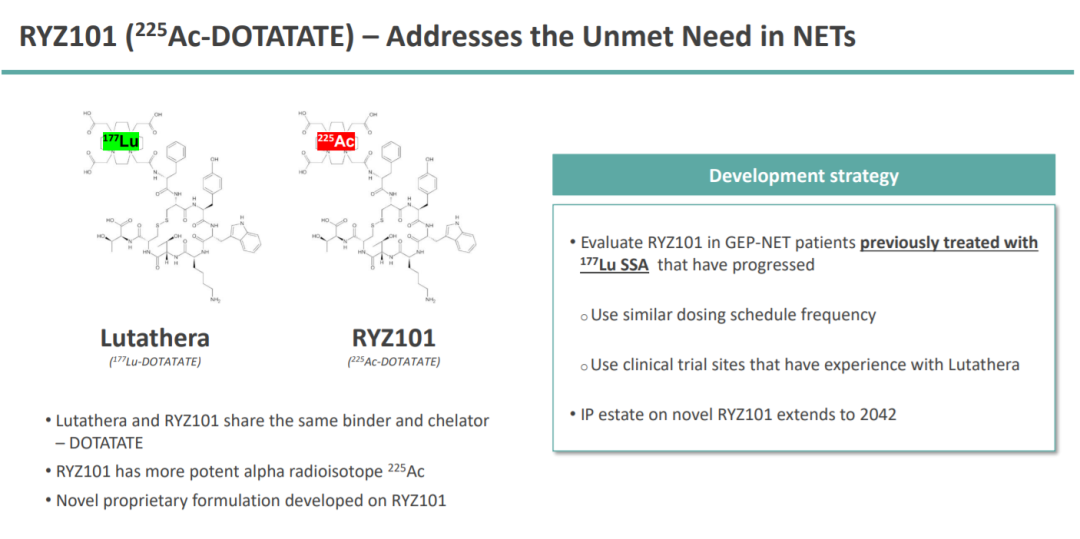
RYZ101 is a targeted radiopharmaceutical that delivers the potent α-particle-emitting radionuclide actinium-225 to tumors overexpressing somatostatin receptors (SSTR). RYZ101 is benchmarked against Novartis' Lutathera®, which uses the β-emitting radionuclide Lu-177, while RYZ101 employs the more potent and shorter-range α-emitting radionuclide Ac-225. The FDA has not yet approved any actinium-based radiopharmaceuticals, and if RYZ101's Phase III clinical trial is successful, it could become the first approved actinium-225 radiopharmaceutical therapy.
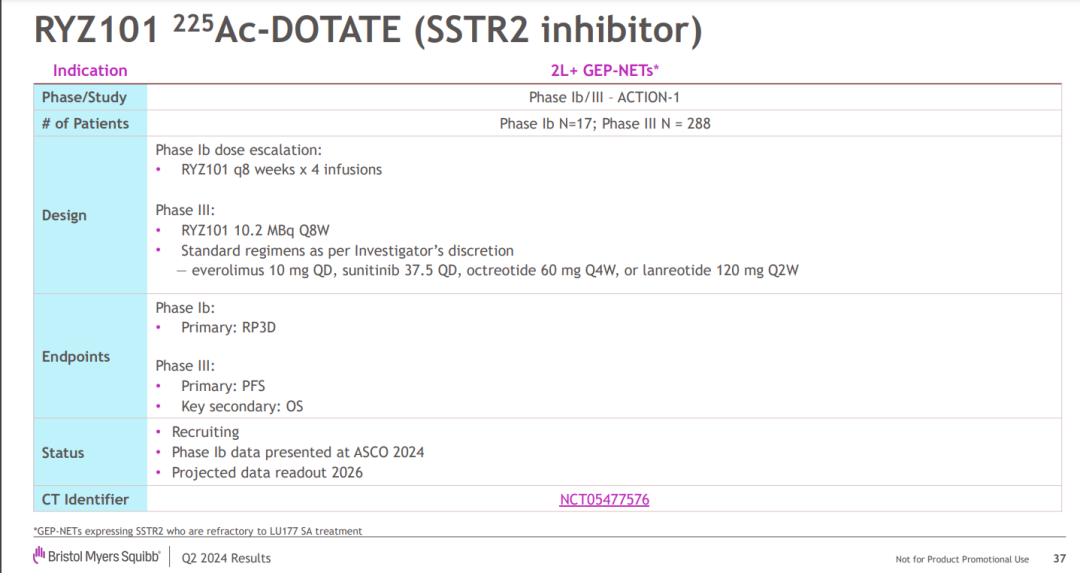
In June this year, BMS announced the suspension of new patient enrollment in the Phase 3 trial of the radiopharmaceutical RYZ101 due to a shortage of isotope supply. At that time, Bristol-Myers Squibb stated that it planned to resume new patient enrollment in the third quarter. The study includes the United States, Brazil, Belgium, Canada, France, the Netherlands, and Spain.
This is a Phase 3 global, randomized, controlled, open-label trial, expected to enroll 288 patients,Comparison of RYZ101 Treatment and Standard of Care (SOC) for Previously Treated with 177Lu-SSA, Inoperable, Advanced, SSTR+, Well-DifferentiatedGastroenteropancreatic Neuroendocrine Tumors (GEP-NET) subjects.
About Bristol-Myers Squibb
Bristol-Myers Squibb is a global biopharmaceutical company dedicated to providing innovative medicines to patients for the treatment of serious and challenging diseases.
Globally, Bristol-Myers Squibb has introduced groundbreaking innovative products in the fields of oncology, hematology, immunology and fibrosis, as well as cardiovascular diseases, possessing one of the richest and most promising pipelines in the industry. The company also has drug research and development capabilities in the three major areas of chemical drugs, biologics, and cell therapy.