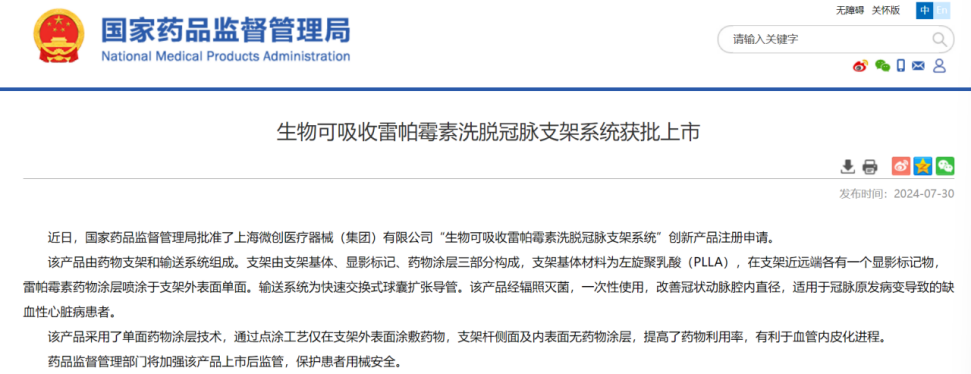
Yesterday (July 30), the National Medical Products Administration approved the innovative product registration application for the "Bioabsorbable Rapamycin-Eluting Coronary Stent System" by Shanghai MicroPort Medical (Group) Co., Ltd.
15 Years of Focus, Overcoming Two Technical Challenges
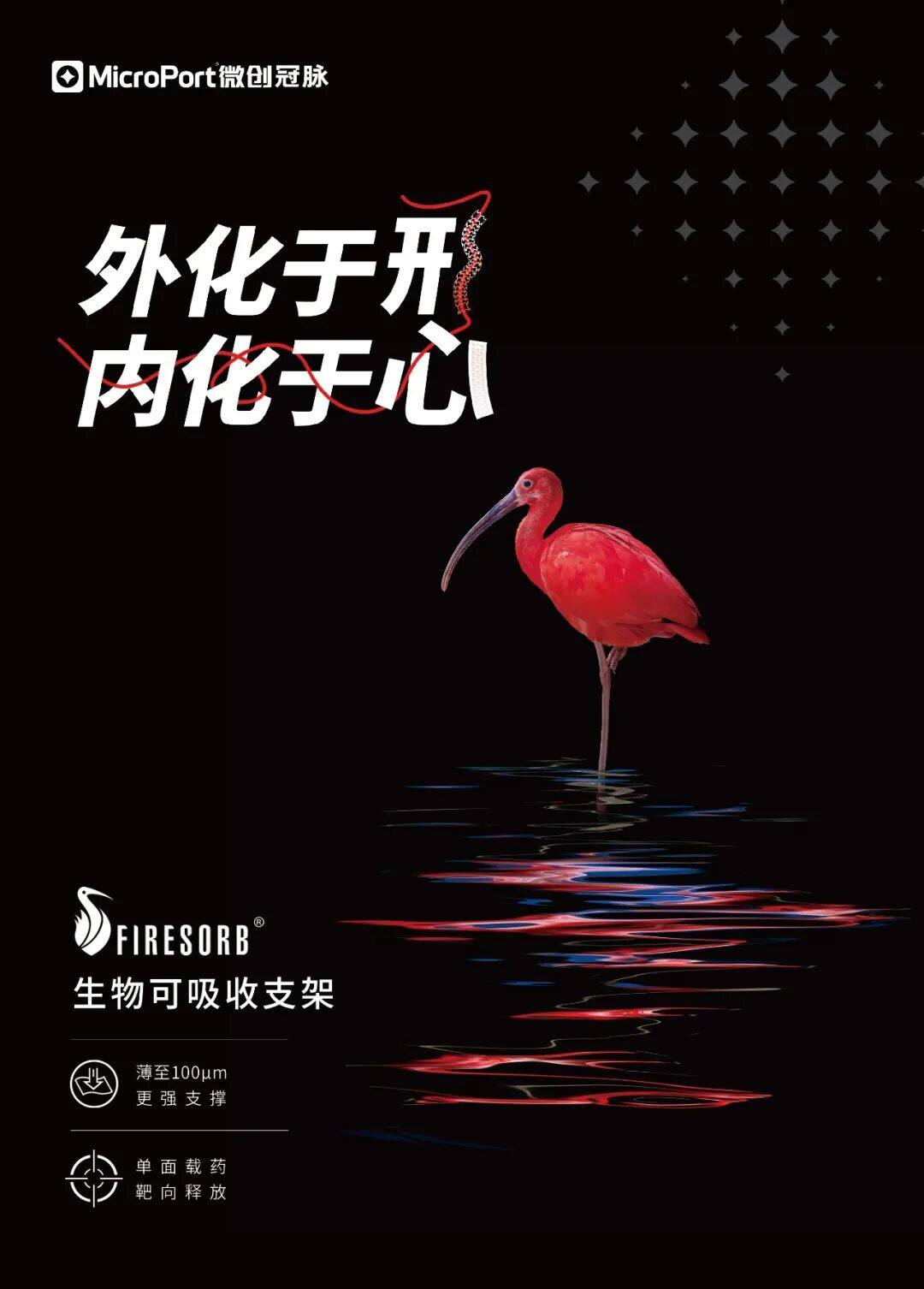
Firesorb (Huiban) is the world's first next-generation fully bioabsorbable cardiac stent independently developed by Shanghai MicroPort Medical (Group) Co., Ltd. (hereinafter referred to as "Shanghai MicroPort"), a wholly-owned subsidiary of MicroPort Scientific Corporation (00853.HK). The product began its research and development in 2009, making it a 15-year journey so far, and was granted entry into the Innovative Medical Device Special Review Process "Green Channel" in May 2016.
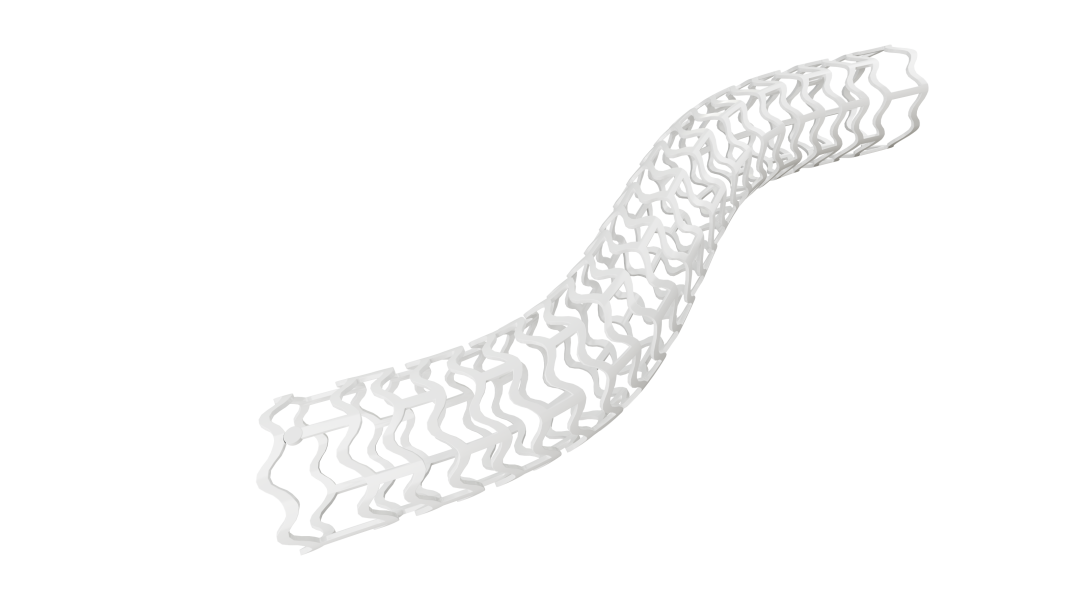
▲The World's First New GenerationFully Bioresorbable Firesorb (Huo Huan) Coronary ScaffoldAccording to publicly available data, Firesorb (Firebird) is a continuation of the first-generation product Firehawk.Targeted Elution Technology, Through the aerospace-grade target intelligent capture and positioning system, combined with the ultra-precision processing equipment and technology of the precision micro-dot spray control system, precise drug positioning and coating are achieved, applying the drug coating only on the side of the stent facing the vessel wall. With this technology, the Firebird StentThe effective drug loading is reduced to one-fourth of the common drug loading while achieving the same therapeutic effect.
Reduce Stent Wall Thickness
In terms of materials and thin walls, the HuoHuan has achieved new breakthroughs. The wall thickness can be reduced to the same level as metal stents while maintaining the same strength, solving the problems of early first-generation absorbable stents, such as vascular endothelium not easily covering and thrombosis caused by wall thickness. It is currently the first targeted absorbable stent that can reduce thickness to the same level as metal stents while maintaining the same strength, and it can achieve full-size lesion coverage and is suitable forTreatment of Small Vessel Lesions with a Diameter of 2.5 MillimetersThe absorbable stent solves the accessibility challenge of absorbable stents in small vessel lesion areas.
Through the above two technologies, the Firebird stent was successfully developed.Reduced the actual thrombosis rate in late and very late stages to only 0.34%,破解了“高临床血栓发生率”医学难题。并且火鹮支架经过五年大规模临床研究被证实可在患者体内Completely degraded and "disappeared" (converted into carbon dioxide and water)。
Focus on Both Efficacy and Safety
According to the latest "Report on Cardiovascular Health and Disease in China" released by the National Center for Cardiovascular Diseases, the incidence and mortality of cardiovascular disease (CVD) in China are still rising, with more than 11 million patients suffering from coronary heart disease.
Interventional therapy is an effective method for treating coronary heart disease and has gone through multiple stages: the earliest balloon dilation reduced the trauma of surgical coronary artery bypass grafting, but the rate of restenosis was as high as 30%-60%. Subsequently, bare-metal stents reduced the restenosis rate to 15%-30%, and drug-eluting metal stents further lowered it to around 5%-10%. However, excessive medication may lead to late thrombosis.
MicroPort discovered in its research that high thrombosis risk is mainly associated with "excessive stent wall thickness" and "excessive drug loading." Since 2009, MicroPort has initiated the development of bioresorbable stents. After five years of dedicated efforts, initial results were achieved in 2014, ultimately overcoming two key technical challenges: low thickness and low drug loading.
After the technology of the Firehawk stent matured, MicroPort conducted a five-year follow-up clinical study (the international standard is three years). Before its market launch, MicroPort initiated three phases of clinical research: FUTURE I, FUTURE II, and FUTURE III, enrolling a total of 1,468 patients and achieving a series of encouraging results.
 In addition, the clinical data of the Huohuan stent has also attracted significant attention from the medical community. Professor Gao Runlin, an academician of the Chinese Academy of Engineering and a professor at Fuwai Hospital, Chinese Academy of Medical Sciences, stated: "Four-year postoperative follow-up of Huohuan shows that its safety and efficacy are comparable to Abbott's Xience metal stent."The endometrial coverage rate reached 99.3%, and it basically disappeared after the surgery. The affected blood vessels returned to their natural state."This discovery is inspiring." Wang Jian'an, an academician of the Chinese Academy of Sciences and a professor at the Second Affiliated Hospital of Zhejiang University School of Medicine, stated: "The long-term clinical data of the Firehawk stent has verified its safety and effectiveness, especially regarding stent thrombosis. The thrombosis rates were 0% for both FUTURE I and II, and 0.34% for FUTURE III."
The Future of Interventional Market
Cardiac stents account for the largest share in the cardiovascular interventional devices market, with the global aging trend and the increasing incidence of cardiovascular diseases driving the demand for cardiac stents. According to reports from "Fortune Business Insights" and "ResearchAndMarkets," the global cardiac stent market size was approximately $X billion in 2022.$12 billionIn 2022, the市场规模of中国心脏支架is approximatelyRMB 8.5 billionIt is expected that by 2027, the market for cardiac stents in China will reach 13 billion yuan, with a compound annual growth rate (CAGR) of 8.9%.
The global heart stent market is growing rapidly and will continue to maintain high growth in the coming years. North America, Europe, and the Asia-Pacific region are the main markets.Abbott, Boston ScientificAndMedtronic, etc.Occupying a major position in the global market. In China, before 2004, more than 95% of the domestic coronary stent market wasJohnson & Johnson, Medtronic, Boston ScientificOccupied by multinational corporations. After 2005,MicroPort and Lepu MedicalChina-produced drug-eluting coronary stents have been successively launched on the market. Relying on excellent product performance, China-produced drug stents have gradually expanded their market share. Currently, cardiac stents are one of the markets with the highest import substitution rates in China's high-value consumables field.Domestic market share accounts for more than 80%.。
The main types of stents used in percutaneous coronary intervention (PCI) procedures in China are: bare-metal stents, drug-eluting stents, and fully bioresorbable stents. Bare-metal stents, as the older generation, have gradually been replaced by drug-eluting stents and fully bioresorbable stents. Drug-eluting stents are currently the mainstream, with a penetration rate of approximately 99.2% in 2019. Fully bioresorbable stents, as a new treatment method, have a much lower penetration rate (approximately 0.8% in 2019) compared to drug-eluting stents in China. With the increasing demand for PCI procedures in China, the number of both drug-eluting stents and fully bioresorbable stents is expected to grow simultaneously.
According to Frost & Sullivan, by 2030, the penetration rates of drug-eluting stents and fully degradable stents in China's percutaneous coronary intervention procedures are expected to be 69.0% and 31.0%, respectively. The market size of China’s fully degradable stent market is projected to grow from RMB 200 million in 2019 to RMB 6.6 billion by 2030, with a compound annual growth rate (CAGR) of 38.5%. The Chinese fully degradable stent market is anticipated to remain dominated by several domestic companies, with the development of advanced products featuring thinner stent thickness while maintaining sufficient radial force becoming a key competitive factor. Additionally, manufacturers of fully degradable stents face intense competition in areas such as research and development, sales and marketing capabilities, distribution network establishment, and relationships with hospitals. MicroPort holds a leading position in the fully degradable stent market, possessing a well-established medical device distribution network in China, with its coronary products already introduced into over 3,300 hospitals, providing it with a significant advantage in commercializing fully degradable stent products.
With the approval of the National Medical Products Administration, Shanghai MicroPort's Firesorb (Fire Stork) stent has officially entered the market, marking another significant breakthrough in China’s interventional cardiology field. In the future, with the launch of Firesorb, patients will have more options to address cardiovascular diseases such as coronary heart disease, benefiting from safer and more effective treatment solutions. We also look forward to MicroPort continuously improving product performance and clinical outcomes, bringing good news to cardiovascular patients worldwide.▲Source of the article:Medical Device Innovation Network▲Reproduction without permission is prohibited.And can be reprinted after 24 hours.!Disclaimer: This article is intended solely for the purpose of information transmission and is for reference only. It does not constitute any advice on investment or treatment; please evaluate with caution. If it involves issues related to the content, copyright, or other aspects of the work, to protect the rights and interests of both parties, please contact us and we will handle it immediately. If any platform reprints this article, it must take responsibility for the content itself; the Medical Device Innovation Network is not responsible for any secondary dissemination caused by reprints.