

Eisai and Biogen Announce Three-Year Long-Term Data from Leqembi (lecanemab) in Early Alzheimer’s Disease

Biogen
Neuroscience Drug Developer

Eisai
Pharmaceutical Product R&D and Manufacturer
▎WuXiEdited by Kant Content Team
Recently, Eisai and Biogen announced the results of a three-year trial of their jointly developed Leqembi (lecanemab) at the 2024 Alzheimer's Association International Conference (AAIC).LatestResults. The data shows that, compared with the baseline,In the earliest subpopulation of Alzheimer's disease (AD) patients treated with lecanemab,51%Show sustained cognitive and functional improvement over three years, these patients at baselineBrainNot detectedTau EggWhite orTau EggVery white.Low。
Compared with the control group, early AD patients who received lecanemab treatment for three consecutive years showed improvements in cognition and function.
The Clarity AD trial announced this time is a global, placebo-controlled, randomized double-blind, parallel-group Phase 3 study, enrolling a total of 1,795 patients with early AD (drug group: 898 participants receiving intravenous injections of 10 mg/kg lecanemab every two weeks; placebo group: 897 participants). Among the patients who completed the core study (18 months), 95% chose to continue participating in the open-label extension study (OLE). In the Clarity AD core study, clinical dementia rating–sum of boxes (CDR-SB, higher scores indicate lower clinical function of the patient) was assessed.On the primary endpoint of the score, the mean CDR-SB change from baseline in the lecanemab group was 1.21 points, which was 0.45 points less than that in the placebo group (1.66 points) (P=0.00005).
Over the three years of treatment in the core study and OLE, compared with similar patient data from the Alzheimer's Disease Neuroimaging Initiative (ADNI) group, lecanemab reduced the average cognitive decline based on CDR-SB by 0.95 points.No new safety issues were observed with three years of continuous lecanemab treatment. Most amyloid-related imaging abnormalities (ARIA) occurred within the first six months of treatment. After six months, the incidence of ARIA was lower and similar to that of the placebo group.
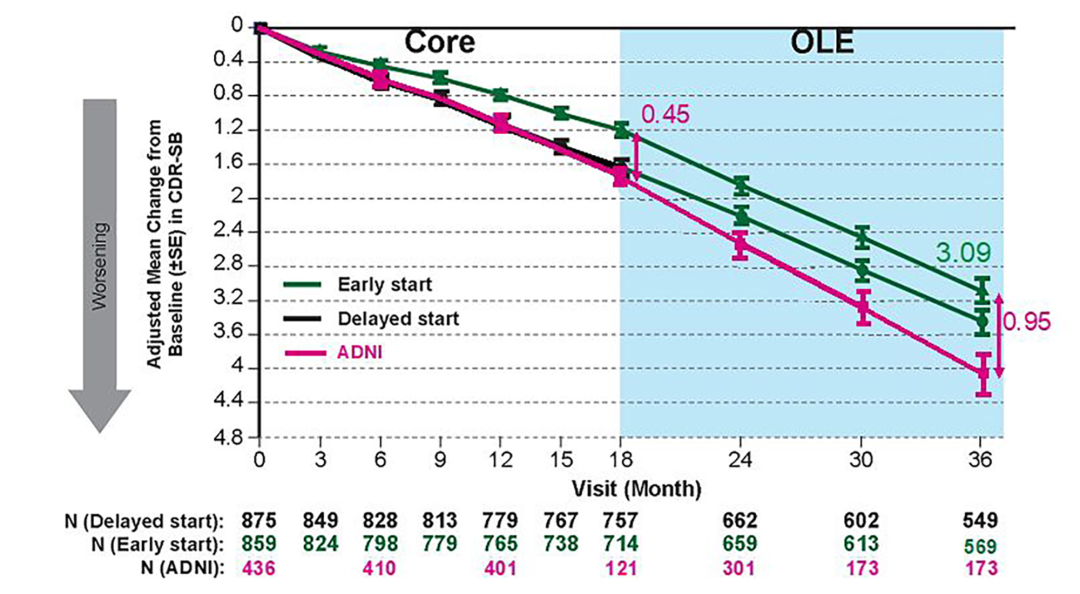
▲Three years of continuous lecanemab treatment reduced the average change in CDR-SB score by 0.95 points in patients with early AD (Image source: Reference [1])
The Clarity AD study includes an optional Tau PET sub-study, which uses the Tau positron emission tomography (PET) probe MK6240 to identify patients with little or no Tau protein accumulation in the brain (earliest-stage AD patients).After three years of lecanemab treatment, 59% (24/41) of these earliest patients showed maintenance or improvement on the CDR-SB, and 51% (21/41) showed improvement compared to baseline on the CDR-SB.On the ADAS-Cog14 scale assessing cognitive performance, 63% of patients showed maintenance or improvement, and 61% demonstrated improvement.On the ADCS MCI-ADL scale for assessing daily living activities, 63% of patients showed maintenance or improvement, and 59% demonstrated improvement.This indicates that,In the mostStarting to use lecanemab early may have a significant positive impact on disease progression and could bring long-term continuous benefits for patients with early AD.
After plaque removal, patients in the trial continued to experience AD progression after discontinuing treatment.
Another published trial is Study 201, a multicenter, double-blind, placebo-controlled Phase 2b trial conducted in 856 patients with early AD. Patients underwent a treatment-free period of 9-59 months (average 24 months) after participating in the 18-month core study.During the treatment-free period, the clinical effects of lecanemab were maintained, but patients who discontinued treatment showed a rate of decline on the CDR-SB that returned to the same rate of decline as the placebo group.The press release pointed out that the results showed that even after removalβAmyloid Beta (Aβ)After plaque, AD will continue to progress and return to a rate of decline comparable to the placebo group after treatment is stopped.
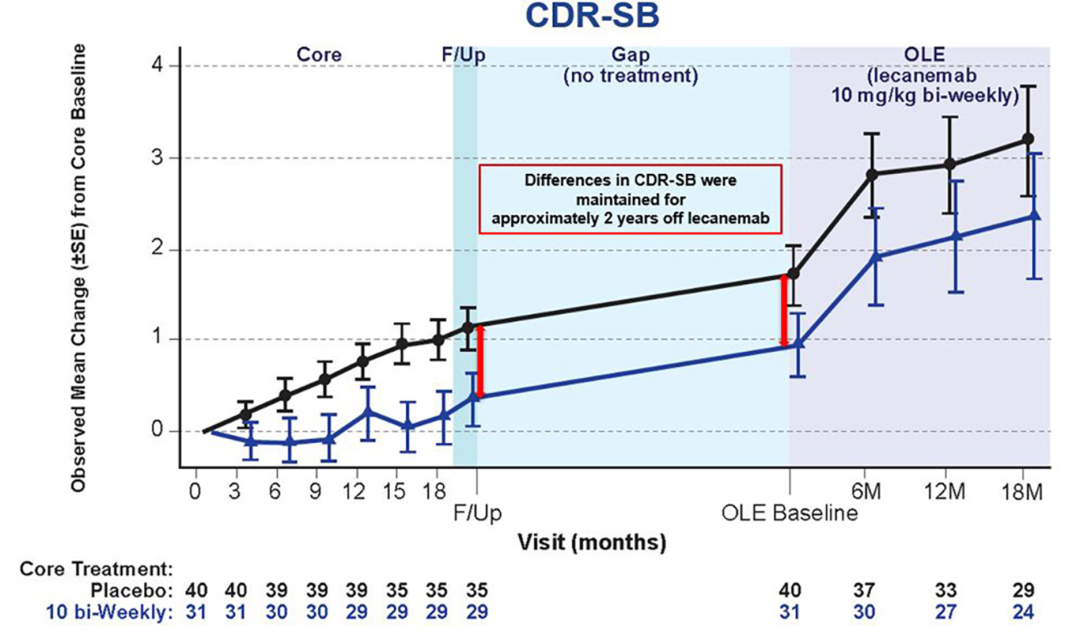
▲After plaque removal, patients in the trial experienced cognitive and functional decline after stopping treatment.(Image source: Reference [1])
After plaque removal, lecanemab continues to positively impact AD biomarkers throughout the treatment process.
Compared with amyloid PET imaging, key AD fluid biomarkers such as Aβ42/40, pTau181, pTau217, and glial fibrillary acidic protein (GFAP) can more sensitively reflect the accumulation of amyloid and Tau proteins. Models based on data from Study 201, Clarity AD, and corresponding OLE studies show that levels of fluid biomarkers plasma Aβ42/40, pTau181, and GFAP rebound more quickly after treatment discontinuation compared to amyloid plaques.The analysis shows,PatientIn the OLE of Study 201, after resuming treatment, there were improvements in fluid biomarkers such as Aβ42/40, pTau181, pTau217, and GFAP.The press release noted that these results suggest that even after the removal of plaques, AD would still progress.After discontinuation of treatmentContinue to progress.Patients who continue to receive lecanemab treatment are able to maintain the improvement in fluid biomarkers of amyloid pathology.

Leqembi is a monoclonal antibody targeting the Aβ protein., has already been approved for marketing by regulatory agencies in the United States, China, and Japan, and is currently under review by regulatory authorities in multiple countries and regions worldwide.

▲To learn more about the application of cutting-edge technologies in the biopharmaceutical industry, please long press and scan the QR code above to access "WuXi Live Studio" and watch live discussions and exciting replays on related topics.


Share,PointLike,In View, Focus on Global Biomedical Health Innovation