

SINOVAC Biotech's Key Oncology Product Gains EU Approval: European Market Emerges as Prime Destination for Chinese Pharma Outbound Expansion
Kexing Biopharm
Developer, Manufacturer, and Marketer of Recombinant Protein Drugs and Microecological Preparations

Haichang Biotech
Innovative Formulation Developer
Amid the wave of internationalization, Europe is becoming the next "dream destination" for Chinese pharmaceutical companies going global.
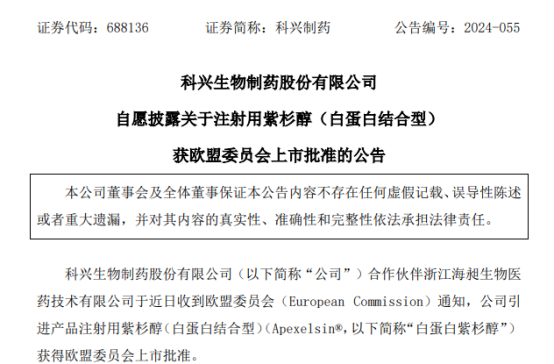
Recently, Kexing Biopharm announced that its partner, Haichang Biotech, has recently received a notification from the European Commission. The product they introduced, Paclitaxel for Injection (Albumin-bound) (Apexelsin®, hereinafter referred to as "Albumin Paclitaxel"), has been granted marketing approval by the European Commission. The drug is indicated for the treatment of metastatic breast cancer, metastatic pancreatic cancer, and non-small cell lung cancer, among other cancers.
It is reported that albumin-bound paclitaxel has significant clinical advantages over conventional paclitaxel injections and paclitaxel liposome. The drug shows improved safety and patient compliance, with high clinical recognition, and holds an indispensable clinical value in the field of cancer treatment.
Notably, the EU market is a crucial component of Kexing Biopharm's overseas commercialization strategy. In recent years, Kexing Biopharm has been actively promoting the marketing channel layout and expansion within the EU market. To date, it has signed agreements with partners across 47 countries and regions, including developed markets such as the EU, Canada, and the UK, as well as emerging markets like Brazil and Singapore.
Besides, 2024 is only halfway through, and domestic pharmaceutical companies such as Henlius, Qilu Pharmaceutical, CStone Pharmaceuticals, and SciClone Pharmaceuticals' subsidiary Yifan Biologics have all had products approved for marketing in the EU. From the overseas expansion trend in recent years, the EU market's attractiveness to Chinese companies is gradually increasing. These companies choose the EU for overseas expansion based on considerations of their own product advantages, seeking regional opportunities arising from unmet clinical needs in specific markets.
EU Albumin Paclitaxel Shortage
Kexing Biopharm Gains Edge with Years of Strategic Layout
Albumin-bound paclitaxel is a broad-spectrum foundational anticancer drug, a novel formulation combining paclitaxel with albumin. It uses human albumin as a carrier and offers advantages such as easier decomposition in the body, higher drug accumulation in tumors, strong targeting ability, and enhanced chemotherapy efficacy. It has demonstrated favorable clinical outcomes in various tumors and is currently one of the main drugs in standard treatment regimens for breast cancer, ovarian cancer, and non-small cell lung cancer.
Unlike the competitive market environment in China, before Kexing Biopharm's albumin-bound paclitaxel was approved for marketing, there were only two suppliers of albumin-bound paclitaxel in the European market: the original research pharmaceutical company BMS and the generic drug company TEVA. However, this does not mean that the albumin-bound paclitaxel market in Europe lacks a sufficiently large scale.
The European Medicines Agency (EMA) website once announced that shortages of albumin-bound paclitaxel have intermittently occurred across multiple European countries and have been listed on the drug shortage list for two consecutive years. In January 2023, the EMA issued its first notification regarding the shortage of TEVA’s albumin-bound paclitaxel product, Pazenir, and subsequently reiterated the shortage in June and November 2023. The latest forecast indicates that the supply tension for Pazenir is expected to persist throughout 2024.
Correspondingly, over the past five years, the incidence of cancer in Europe has been on the rise, and the sales of albumin paclitaxel have gradually increased in the European market. Currently, although demand in the European market continues to grow, the albumin paclitaxel products from BMS and TEVA have remained in short supply, with a persistent supply gap.
Against this backdrop, in April 2021, Kexing Biopharm and Haichang Biotech signed a drug cooperation agreement. Haichang Biotech transferred the commercial rights (excluding the U.S. market) of its generic albumin paclitaxel, coded as HC007, to Kexing Biopharm.
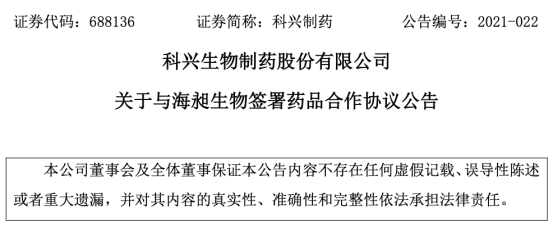
According to the agreement, Kexing Biopharm will pay Haichang Biotech a total of no more than 70 million yuan in signing fees and milestone payments based on the progress of specific cooperation in R&D, commercialization, industrialization, and the transfer of certification rights. At the same time, Kexing Biopharm will pay sales royalties to Haichang Biotech under the terms and methods agreed upon by both parties.
After Kexing Biopharm's albumin-bound paclitaxel received approval from the European Commission for market launch, the product can now be marketed and sold across all EU countries, which will greatly address the supply gap issue within the EU. Kexing Biopharm also stated that the EU market is an essential component of the company’s overseas commercialization strategy, and the company is actively promoting the development and expansion of its marketing channels within the EU.
In fact, the cooperation between Kexing Biopharm and Haichang Biotech, as well as the successful launch of albumin paclitaxel in the EU, is not accidental. In addition to factors such as the improvement in domestic R&D quality and the increase in international market demand, this is closely related to Kexing Biopharm's international layout and overseas strategy.
Kexing Biopharm's overseas strategy began in 2000, making it one of the first pharmaceutical companies in China to expand abroad. Currently, Kexing Biopharm has established a comprehensive overseas commercial network and accumulated extensive resources and commercial capabilities. It has set up subsidiaries in Egypt, Mexico, and Singapore, with plans to further expand in Brazil, the EU, and other regions. Additionally, Kexing Biopharm has successfully built professional sales teams in several key markets, including Brazil, Peru, Thailand, the Philippines, and Russia. For instance, Kexing Biopharm’s self-developed human erythropoietin injection has become a leading brand in countries like Brazil, the Philippines, and Egypt, and has gained market access in more than forty countries and regions.
Industry insiders said that, with the continuous enhancement of overall strength, China's pharmaceutical enterprises have begun to play an increasingly important role on the international stage. Kexing Biopharm is one of the most representative examples. Through unique market development strategies, innovative model construction, and forward-looking strategic layouts, Kexing Biopharm has not only successfully promoted the globalization of its own products but also provided rich practical experience and valuable resources for its domestic peers.
New Opportunities for Internationalization of Chinese Pharmaceutical Enterprises
Europe the Preferred Destination for Going Overseas in 2024?
Chinese pharmaceutical companies seeking international development has become a necessary move, but the U.S. pharmaceutical market, which is difficult to access, is no longer the top choice for going overseas. The focus that was once on the U.S. market has now begun to shift toward EU countries.
So far this year, in addition to Kexing Biopharm, new drugs from five pharmaceutical companies—CStone Pharmaceuticals, Henlius, Yifan Pharmaceutical, and Qilu Pharmaceutical—have been approved for marketing in the EU. The approved products cover indications in multiple fields, including oncology, cancer adjuvant therapy, orthopedics, ophthalmology, and more.
On July 26, CStone Pharmaceuticals announced that the European Commission has approved Sugemalimab (Cejemly) in combination with platinum-based chemotherapy for the first-line treatment of adult patients with metastatic non-small cell lung cancer (NSCLC) who have no EGFR-sensitive mutations or ALK, ROS1, RET genomic tumor alterations. Sugemalimab has become the world’s first PD-L1 antibody to be launched in Europe for the first-line treatment of both squamous and non-squamous NSCLC in combination with chemotherapy. CStone Pharmaceuticals is also the first innovative biopharmaceutical company to bring a China-produced PD-L1 antibody to the international market.
In May this year, Henlius and Organon jointly announced that the marketing authorization application for HLX14, a biosimilar of denosumab (Prolia/Xgeva®) under development, has been accepted by the European Medicines Agency. This acceptance by the European Medicines Agency is primarily based on a randomized, double-blind, international multi-center, parallel-controlled Phase III clinical trial, which aims to compare the efficacy, safety, tolerability, and immunogenicity of HLX14 with the EU-marketed original denosumab in postmenopausal women with osteoporosis at high risk of fractures.
Prior to this, in March this year, Yifan Pharmaceutical announced that Ryzneuta (Aibegestim α Injection, F-627), an innovative biologic independently developed by its holding subsidiary, had been approved by the European Commission for marketing in the EU. The drug is a long-acting granulocyte colony-stimulating factor (G-CSF). G-CSF drugs are currently the main clinical medications for neutropenia caused by cancer patients receiving anti-cancer drugs and are essential treatments recommended as first-line clinical options by guidelines such as ASCO and NCCN.
In January this year, Qilu Pharmaceutical's Ranibizumab Injection (Rimmyrah) received marketing approval from the European Medicines Agency for the treatment of wet (neovascular) age-related macular degeneration, vision impairment caused by diabetic macular edema, diabetic retinopathy, vision impairment due to macular edema secondary to retinal vein occlusion, and vision impairment caused by choroidal neovascularization.
Industry insiders pointed out that, with the continuous improvement in the R&D capabilities and international experience of pharmaceutical companies in China, the overseas expansion of China's new drugs is no longer limited to the U.S. pharmaceutical market. As a high ground for pharmaceutical R&D, the competition in the U.S. market has long reached a fever pitch. Despite the vast number of applications and high costs, there are only a few successful cases. On the other hand, EU countries, with their large market scale, relatively high per capita GDP, and mature business environment, have naturally become an important destination for pharmaceutical companies looking to expand overseas.
As is known to all, the EU market, as a whole, is also a major player in the global innovative drug market. Not only is it a highly mature market with a scale comparable to that of the United States, but it also has high R&D investment in new drugs, making it a preferred location for many new drug R&D trials.
The difficulty in "going global" to the EU lies in the large number of EU countries, each with different levels of development, industrial growth, and market demands, along with strict and complex laws, regulations, and regulatory policies. In the past, Chinese pharmaceutical companies, without sufficient experience and time for in-depth exploration, could not replicate a unified model as they did in the U.S. market to achieve drug approval and full coverage across the EU.
Nowadays, with the ability to flexibly respond to market reactions and a comprehensively enhanced integrated pharmaceutical R&D capability, coupled with the continuous cultivation of a robust team with mature local experience, many Chinese pharmaceutical companies have already carved out a path in Europe. At the same time, unmet clinical needs objectively exist within the EU. Market analysts believe that under the continuous stimulation of domestic demand and foreign trade, the EU represents a "blue ocean" in another sense — a blue ocean implying boundless potential and business opportunities. It is no surprise that it has become one of the important options for Chinese pharmaceutical companies going global.
As Chinese pharmaceutical companies expand their presence in the international market, the industry has every reason to expect that China's new drugs will accurately target global market demands, cover the majority of valuable markets worldwide, and become the "benchmark" for global new drug research and development.


www.yyjjb.com.cn
Insight into Industry Trends
"Pharmaceutical Economy Newspaper"
Academic Official Account
Focus on the Frontier of Oncology Academia

Terminal Official Account