

Flagship Pioneering's ISC Model Drives $15 Billion in Partnerships Within a Year

GSK
Pharmaceutical R&D Manufacturer

Flagship Pioneering
Venture Capital Firms
Recently, GlaxoSmithKline (GSK) and Flagship Pioneering Partner announced a collaboration to develop 10 innovative drugs or vaccines. This partnership will initially focus on respiratory diseases and immunotherapy, with plans to expand into other therapeutic areas. In this collaboration, over 40 biopharmaceutical companies under Flagship will act as a "portfolio" to partner with GSK in the development of drugs and vaccines.
Under the terms of the agreement, GSK and Flagship will jointly contribute $150 million to support the initial exploration. GSK will provide an upfront payment, R&D, and commercial milestone funds of $720 million for each drug, along with preclinical funding support and a specific percentage of sales royalties. The total amount is expected to exceed $7 billion.
Compared to the previous collapse of several star Biotechs under Flagship, which led to continuous doubts and pessimism about the industry, Flagship seems to have turned a corner in the past year. It has successively reached partnerships with leading companies such as Samsung, Thermo Fisher, Pfizer, Novo Nordisk, and GSK, revving up its rapid development once again. What new "secrets" can we learn from Flagship's ability to accelerate growth in an adverse environment?
"Institutionalized Entrepreneurship" + "Paranoid Optimism"
The Legend of VCBeat
As a "myth" in the global venture capital circle, Flagship has pioneered a distinctive path of venture capital investment based on the concept of "institutionalized entrepreneurship," while also solidifying its position as a top-tier investment institution with this unique approach.
Based on this concept, Flagship creates and incubates companies in four stages: Hypothesis Exploration (Explorations) → Scientific Validation (ProtoCos) → New Company Formation (NewCo) → External Venture Capital (External Venture).
In the first three stages, Flagship is deeply involved in incubation, including idea generation and screening, proof of concept, company strategy formulation, and team building. Additionally, to maximize success rates, systematic and timely incubation services are essential. For instance, before a team is found, internal members of Flagship may serve as interim CEOs and provide the initial funding for development. A case in point is Moderna, where Noubar Afeyan is one of its founders.
Based on this, Flagship has also introduced a new concept called "Parallel Entrepreneurship": sourcing cutting-edge biotechnologies globally from universities and other origins, then fully integrating them as internal IPs. These IPs are embedded into the company with partners serving as key executives, while also overseeing R&D cultivation, team building, attracting external investment, and other tasks. After extensive funnel-style screening, successful enterprises will spin off to pursue IPOs, but their "roots" remain with Flagship.
In "institutionalized entrepreneurship," Flagship advances the incubation of multiple innovative companies on a large scale and in parallel. By re-integrating risk assumptions or eliminating prototype companies at an early stage, Flagship can identify and halt meaningless project progress as soon as possible, reallocating time, manpower, and funding to more critical projects.
In addition to the SOP-like incubation model that has already been established, Flagship's success is also heavily influenced by individual personality. Noubar Afeyan, the founder of Flagship, possesses a strong personal will, which has driven the formation of Flagship's unique corporate culture.
Due to his early exile experiences, Noubar Afeyan developed a strong and optimistic mindset. He once described himself as having a "paranoid optimism attitude," which has driven him to actively explore the highly uncertain biopharmaceutical industry.
Typically, an incubated company goes through countless rounds of skepticism and failure before transforming from multiple hypotheses into an independent commercial entity. Under the leadership of Noubar Afeyan, the strong personal will that shapes Flagship’s corporate culture has brought a unique perspective to its development in the biopharmaceutical industry, as well as the determination to venture boldly into uncharted territory.
Founder Noubar Afeyan once said that Flagship is "a fully integrated life sciences innovation enterprise" that is passionate about continuous innovation in unique fields that are "unoccupied." Its innovation is not about iterating and updating existing technologies but providing entirely new solutions for potential future problems and scenarios. This vibrant belief allows Flagship to move faster through the unfamiliar process of "crossing the river by feeling the stones."
Since 2021, Flagship has raised a total of $6.4 billion in funding, with $10.9 billion in operating capital and $14 billion in assets under management. To date, Flagship has created over 109 companies across fields such as biopharmaceuticals, information technology, agriculture, and energy, with a total value exceeding $140 billion. These include well-known companies such as Moderna, Sana Biotechnology, and Denali Therapeutics. Among them, 25 companies have successfully gone public, while more than 30 others have continued to develop through acquisitions or mergers.
However, the myth constructed by Flagship was shaken in 2023.
According to incomplete statistics from VCBeat, more than 30 U.S.-listed biotech companies went bankrupt in 2023, four of which were incubated by Flagship, including biotechnology company Axcella Health, red blood cell therapy company Rubius Therapeutics, exosome pharmaceutical company Codiak BioSciences, and microbiome therapy company Evelo Biosciences.
According to data displayed on Flagship's official website, among the 87 biopharmaceutical companies it has invested in and incubated, nearly 50 encountered bottlenecks between 2022 and 2023. The main reason for most of these companies reaching their endpoint can be attributed to one factor: consecutive setbacks in clinical trials, coupled with a lack of stable cash flow, which led to mounting financial pressure, ultimately becoming unsustainable.
The reason behind this is that these companies share a common trait: they all value innovation and attempt to explore niche markets. This aligns perfectly with Flagship's philosophy of being passionate about innovating in "unoccupied" fields. However, Flagship’s “nanny-style” incubation system has also revealed its drawbacks after the funding boom subsided. Due to the overly meticulous nature of its “cradle-to-adulthood” incubation process, which covers aspects such as team building, operational management, and financial support, it leaves little room for companies to explore independently, thereby weakening their ability to face marketization on their own to some extent.
The bigger reason lies in the cooling macro environment and the contraction of the capital market, which has indiscriminately led to a collective setback for investment projects.
However, the entrepreneurial spirit of Flagship is destined to make it uncompromising.
In 2023, Flagship innovatively proposed a novel form of partnership – the Innovative Supply Chain (ISC) model.
This type of collaboration has several key characteristics: 1) It begins early in the innovation process, before there are proven therapies; 2) The collaboration is built on a biological platform, which, once validated, is expected to generate many new drugs; 3) The collaboration is flexible and long-term, with both parties continuing to work together and leveraging new insights and models that emerge during the collaboration. Essentially, this model creates an entirely new distributed, networked R&D paradigm aimed at maximizing innovation at every step from platform to pipeline to product.
That is, by leveraging its incubated ecosystem of biotechnology companies, it continuously develops innovative drugs for partners. These companies each have their own biological platforms and technologies, providing an unceasing source of innovation. Based on this collaborative model, Flagship has rapidly established significant partnerships with leading multinational corporations such as Samsung, Thermo Fisher, Pfizer, Novo Nordisk, and GSK in just under a year, with the known cumulative value exceeding 15 billion US dollars.
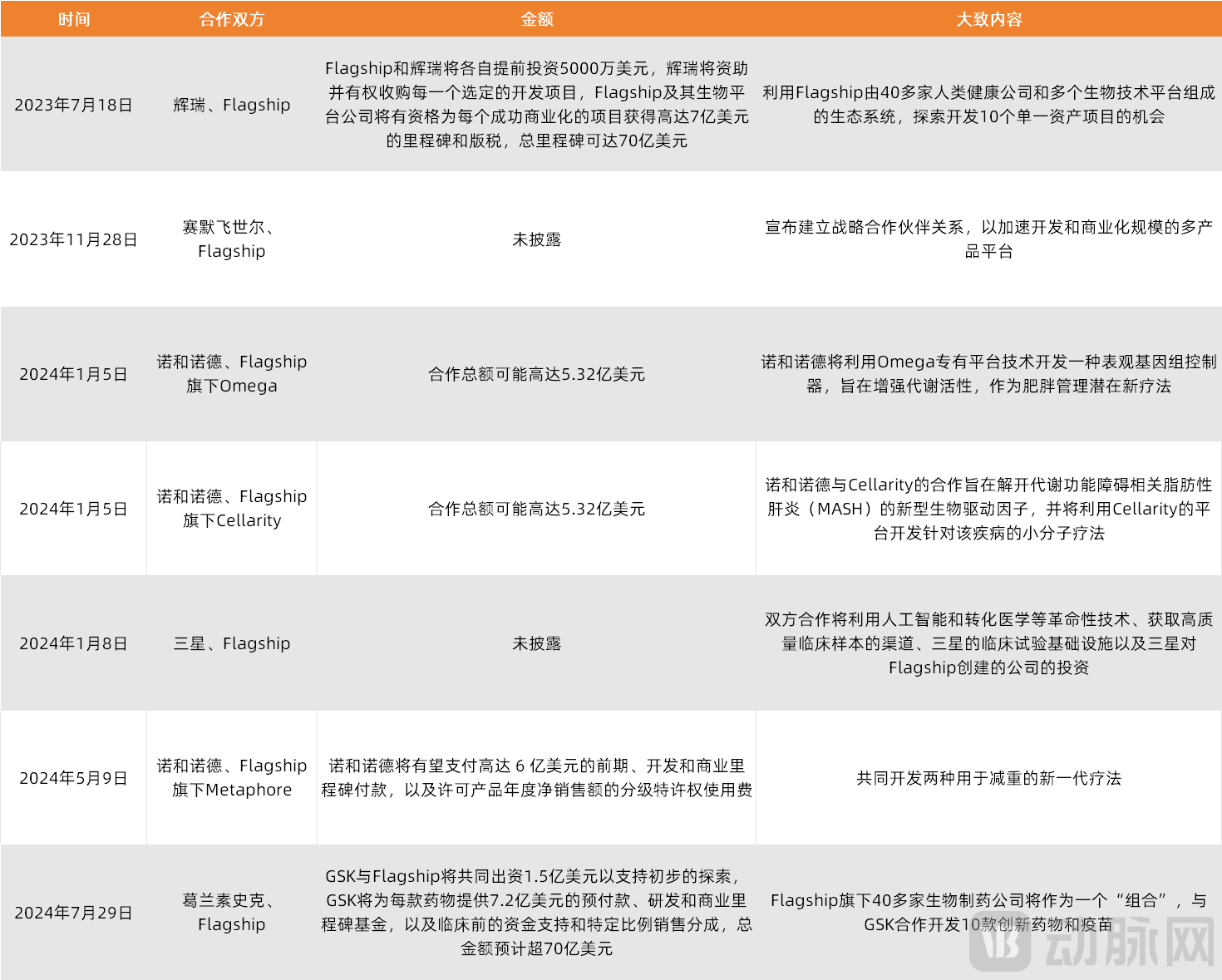
Under the ISC model, Flagship's partnerships achieved in the past year (based on publicly available information)
As an example of this cooperation with GSK, Paul Biondi, General Partner of Flagship Pioneering and President of Pioneering Medicines, stated at the press conference, "This collaboration is the latest testament to Flagship's innovative supply chain partnership model, which aims to create a sustainable source of transformative therapies for patients with unmet needs by leveraging our first-of-their-kind bio-platform ecosystem in conjunction with our pharmaceutical partners."
The innovative partnership between Flagship and MNC is essentially similar to the cooperation between Biotech and MNC, where one party provides innovative technology and the other offers resources and financial support. Moreover, based on its incubation industry chain, Flagship also possesses abundant industrial chain innovation resources and more mature commercial operation experience. This new model brings new opportunities to a less optimistic macro environment, paving another path amidst the winter.
Flagship has repeatedly proposed innovative models, which have been reviewed and analyzed by industry insiders time and again. Many have also raised the question: Can a "Chinese version of Flagship" be created based on this?
Overall, the possibility of replication is slim, just as there are no two identical snowflakes in the world, and just as a biological phenotype depends on the interaction of genotype and environmental factors. Flagship's success is not only based on its unique and innovative development model but also benefits from various contributing factors such as timing, geographical advantage, and harmonious human relations.
But today's market can no longer recreate the development environment that once possessed "the right timing (the U.S. biopharmaceutical policy framework was basically complete), geographical advantage (the U.S. biopharmaceutical industry had established a pharmaceutical industry cluster based on biological science, mainly around universities and research institutions), and people’s harmony (professionals in academia and the industry were passionate about original innovation)."
But we can still summarize three valuable experiences that can be learned to help China's biomedicine industry accelerate and improve the process of catching up in this field. However, the premise is that we first need to be in a good incubation and transformation environment, which is the foundation for the industry to develop in a healthy, rapid, and sustainable manner. This involves the efforts of the entire industrial chain, including industry-academia-research collaboration, government and regulatory agencies, and investment institutions.
First, in terms of industry-university-research collaboration,The United States, where Flagship is located, has a biopharmaceutical industry based on bioscience, primarily forming pharmaceutical industry clusters around universities and research institutions. The main biopharmaceutical industry clusters in the U.S. include biotechnology industry concentration areas such as San Francisco, Boston, and Washington. For instance, in the San Francisco area, there are Stanford University and the University of California, Berkeley; in the Boston area, there are Harvard University, the Massachusetts Institute of Technology, and the New England Medical Center; and in the Washington area, there are the National Institutes of Health, the University of Maryland Research Center, and Johns Hopkins University.
In this aspect, China has developed well in recent years. Currently, China's biopharmaceutical industry clusters are mainly concentrated in areas with relatively abundant natural resources, high levels of technology, and a strong talent base, such as Beijing, Shanghai, and the Pearl River Delta. These regions have advantages such as higher economic levels, stronger R&D and innovation capabilities, and a more favorable investment and financing environment, gradually forming biopharmaceutical industrial parks like Beijing Zhongguancun Life Science Park, Beijing Daxing Bioengineering and Pharmaceutical Industry Base, and Shanghai Zhangjiang High-Tech Park.
Secondly, it is related to investment institutions and incubation institutions.Since Flagship is mostly involved in the creation and incubation of its invested companies, this means that Flagship often holds the dual role of being both the founder and angel investor of the company. Additionally, it can directly make crucial decisions as an executive in the development of Biotech.
In China, quite a number of investment institutions have directly established incubators, deeply participating in the business incubation process. Incubators founded by investment institutions possess strong resource integration and professional service capabilities. They mainly provide financing services to startups and help enterprises connect with complementary resources, thereby increasing the success rate of entrepreneurship. During stages such as concept validation services and technology transfer, they allocate seed funding for early-stage technical ideas and scientific achievements.
For example, Pinehurst Capital has become a booster for overseas Chinese scientists returning to China to start businesses through the "funding + services" system provided by the Pinehurst Overseas Chinese Scientists Pre-Incubation Base and the Pinehurst Overseas Innovation Fund.
In addition, at the level of legal regulation and patent layout,Compared with pharmaceutical giants that have "a multitude of patents," Flagship's performance in patent licensing is no less impressive. The numerous portfolio companies of Flagship represent a vast source of inventions. Compared to pharmaceutical giants with massive investments, Flagship has been involved with enterprises from the incubation stage (or even earlier), enabling it to acquire more patent licenses with lower investment.
In 2017, Flagship's total R&D expenditure was $1.2 billion, significantly lower than that of a representative biopharmaceutical company, but its patent productivity surpassed that of these medium to large companies in the biopharmaceutical industry. Over the past 20 years, Flagship has licensed more than 2,500 patents globally, and in 2020 alone, it filed over 300 patent applications.
China's patent system was established in 1984 and has undergone four amendments to the patent law since then. With the continuous improvement of policies and the coordinated development of the entire industry chain, China's innovation is advancing at a pace that could soon reach the world's top.
According to VCBeat, before 2013, although the number of pharmaceutical patent applications in China was also in a stage of steady growth, it was still far lower than countries with earlier established intellectual property systems such as the United States, Europe, and Japan. Between 2013 and 2015, the number of patent applications in China gradually surpassed that of Japan and Europe. After the drug evaluation reform in 2015, there was a significant surge in the number of pharmaceutical patent applications in China in 2016, surpassing the United States with nearly 50,000 applications, ranking first in the world.
Various factors indicate that China's pharmaceutical environment is moving closer to that of developed countries. Although myths cannot be recreated, we can stand on the shoulders of giants, summarize the right experiences, and allow China's late-starting biomedicine industry to avoid some detours, see further, and move faster. As long as human development continues, innovation in life sciences will not stop. Let us look forward to China's fertile ground for the pharmaceutical industry nurturing top global life science venture capital enterprises.
References:
1. VCBeat Capital and Technology Observation, "Flagship Pioneering - The Flagship Pioneer in Biotech Venture Capital"
2. PharmHunter Club, "Raising $3.6 Billion! Top VC Flagship Raises 'AI Drug Discovery' Ambitions Again"
3. VCBeat, "Four Star Biotechs Collapse Within a Year, Is the 'Flagship Myth' Collapsing?"