

Zhenyi Medical Secures Series B+ Financing as Global Bicuspid/Tricuspid Valve Device Market Set to Exceed RMB 100 Billion

Trulive
Structural Heart Disease Device Developer
Source: Smart Medical Device, reproduction without authorization is prohibited.
As is known to all, in the high-end field of structural heart disease, it is mainly monopolized by foreign medical giants. Especially in the global valve market, data shows that Edwards Lifesciences' market share has reached nearly 70%.Recently, Jiangsu Trulive Medtech Co., Ltd. (hereinafter referred to as "Trulive"), a domestic structural heart disease device company in China, announced the completion of its B+ round of financing, with investors being Xiamen High-Tech Investment and Yixing Jiayi.
This round of financing will be used to accelerate Trulive's product development and market promotion, further consolidating its leading position in the field of structural heart disease treatment. Xiamen Hi-Tech Investment and Yixing Jiayi, the investors, expressed that they are optimistic about Trulive's technical strength and market prospects and are willing to join hands to support the company’s development.
And according to data, by 2030, the global market size for mitral and tricuspid valve interventional devices will exceed 100 billion yuan. Both overseas and the Chinese markets will maintain rapid growth. However, currently, only four tricuspid valve interventional treatment devices globally have obtained CE certification, all of which are developed by overseas companies.
01
Break the Foreign Monopoly
Boosting the Development of High-End Cardiovascular Intervention Devices Produced in China
It is reported that Trulive, as a high-end medical device enterprise, focuses on disease areas with extremely high mortality and disability rates where the domestic market in China remains空白. Its business comprehensively covers the field of heart valve diseases. Currently, the company has seven core products advancing simultaneously, three of which have completed large-scale clinical trials. Trulive has become the first domestic platform-based high-end medical device company in China whose core products have all achieved substantial progress.


Although Trulive has only been established for five years, it has quickly risen in the field of cardiovascular interventional therapy. Data shows that the company's one-stop toolbox for cardiovascular treatment provides solutions for various blood flow issues within the cardiovascular system. The progress of its full range of products places it among the leading companies in China, with some product performance and development progress comparable to international giants. In addition, there are several pioneering products with "China’s only" and "first in China" engineering achievements following closely, further expanding Trulive's comprehensive portfolio in cardiovascular treatment.
Prior to this, Trulive had completed multiple rounds of financing. In 2023, Trulive announced the completion of a new round of financing exceeding RMB 100 million. This round of financing was jointly invested by Belling Star Venture Capital, Anhui Life Health Fund, and existing shareholder C&D Emerging Investment. Huaxing Capital served as the exclusive financial advisor for this financing.
At that time, Wen Jing, Chairman of Trulive, stated: "Currently, whether in research and development or clinical stages, Trulive is in a period of rapid development. Six core products are proceeding methodically in clinical trials, with several more products soon to enter clinical stages. The success of this financing will further accelerate the R&D progress of Trulive's core products and expedite their commercialization. In the future, Trulive will continue to focus on unmet market needs in the field of cardiovascular interventional therapy, developing innovative, safer, more effective, and accessible high-end medical device products."
Jiang Jiajia, Managing Director of Healthcare and Life Sciences at Huaxing Capital, stated: "Trulive has made breakthroughs in multiple high-end 'chokepoint' technologies in the core field of cardiovascular interventional treatment, breaking overseas monopolies. It has built a multi-dimensional cardiovascular intervention product pipeline with significant market prospects in the fields of valves, peripherals, coronary arteries, and heart failure. I firmly believe that Trulive's innovative technology platform and one-stop toolbox layout will enable more doctors and patients to benefit from domestically produced high-end interventional medical devices."
Interventional Therapy Becomes an Important Model for Structural Heart Disease
02
The Market Size of Interventional Devices for Mitral/Tricuspid Valves to Exceed 100 Billion Yuan
It is reported that structural heart disease mainly includes congenital heart disease, valvular heart disease, cardiomyopathy, aortic disease, etc., which are currently serious threats to residents' health.
With the continuous extension of average life expectancy and the gradual deepening of the aging process, the incidence rate and the number of patients are still increasing. In recent years, interventional treatment for structural heart disease has become a major hotspot in global cardiovascular interventional therapy. The scientific and effective prevention and treatment of structural heart disease have become an urgent clinical issue to address, and its diagnosis and treatment have also emerged as a significant focus and new direction in the global cardiology field.
Heart valve disease is a very common heart condition. The valves act as "one-way gates" controlling blood flow, and in an adult's day, the heart valves open and close up to 100,000 times. Currently, there are 25 million patients with heart valve disease in China, but only 1% to 2% of them receive surgical intervention.
However, open-chest surgery is highly invasive and risky. In contrast, Trulive's Neo series of transcatheter valve clamps can achieve very satisfactory therapeutic effects through interventional treatment, making them more suitable for elderly and high-risk patients. It is reported that the Neo series of transcatheter valve repair systems independently developed by Trulive is the first product in China to enter the large-scale clinical stage with the ability to achieve dual-valve repair through a single catheter. It can be applied simultaneously to mitral and tricuspid valve repair, breaking foreign technological monopolies and filling the gap in domestically produced devices. This provides patients with safer and more accessible medical device solutions.
It is reported that mitral regurgitation is the most common heart valve disease. In China, there are approximately 10 million patients with mitral regurgitation (≥Grade III) in need of treatment. However, the current number of mitral valve surgeries performed in China is only over 40,000 per year, leaving more than 98% of patients with mitral regurgitation unable to receive effective treatment.
In addition, tricuspid regurgitation is another common type of valvular heart disease, and it is estimated that the number of patients with tricuspid regurgitation in China will reach 9.9 million by 2025. Currently, tricuspid regurgitation is widespread among people with cardiovascular diseases, and a significant portion of these patients develop symptoms later; by the time they are diagnosed, their condition is often already very severe, posing a high risk for surgical intervention.
In short, due to its minimal invasiveness, low risk, fewer complications, and shorter hospital stays, minimally invasive interventional treatment has now become the primary therapeutic approach for patients with structural heart diseases such as mitral regurgitation and tricuspid regurgitation. According to previous estimates by Edwards Lifesciences, a global leader in the field, the total market size for transcatheter mitral and tricuspid disease treatment devices is expected to reach $3 billion by 2024, showing far greater growth potential than TAVI (Transcatheter Aortic Valve Implantation).
According to data, in terms of market size, from 2021 to 2030, the global tricuspid valve interventional device market will grow from USD 10 million to USD 11.28 billion, with a CAGR of 118.35%; from 2023 to 2030, China's overall tricuspid valve interventional device market will increase from CNY 90 million to CNY 20.31 billion, with a CAGR of 118.44%. It can be seen that the global tricuspid valve interventional device market is in a state of rapid growth.
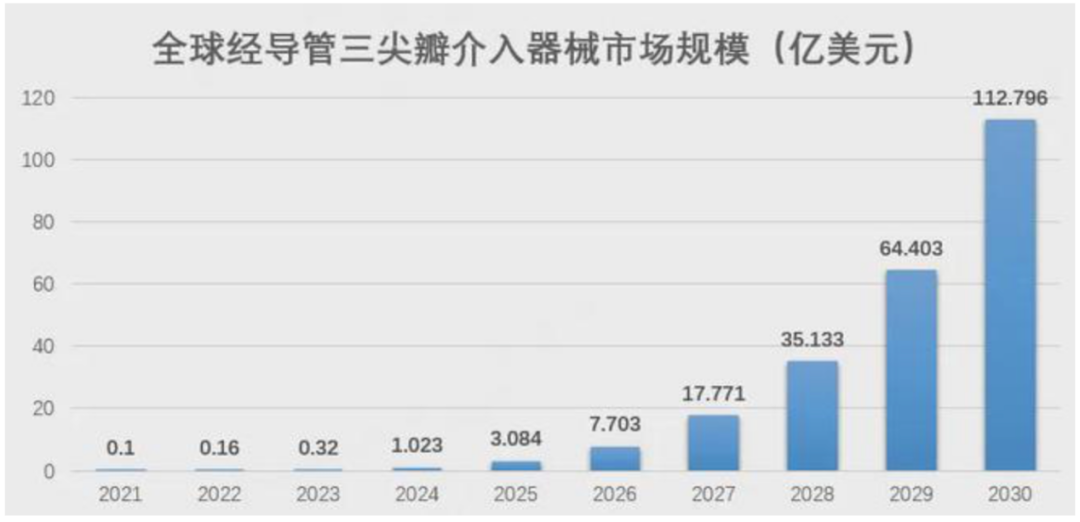
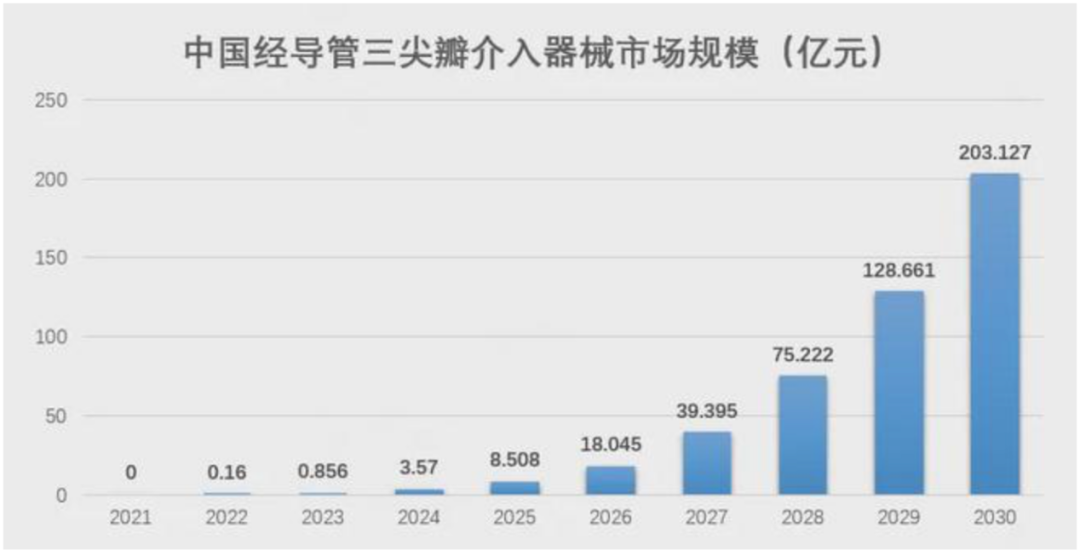
Data Source: Frost & Sullivan
Moreover, according to estimates from the Eggshell Research Institute, the compound annual growth rate (CAGR) of China's tricuspid valve interventional device market will reach 57% from 2023 to 2030, while the global market's CAGR during the same period will be 24%. This indicates that the growth rate of the Chinese market is significantly higher than that of the global market, foreshadowing a high-speed expansion of China's tricuspid valve interventional device market.
It is reported that currently, only four tricuspid valve interventional treatment devices worldwide have obtained CE certification, two products have received FDA approval in the United States, and no products have been approved for marketing by China's NMPA. The four products with CE certification include Abbott's TriClip, Edwards' PASCAL, Edwards' Cardioband, and Germany's PF TricValve; the products approved by the FDA are Abbott's TriClip and Edwards' EVOQUE.
In the current global valve market, Edwards Lifesciences holds nearly 70% of the share, dominating the structural heart disease treatment field with an absolute advantage. In addition to its TAVR products, it also possesses the most comprehensive (mitral valve) TMVR product line among all valve companies.
Especially in recent times, it has further accelerated the expansion of its product line through capital acquisitions, further perfected its product portfolio to consolidate its position in the cardiovascular device industry, with the total amount of acquisitions and investments exceeding 1.5 billion US dollars (over 10.7 billion RMB).
On July 15, Jiangsu Trulive Medtech Co., Ltd. announced that it had signed multiple agreements with the French company Affluent Medical related to structural heart disease products. The agreements cover Affluent Medical's Kalios adjustable mitral annuloplasty ring and related mitral valve technologies. According to the agreements, Affluent Medical will receive an upfront payment of $16.3 million (approximately €15 million) in cash.
On July 18, it announced a $300 million acquisition of Innovalve, an innovative mitral valve replacement company, to strengthen its mitral valve replacement product pipeline. The acquisition is expected to be completed by the end of 2024.
On July 24, Edwards Lifesciences announced two major deals; it will spend $1.2 billion (approximately 8.7 billion yuan) to acquire two structural heart disease interventional companies, JenaValve Technology and Endotronix. The products of these two companies will strengthen Edwards Lifesciences' transcatheter aortic valve replacement (TAVR) and heart failure pipelines.
In terms of performance, Edwards Lifesciences maintained overall growth in the first half of 2024, with group revenue increasing by 8% year-over-year to $2.733 billion. Among this, TAVR (Transcatheter Aortic Valve Replacement) revenue reached $2.046 billion, a year-over-year increase of 5.5%; TMTT (Transcatheter Mitral and Tricuspid Therapies) revenue was $156 million, growing by 75% year-over-year; and the surgical structural heart disease business revenue was $530 million, marking a 5.1% year-over-year increase.
Without a doubt, Edwards Lifesciences has seen strong sales momentum this year in transcatheter mitral and tricuspid therapies, with the company forecasting full-year sales to be at the higher end of the previously estimated range of $320 million to $340 million. However, due to shifts in TAVR sales trends, the company is revising downward its full-year TAVR sales expectations.
Another example is HeartFlow Medical, a company listed on the Hong Kong Stock Exchange. According to the company, in terms of R&D, the registration of its third-generation TAVI product, VitaFlow III, with the National Medical Products Administration (NMPA) is proceeding in an orderly manner. The humanitarian application of its transcatheter mitral valve replacement product is also ongoing, further validating the safety and efficacy of more models.
Overall, in the field of cardiovascular devices, the gap between companies in China and foreign countries remains significant, with a highly concentrated market share. For instance, major players like Medtronic, Abbott, Boston Scientific, Johnson & Johnson, and Edwards Lifesciences all reported year-on-year growth in their cardiovascular business revenues for the first half of this year, with revenues reaching $5.773 billion, $5.501 billion, $5.082 billion, $3.679 billion, and $2.733 billion, respectively. In terms of scale, there is still a considerable gap between companies in China and those abroad. However, with the acceleration of the process to replace imported products with domestically produced ones, more Chinese companies are expected to stand out in the future!
——【END】——
Latest Review
Review of previous periods