Novartis Submits Second Indication Application for Iptacopan in China, Likely for IgA Nephropathy or C3 Glomerulopathy

Novartis
Drug Development and Manufacturing

On August 7, according to the CDE official website, Novartis' second indication for Iptacopan has been submitted for marketing approval.Application No.: JXHS2400053). Based on the progress of previous clinical trials of this drug, we speculate that the indication for this application may be IgA nephropathy (IgAN) or C3 glomerulopathy (C3G)。In April this year, the first indication of Ipkepan was approved in China for the treatment of adult PNH patients.
 Screenshot source: CDE official website
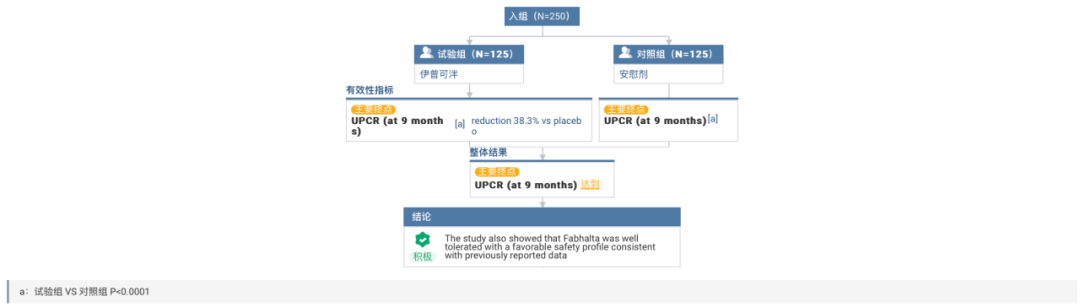
Iptacopan is a potential "first-in-class" oral CFB inhibitor developed by Novartis. Previous Phase II studies have shown that iptacopan can reduce proteinuria in IgAN patients, stabilize eGFR, and decrease complement-related biomarkers. At this year's World Congress of Nephrology (WCN) At the conference, Eproxan APPLAUSE-IgAN (NCT04578834) Phase III study results announced.
In the study, patients were randomly assigned in a 1:1 ratio to receive either 200 mg of Iptacopan twice daily or a corresponding placebo treatment group for a treatment period of 24 months, during which they continued to receive standard supportive care. The primary endpoint of the study was to assess the annual estimated glomerular filtration rate (eGFR) over 24 months.eGFR) Total slope, and the secondary endpoints were to evaluate the effect of Ipkapan on patient-reported outcomes as well as its safety and tolerability.
The results showed that, in the Iptacopan group and the placebo group, the patients' 24-hour urine protein/creatinine ratio (24 h-UPCR) Median (IQR) were 1.8 (1.4-2.7) g/g and 1.9 (1.5-2.8)g/g。Except for two patients in the placebo group, all patients received the maximum standard and/or tolerated dose of RASi treatment. During the follow-up period, the proportion of patients reaching the composite renal failure endpoint was 6.4% in the Iptacopan group, significantly lower than 13.6% in the placebo group. Additionally, patients who discontinued Iptacopan treatment (16.0%) significantly fewer than the patients who discontinued placebo (28.0%)。
From baseline to month 9, iprocopan significantly reduced proteinuria levels in IgAN patients compared to the placebo group, with a 38.3% reduction in 24h-UPCR.95% CI: 26.0%-48.6%; one-sided p<0.0001), significantly different.Compared with the placebo group, the ipcopone group showed a proteinuria/creatinine ratio in the first morning urine sample (UPCR-FMV) also decreased by 35.8% from baseline (95% CI:22.6%-46.7%), which is consistent with the main analysis results. The overall safety during the treatment process was good, and the severity of most adverse events (AEs) was mild to moderate. No deaths were reported in the study.
 Screenshot source: Insight Database official website
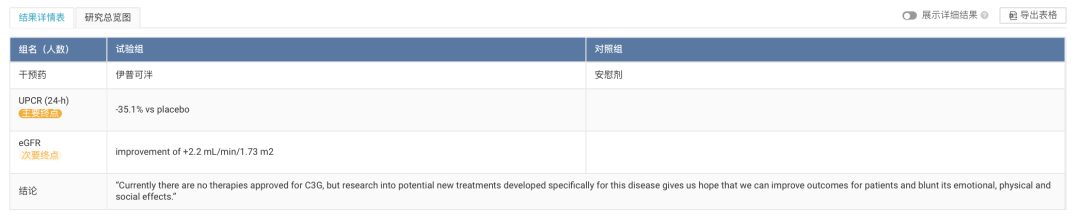
TargetingC3G Indication,This year's European Renal Association (ERA) The conference announced the results of Iptacopan in APPEAR-C3G (NCT04817618) showed positive results. In this multicenter, randomized, double-blind, parallel-group, placebo-controlled study, adult patients were randomly assigned in a 1:1 ratio to receive either eptacog alfa or placebo on top of supportive care, followed by a 6-month open-label period.
The results showed that, compared with placebo, patients treated with Iptacopan for 6 months had proteinuria (Through 24-hour UPCR) decreased by 35.1% (p=0.0014), with results showing both clinical and statistical significance. Secondary endpoint eGFR data indicate a numerical improvement over the 6-month period compared to placebo.
 Screenshot source: Insight Database official website
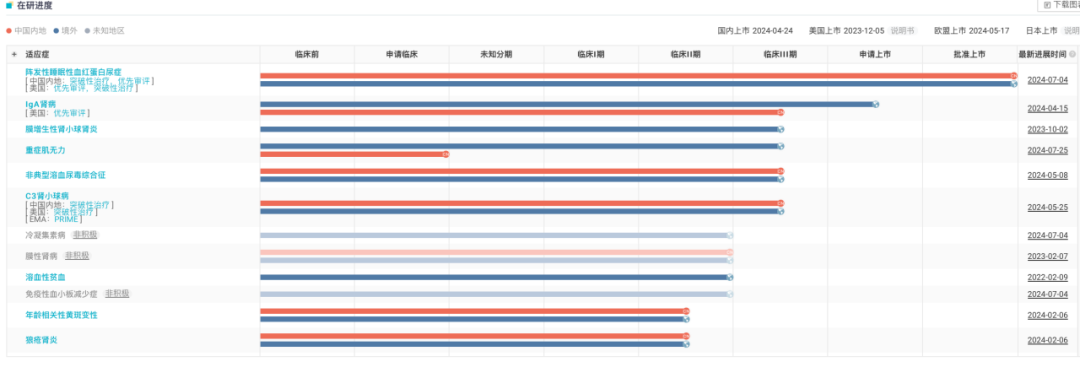
In addition to the above two indications, in December 2023, the FDA approved Epcoritamab for marketing as a treatment for adult paroxysmal nocturnal hemoglobinuria (PNH) The first oral monotherapy.In addition, the clinical trials of Eptinezumab for diseases such as myasthenia gravis and lupus nephritis are proceeding steadily both in China and internationally.
 Screenshot source: Insight Database official website