AstraZeneca Launches Phase IIIb Trial of Capivasertib, the First-in-Class AKT Inhibitor, in China for HR+/HER2- Advanced Breast Cancer

AstraZeneca
Biopharmaceutical Manufacturer

On August 7, the Chinese Drug Clinical Trial Registration and Information Disclosure Platform showed that AstraZeneca registered aPhase IIIb Study of AKT Inhibitor Capivasertib(CAPItrue), to evaluate the efficacy of this drug in combination with fulvestrant in treating patients with disease progression after 1-2 lines of endocrine therapy.HR+/HER2- Advanced Breast Cancer PatientsSafety and effectiveness. According to the Insight database,Capivasertib Is the world's first approved AKT inhibitor, and it is also the first AKT inhibitor to be submitted for marketing approval in China.。
 Screenshot from:Drug Clinical Trial Registration and Information Disclosure Platform
HR+/HER2- breast cancer is the most common type of breast cancer, accounting for approximately 70% of all new cases. For patients with HR+/HER2- metastatic breast cancer, endocrine therapy is an effective option. However, as treatment progresses, patients develop resistance to endocrine-based therapies, and the prognosis remains poor. Studies have found,Activation of the AKT pathway is associated with the development of endocrine therapy resistance in HR+/HER2– advanced breast cancer.Therefore, therapies targeting AKT are expected to offer a novel treatment option for such patients.
Capivasertib is a potent, selective pan-AKT inhibitor, which was first approved for marketing in the United States in November 2023 for the treatment of HR+/HER2- breast cancer. In March and June 2024, the drug was successively approved in Japan and the European Union. In China,AstraZeneca submitted the marketing application for Capivasertib to the NMPA for the first time in October 2023.Insight database speculates that the drug's indication for marketing application is also HR+/HER2- breast cancer, and it is expected to be approved in early 2025.
Capivasertib Development Timeline

Screenshot from:Insight Database Web Version
The study registered in China this time is a single-arm, non-randomized, open-label Phase IIIb trial, aimed at evaluating Capivasertib plus fulvestrant for the treatment of patients receiving...Disease progression during endocrine therapyOrDisease recurrence occurred within 12 months after the completion of adjuvant therapy.TheHR+/HER2- Locally Advanced (Inoperable) or patients with metastatic breast cancerEfficacy and safety in China. The study will be conducted across 90 medical institutions in China, with a target enrollment of 500 participants.
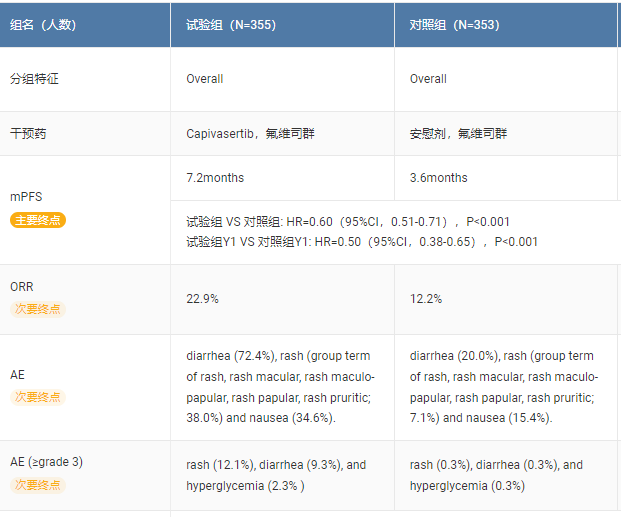
In the Phase III CAPItello-291 trial (NCT04305496), researchers evaluated the efficacy of Capivasertib and fulvestrant in treating patients with HR+/HER2- advanced breast cancer who are resistant to aromatase inhibitors, with the control group receiving placebo + fulvestrant. The data showed,The mPFS for patients in the Capivasertib + Fulvestrant group was 7.2 months (vs Control Group 3.6 Months), ORR was 22.9% (vs Control Group 12.2%). In tumor patients with AKT signaling pathway mutations,The mPFS for patients in the Capivasertib + Fulvestrant group was 7.3 months (vs Control Group 3.1 months),ORR was 28.8% (vs Control Group 9.7%)。
 Screenshot source: Insight Database Web Version
At the 2024 European Society for Medical Oncology Breast Cancer Annual Meeting (2024 ESMO BC), researchers once again announced the second progression-free survival (PFS2) and the time of first subsequent chemotherapy (TFSC). PFS2 is a secondary endpoint, defined as the time from randomization to second progression (That is, the first occurrence of death or progression event after the start of treatment following the initial progression.). TFSC is defined as the first time of death or the start of chemotherapy treatment. The data shows:
Capivasertib + Fulvestrant GroupmPFS2 was 14.7 months, while the control group was 12.5 months;
Capivasertib + Fulvestrant GroupmTFSC is 11 months, while the control group was 6.8 months.
In tumor patients with PIK3CA/AKT1/PTEN alterations, similar results were observed, with the Capivasertib + Fulvestrant group showing mPFS2 (15.5 months vs 10.8 months) and mTFSC (11 Months vs 6 Months) was also higher than that of the control group.
The study concluded that, with similar subsequent treatments in both groups, the Capivasertib + fulvestrant group demonstrated clinically meaningful improvements in PFS2 and TFSC compared to the placebo + fulvestrant group.
Cover Source:Company Logo