Recently, Novo Nordisk's semi-annual report showed,The Phase III OASIS 4 trial for weight loss with oral semaglutide Rybelsus (25mg) has been successfully completed. OASIS 4 is a 64-week efficacy and safety trial that enrolled 307 adults who were obese or overweight with one or more comorbidities, evaluating the weight loss effects and safety of once-daily oral semaglutide (25mg) compared to placebo. The primary endpoint of the study was the percentage change in body weight from baseline during the treatment period and the number of subjects who lost at least 5% of their body weight. The results showed that, in adults with a baseline weight of 105.9 kg,OralSemaglutide TabletsPatients with obesity or overweight who took 25mg lost 13.6% of their body weight, while the placebo group lost 2.2%. If the subjects坚持完成治疗, their weight can be reduced by 16.6%, while the control group's weight is reduced by 2.7%. Prior to this, Novo Nordisk had completed a clinical study on the use of 50mg oral semaglutide tablets for weight loss. In the OASIS 1 trial, patients receiving 50mg semaglutide tablets experienced weight loss after 68 weeks.By 17.4%, while the use of placebo reduced it by 1.8%. In the United States, the oral semaglutide tablet has not yet been approved for weight loss indications. In 2019, the FDA approved the oral semaglutide tablet Rybelsus (7mg and 14mg) for market release, becoming the world's first approved oral GLP-1 drug for the treatment of type 2 diabetes. As of now, Novo Nordisk has completed two studies on weight loss involving oral semaglutide, includingOASIS 1 andOASIS 4。 However, the larger the oral dose, the more obvious the adverse reactions. The general adverse reactions are intestinal events that occur when the dose is increased.
Nowadays, oral GLP-1 has become the next battleground for pharmaceutical companies.
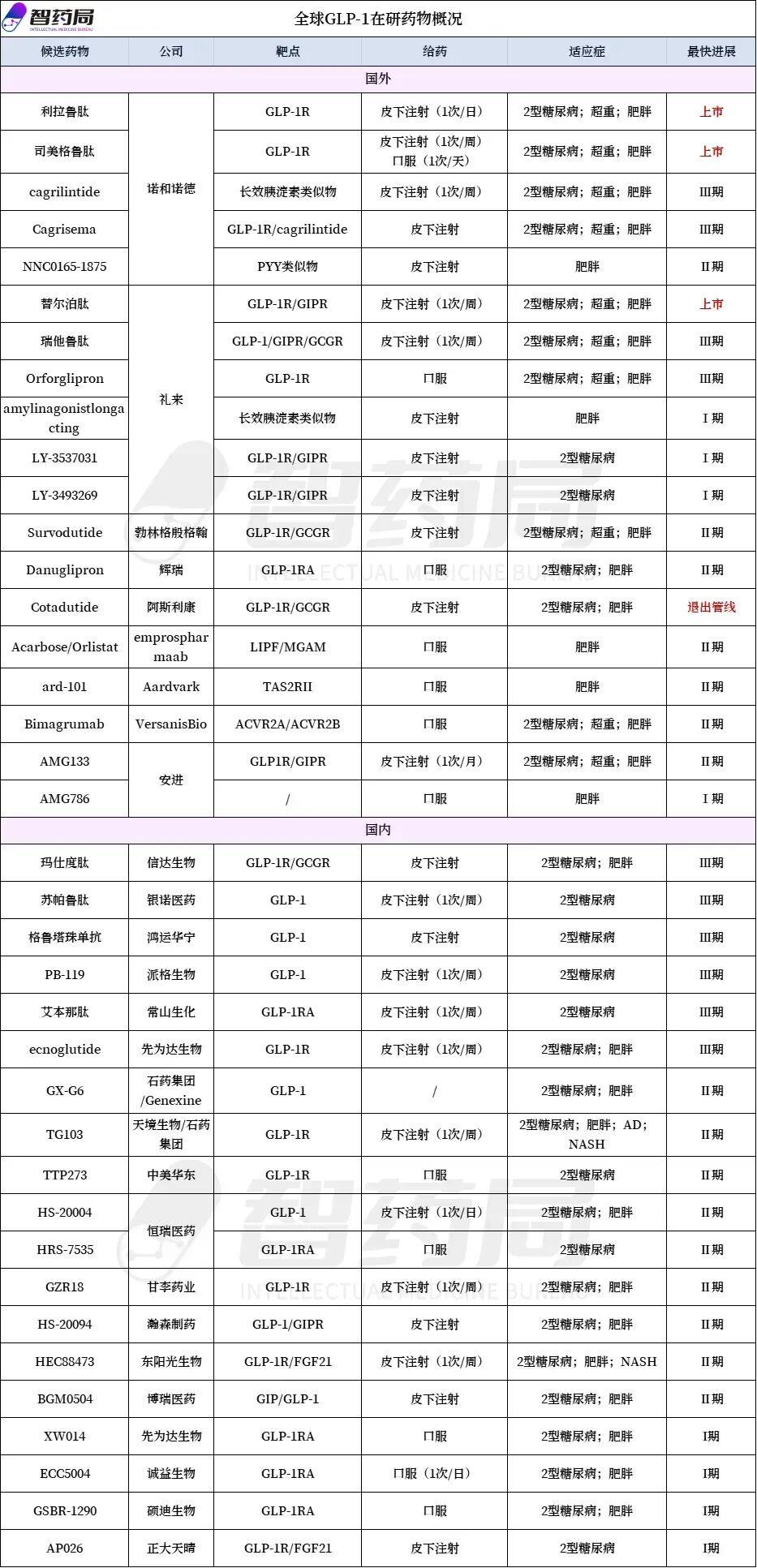
Although Rybelsus, developed by Novo Nordisk, remains the only oral GLP-1 medication, many pharmaceutical companies are committed to improving the drug in order to capture a larger market share. The main component of oral semaglutide tablets is still a polypeptide, which is susceptible to enzymatic degradation.Bioavailability is approximately 0.4~1%., 7 days of continuous oral administration is equivalent to a single subcutaneous injection of 1mg. To improve patient accessibility, major pharmaceutical companies are accelerating the development of oral formulations that are more effective than existing products, particularly small-molecule formulations that enhance human absorption. Apart from Novo Nordisk's Rybelsus, Eli Lilly, one of the GLP-1 dual giants, also has two drugs in Phase III clinical trials. One is oral GLP-1, calledorforglipronNext year will approach a key data readout, while another is an injectable treatment called retatrutide, which stimulates GLP-1, GIP, and a third hormone, glucagon. Clinical results are set to be released in 2026. Another is an injectable treatment called retatrutide, which stimulates GLP-1, GIP, and a third hormone, glucagon. The obesity results will be published in 2026. By the end of 2023, Roche acquired Carmot for $2.7 billion.Securing a position in the weight-loss drug market. Phase I clinical trial data show that CT-996, an oral GLP-1 receptor agonist developed by Carmot, can help obese individuals without type 2 diabetes lose weight within four weeks.7.3%。 In China, companies such as Hengrui Medicine, Huadong Medicine, and Sinoway Biotech are all developing oral GLP-1 small molecule drugs. In addition, the AI pharmaceutical company DearDrug has developedOral Small Molecule GLP-1 Receptor AgonistMDR-001, has also been pushedAdvanced to Phase 2a.