Medtronic and Abbott Announce Strategic Collaboration to Integrate CGM and Insulin Delivery for Advanced Diabetes Management

Abbott
Provider of Health Diagnostic Products and Health Diagnostic Management Solutions

Medtronic
Medical Device Manufacturer

Top Giants Forge Alliance, Stirring Up the Diabetes Arena.
01
Powerhouse Combination:
Abbott and Medtronic Collaborate on CGM
On August 7, Abbott and Medtronic jointly announced a significant partnership in the field of diabetes care. Medtronic (NYSE: MDT) is the world's largest medical device company.

This collaboration aims to integrate Abbott's FreeStyle Libre CGM (FreeStyle Libre 3) product with Medtronic's automated insulin pump (MiniMed 780G) and smart insulin pen (InPen system) to jointly develop a comprehensive system.
Jared Watkin, Executive Vice President of Abbott's Diabetes Care business, stated: "This partnership brings together two global leaders in glucose sensing technology and insulin delivery. The FreeStyle Libre technology sets the standard for accurate, easy-to-use, and reliable continuous glucose monitoring."
Medtronic Diabetes Executive Vice President and President Que Dallara said, "This system can provide first-class results for the world's most widely used CGM. We are committed to simplifying diabetes management, allowing those who wish to achieve more in diabetes care to transition more seamlessly to automated technology."
As top companies in the industry, the collaboration between Abbott and Medtronic has broken the stereotype of "kings not meeting each other," and the capital market has responded positively.Both stocks rose by approximately 1.7%.
Based on the high market growth rate, the diabetes sector has always been a fiercely competitive stage among giants.
Abbott's diabetes care business revenue reached $1,648 million in Q2 2024, increasing by 15.8% year-over-year; Medtronic's diabetes business also performed remarkably, with fiscal year 2024 revenue of $2.488 billion, growing by 10.0%.
As Abbott and Medtronic shift from pure competition to coopetition in the diabetes care field, the existing market landscape will face a strong impact.
RBC Capital analysts believe that this deal is beneficial for both companies and strengthens their positions in the diabetes care market.
02
Giant Competition: Who Takes the Lead?
02
Giant Competition: Who Takes the Lead?
Continuous Glucose Monitoring (CGM) is a technology used for real-time tracking and recording of blood glucose levels in diabetic patients. Compared to traditional blood glucose monitoring methods, CGM provides more frequent and precise blood glucose readings, significantly enhancing the ability of diabetic patients to understand and adjust their blood glucose control.
Mentioned in the research report by Deutsche Securities,The global usage share of CGM in the blood glucose monitoring field has increased from 9.5% in 2015 to 21.4% in 2020, with a market size of $5.7 billion in 2020. The United States and Europe together account for about 70%, showing a duopoly pattern of Dexcom and Abbott.
As the commercial potential has been validated, market competition has become extremely intense. Established leaders continue to increase their investments, while various newcomers are also accelerating their entry.
In 2023, Abbott completed the acquisition of Bigfoot Biomedical ("Bigfoot"). Bigfoot is a long-established company in the diabetes care field. Before being acquired by Abbott, it sold its pump-based automated insulin delivery technology to another leading diabetes care company, Insulet, and had also collaborated deeply with Dexcom.
As专注 players in the diabetes sector, Dexcom and Insulet have evidently felt the pressure of industry giants entering the field. Following the announcement of the collaboration between Abbott and Medtronic, Dexcom's stock dropped by approximately 8%, while Insulet's fell by 3%.
However, the CGM market is still in a stage of rapid expansion, and changes in niche segments will not threaten the fundamental market positions of the two.
Analysts at BTIG said,As a leader in the field of automated insulin delivery, Insulet's Omnipod patch pump product features a unique form factor and business model, typically not overlapping with patients considering the use of tubed pumps.
Analysts believe that there will be no significant impact on Dexcom's existing Type 1 diabetes user base, as these patients require the use of pumps and need to decide whether to switch from their current devices to Medtronic's system.
At the same time, the battle for the CGM market continues.
In July this year, Roche announced that its first CGM product — the Accu-Chek® SmartGuide CGM solution — had received the CE mark.
With many strong players, the future market landscape of the CGM field remains uncertain.
03
Competitive Channel Pricing: What Are the Chances for Domestically Produced Products?
The 10th Edition of the IDF Diabetes Atlas shows that the total number of adults with diabetes in China has reached 140 million, ranking first among all countries. Compared to the United States and Europe, the penetration rate of CGM in China is still relatively low, indicating significant market growth potential.
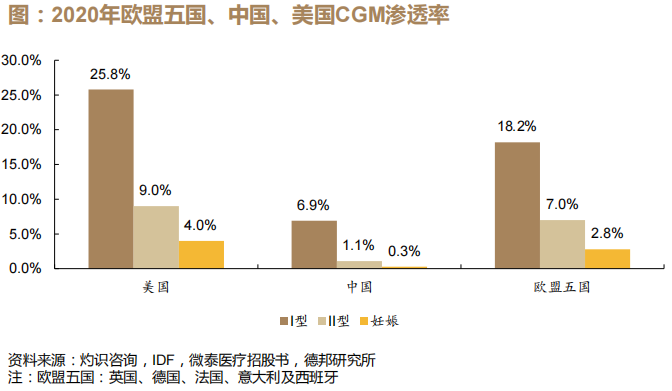 Source: Derway Securities Research Report
According to GY Industry Consulting,In 2023, the CGM market size in China increased by 55.4% year-on-year. It is estimated that in 2024, the CGM market size in China will increase by 49% year-on-year.
Since 2021, domestically produced CGMs have been successively approved and gradually entered commercial transformation. Compared with imported products, the newly approved domestic products show no inferiority in configuration data performance and possess the capability to replace imports in the market.
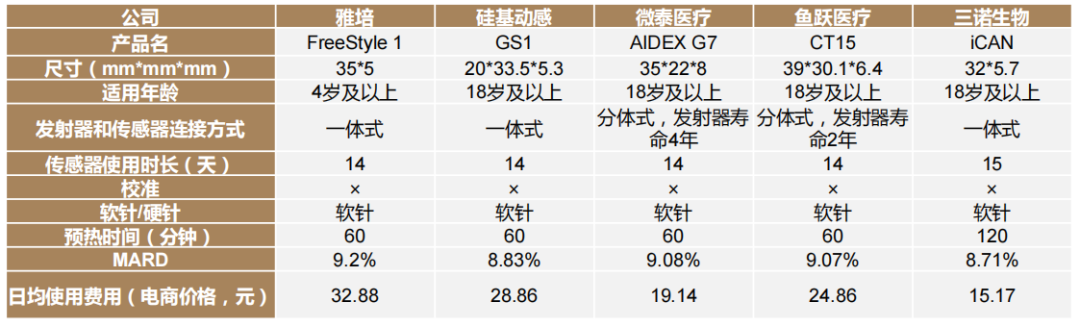 Source: Derivatives Research Report by Tebon Securities
Moreover, the sales of CGM and traditional blood glucose meters have strong synergy, and Chinese manufacturers have a natural advantage in both hospital and non-hospital channels.
For example, Sinocare's blood glucose meter products have covered more than 3,500 secondary hospitals in China, over 220,000 pharmacies and health service terminals, and more than 9,000 community hospitals and township hospitals, which can build a conversion platform for the scaling up of its CGM products.
In addition, the single-use price of domestically produced CGM is relatively low. Combined with the increased awareness of patient self-monitoring, the potential market for CGM in China will gradually be unleashed. According to estimates by Guolian Securities,The CGM market size in China is expected to reach 13.1-19.6 billion yuan by 2030.
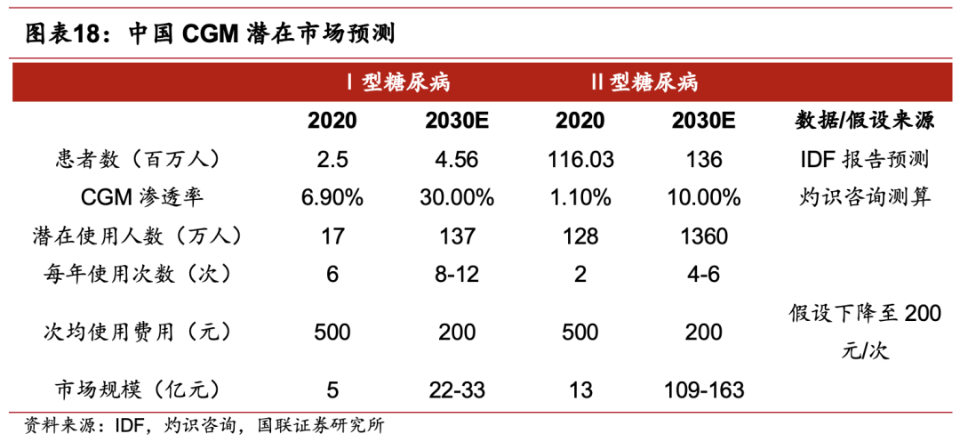 Source: Research report from Guolian Securities
As a rising star, China-produced CGM has already started "involution" at the product level.
In April this year, MicroTech Medical released its new generation CGM product, AiDEX X, which leverages artificial intelligence technology for ecological development and builds an intelligent doctor consultation platform and a social platform for people with diabetes.
Yuwell Medical's Anytime CT3/CT15, launched last year, offers advantages such as calibration-free, finger-prick-free, and high/low blood sugar alerts. It is reported that Yuwell recently filed two new trademarks for "Anytime CGM," indicating a new strategic product layout.
Europe and America have become the main battleground for CGM, partly because their products got an early start, and partly due to the boost from medical insurance policies.
So far, some hospitals in Beijing, Shenzhen and other places have included CGM in the scope of medical insurance payments. As the coverage expands, CGM in China will be fully activated, and the golden development period of domestically produced CGM is also accelerating.

↑Swipe up and down to book all live streams↓
Hot Video Recommendations