GSK's ADC Portfolio: First-in-Class BCMA ADC Poised for Comeback, Major Investments in Chinese-Origin ADCs

GSK
Pharmaceutical R&D Manufacturer

Recently, GSK announced that the marketing application for Blenrep (belantamab mafodotin) has been accepted by the European Medicines Agency (EMA) for use in combination with bortezomib/pomalidomide plus dexamethasone as a second-line treatment for relapsed or refractory multiple myeloma (r/r MM).
Blenrep was previously granted accelerated approval by the FDA in 2020 as a monotherapy for the later-line treatment of r/r MM patients, becoming the first approved BCMA ADC drug. However, following the failure of the confirmatory Phase III DREAMM-3 trial (Blenrep monotherapy vs. pomalidomide + dexamethasone), GSK initiated the withdrawal process for the drug in the U.S. in November 2022. This time, GSK has submitted Blenrep in combination therapy for second-line treatment of r/r MM, which could potentially revive the drug and reopen the door to regulatory approval.
After successfully spinning off its Consumer Healthcare (CHC) division in 2022, GSK has focused on four core therapeutic areas in the biopharmaceuticals sector: infectious diseases, HIV, immunology/respiratory diseases, and oncology. The first three areas are GSK's strengths and primary sources of revenue, while oncology is the segment where GSK is heavily investing and experiencing the fastest growth. According to GSK's recently released 2024 half-year report, GSK’s total revenue for the first half of the year reached £15.247 billion, with sales of oncology products more than doubling to £629 million.
And in oncology, what GSK has high hopes for is ADC, as well as the combination regimen of ADC with its PD-1 antibody Jemperli (dostarlimab). In the field of hematological tumors, GSK already has the BCMA ADC new drug Blenrep. However, in the field of solid tumors, due to the lack of previous layout, GSK has chosen the license-in approach to quickly build a solid tumor ADC pipeline, successively introducing the HER2 ADC drug XMT-2056, the B7-H4 ADC drug HS-20089, and the B7-H3 ADC drug HS-20093 from Mersana and Hansoh Pharma, adding significant leverage to its future solid tumor treatment pipeline.
First BCMA ADC
GSK Expects Sales Peak to Reach £3 Billion
Blenrep is an ADC targeting B-cell maturation antigen (BCMA). The antibody utilizes BioWa's POTELLIGENT technology from Kyowa Kirin's subsidiary, enhancing ADCC activity through defucosylation. For the ADC construct, a non-cleavable linker conjugates auristatin F toxin, with the linker licensed from Seagen.
In 2020, Blenrep was granted accelerated FDA approval for use in fifth-line and later treatment of r/r MM patients, and shortly after, the indication also received conditional marketing authorization from the European Commission (EC).
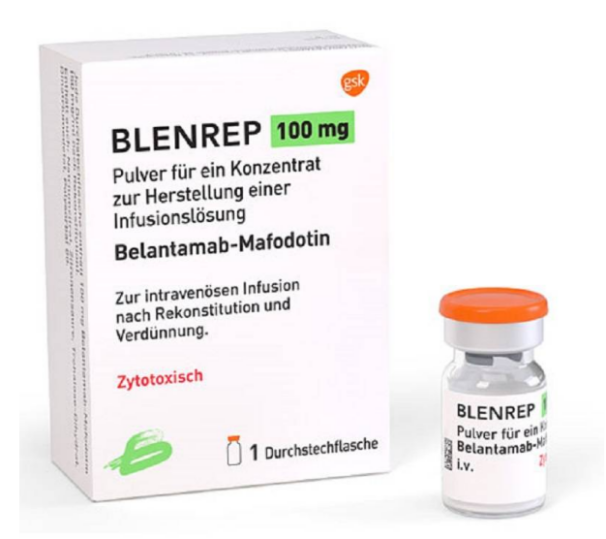
Image Source: GSK
The initial approval of Blenrep was based on the open-label, multicenter DREAMM-2 clinical study, which enrolled patients with relapsed or refractory multiple myeloma who had previously received various treatment regimens. Patients were administered Blenrep 2.5 mg/kg or 3.4 mg/kg intravenously once every three weeks.
The results showed that the overall response rate (ORR) of Blenrep (2.5mg/kg, Q3W) monotherapy was 31%, the median duration of response (DoR) has not been reached yet, but among the responding patients, 73% had a DoR of more than 6 months.
Although it is a later-line treatment, Blenrep generated $43 million in revenue for GSK within five months of its launch. The total sales of Blenrep in 2022 reached $143 million.
Unfortunately, in November 2022, GSK announced the failure of its confirmatory Phase III DREAMM-3 trial, which did not meet the clinical endpoint. This was a "head-to-head" superiority trial comparing the efficacy of Blenrep monotherapy with pomalidomide plus low-dose dexamethasone (PomDex). The results showed that the median progression-free survival (mPFS) was 11.2 months for the Blenrep group and 7 months for the control group. Although the Blenrep group had a longer mPFS, the difference was not statistically significant. In December of the same year, Blenrep was withdrawn from the U.S. market.
However, GSK did not stop the development of this drug, and its sales in the EU continued as well.
At the 2024 ASCO Conference, GSK announced the latest clinical data from the DREAMM-7 trial. The results showed that, compared to standard therapy, treatment with "Blenrep + bortezomib + dexamethasone" for relapsed/refractory multiple myeloma patients extended PFS nearly threefold (36.6 months vs 13.4 months) and reduced the risk of disease progression or death by 60%.
Additionally, in the updated clinical data from DREAMM-8, the Blenrep + pomalidomide + dexamethasone group demonstrated statistically significant and PFS benefits compared to the control group. At a median follow-up of 21.78 months, the 12-month PFS rate was 71% for the Blenrep + pomalidomide + dexamethasone group versus 51% for the control group.
Based on the results of the DREAMM-7 and DREAMM-8 clinical trials, in July 2024, GSK resubmitted the marketing application for Blenrep (belantamab mafodotin), which was accepted by the European Medicines Agency (EMA), for use in combination with bortezomib/pomalidomide plus dexamethasone as a second-line treatment for relapsed or refractory multiple myeloma (r/r MM).
If approved, the Blenrep combination therapy is expected to transform the treatment landscape for relapsed/refractory multiple myeloma. GSK is also highly confident about Blenrep's return to the market. During its recent investor meeting, GSK boldly projected that Blenrep’s peak sales could reach £3 billion.
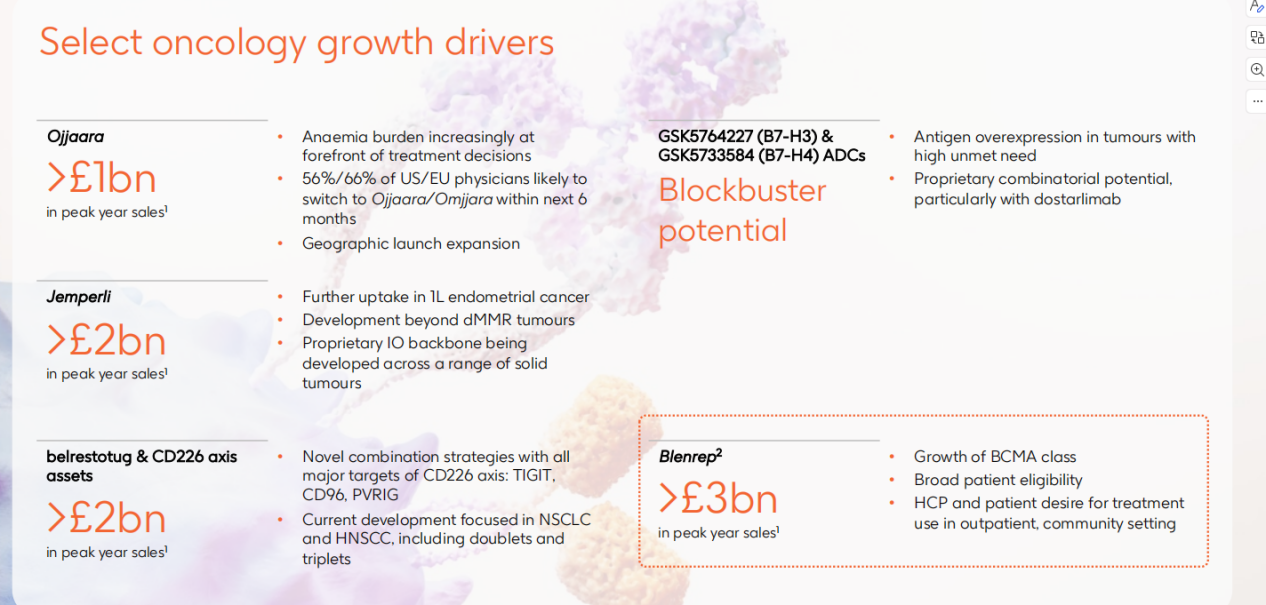
Image Source: GSK Official Website
New Opportunities
$3.2 Billion Layout for B7-H3/H4 Targeted ADC
In the field of solid tumors, GSK's layout started relatively late. Currently, it only has two marketed products: the PD-1 antibody Jemperli (dostarlimab), approved in 2021, and the PARP inhibitor Zejula, acquired from the 2018 purchase of TESARO. Both products are indicated for gynecological cancers.
In 2022, after recognizing the potential of ADCs in the field of solid tumor treatment, GSK also began heavily investing in ADC pipelines, successively acquiring ADC pipelines from Mersana and Hansoh Pharma, seeking new breakthroughs.
Table 1. Summary of GSK's License-in Transactions in the ADC Field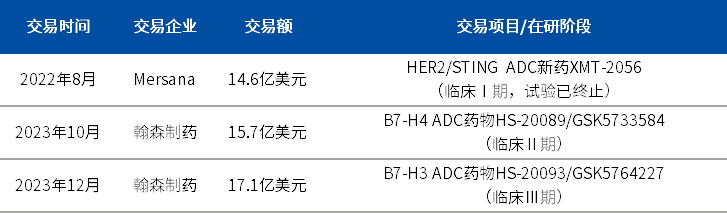
Source: Boyao整理 according to publicly available corporate information
In August 2022, GSK paid $100 million upfront and up to $1.36 billion in potential payments to co-develop and commercialize Mersana's XMT-2056.
XMT-2056 was developed using Mersana's Immunisynthen platform and aims to activate the innate immune system through STING signaling.
However, in March 2023, GSK announced that a Grade 5 Serious Adverse Event (SAE) occurred during the Phase I clinical trial of XMT-2056, resulting in the death of one patient. Currently, the trial has been suspended.
In the second half of 2023, GSK made another move, introducing two solid tumor ADC pipelines from Chinese pharmaceutical company Hansoh Pharma.
In October 2023, GSK and Hansoh Pharmaceutical reached an exclusive licensing agreement for the B7-H4-targeted ADC new drug HS-20089. According to the agreement, Hansoh Pharmaceutical received an upfront payment of $85 million and is eligible to receive up to $1.485 billion in success-based milestone payments, as well as tiered royalties on global net sales. GSK obtained the exclusive worldwide rights (excluding mainland China, Hong Kong, Macao, and Taiwan) to develop and commercialize HS-20089.
In December 2023, GSK entered into an exclusive licensing agreement with Hansoh Pharma for the B7-H3-targeted ADC new drug HS-20093. Under the agreement, Hansoh Pharma received an upfront payment of $185 million and is eligible to receive up to $1.525 billion in success-based milestone payments, as well as tiered royalties on global net sales. GSK obtained exclusive worldwide rights (excluding mainland China, Hong Kong, Macao, and Taiwan) for the development, manufacturing, and commercialization of HS-20093.
The B7 family is a group of immune regulatory ligands that modulate T-cell activation and differentiation, expressed in acquired immune cells, innate immune cells, and various cancer tissues. Among them, B7-H1, also known as PD-L1, has played a significant role in cancer immunotherapy through the PD-1/L1 pathway, becoming a cornerstone drug. Similar to PD-L1, B7-H3 and B7-H4 are widely expressed in various human malignant tumors and have become popular targets for the development of immunotherapy drugs.
HS-20089
B7-H4 is highly expressed in gynecological tumors. HS-20089 is a novel B7-H4-targeting ADC with a topoisomerase inhibitor (TOPOi) as its payload. According to data released by Hansoh at ESMO 2023, HS-20089 demonstrated an objective response rate (ORR) of 33.3% (at a dose of 4.8 mg/kg) and 27.3% (at a dose of 5.8 mg/kg) in patients with triple-negative breast cancer (TNBC). GSK is particularly interested in its potential in gynecological cancers such as ovarian and endometrial cancer, as well as its potential for combination use with GSK's PD-1 antibody Jemperli (dostarlimab).
Currently, HS-20089 is undergoing Phase II clinical trials for the treatment of gynecological cancers.
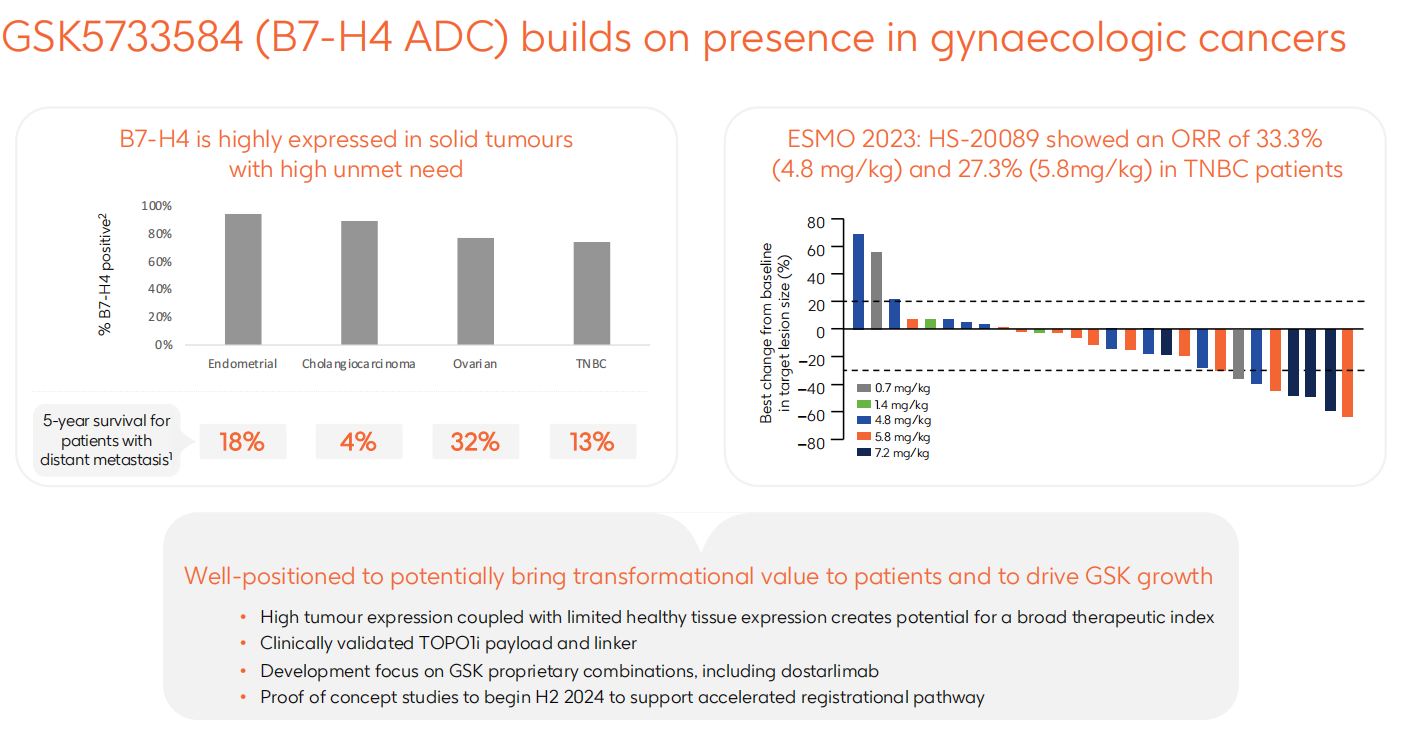
Image Source: GSK
HS-20093
B7-H3 is widely expressed in a variety of tumors. HS-20093 is a novel B7-H3-targeted ADC, covalently linked by a fully humanized B7-H3 monoclonal antibody and a topoisomerase inhibitor (TOPOi) payload.
According to data presented by Hansoh Pharma at the 2023 ASCO Annual Meeting, HS-20093 demonstrated clinical activity across multiple tumor types, with an objective response rate (ORR) of 63.6% observed in small cell lung cancer (SCLC) patients, and ORRs of 17.4%/25% in osteosarcoma/sarcoma, along with a favorable safety profile. GSK values its potential opportunities in lung cancer, genitourinary, gastrointestinal, and other tumors.
The drug is currently undergoing multiple Phase I and Phase II clinical trials in China for the treatment of lung cancer, sarcoma, head and neck cancer, and other solid tumors.
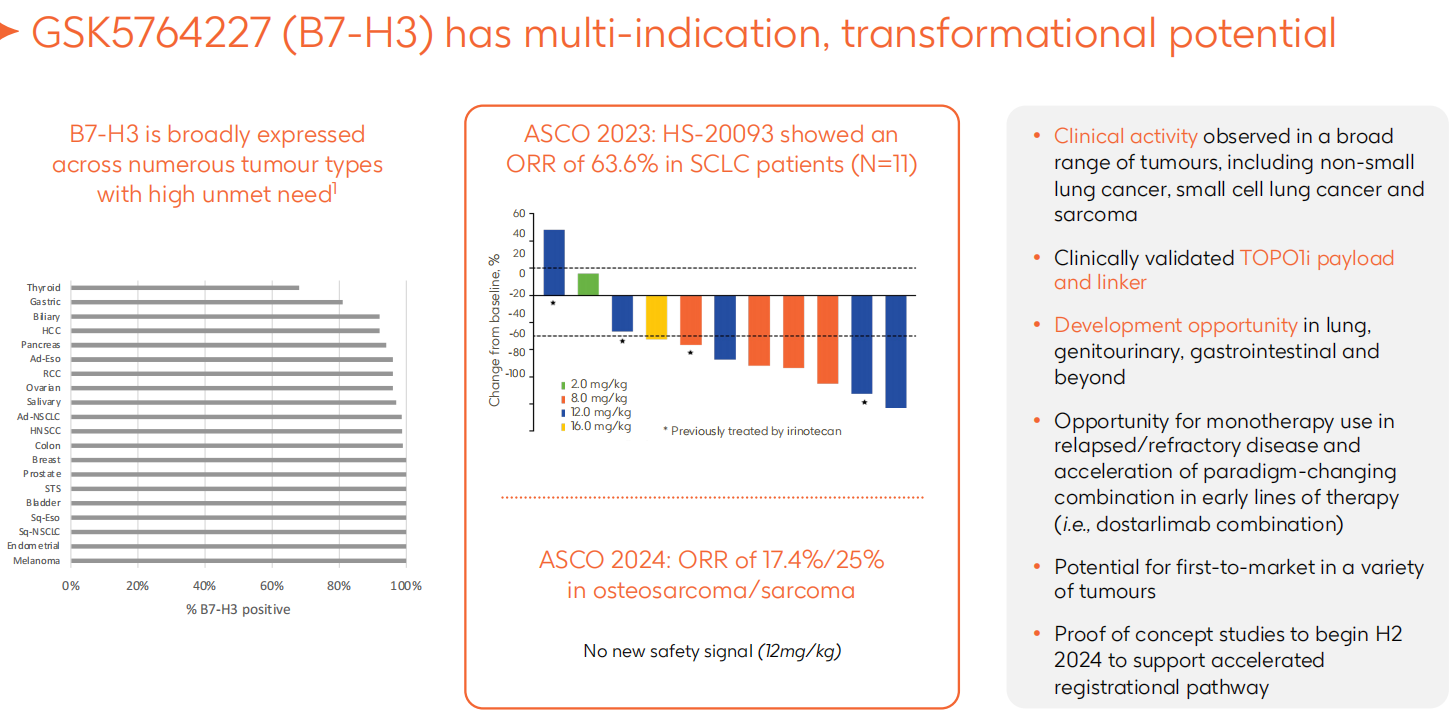
Image Source: GSK
Summary
Oncology was not traditionally GSK's strong suit, but recent financial reports show that revenue from oncology products is growing rapidly and may become a major source of income for GSK in the future.
In the popular ADC field, GSK developed the first BCMA ADC product, Blenrep (belantamab mafodotin). Despite experiencing setbacks, GSK has successfully repositioned Blenrep. Its combination therapy demonstrated excellent data in clinical trials for the treatment of relapsed or refractory multiple myeloma, positioning it to potentially play a significant role in this area.
In the broader field of solid tumors, GSK has introduced the B7-H4 ADC drug HS-20089 and the B7-H3 ADC drug HS-20093 from Hansoh Pharma, targeting markets with significant potential in gynecological cancers, lung cancer, genitourinary system, gastrointestinal, and more. These drugs are also expected to form a powerful combination with GSK's own PD-1 inhibitor Jemperli, paving the way for entirely new treatment pathways and offering boundless possibilities for the future treatment landscape.
Table 2. GSK’s ADC Pipeline in Clinical Stage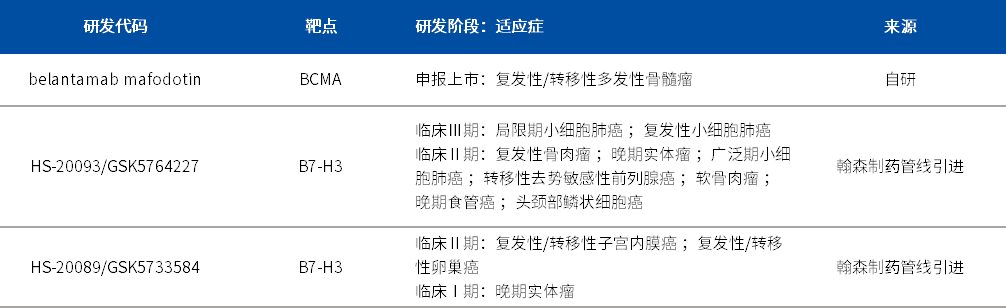
Source: Yaoke Data
References:
https://www.gsk.com/en-gb/media/press-releases/blenrep-belantamab-mafodotin-combinations-in-multiple-myeloma-application-accepted-for-review-by-the-european-medicines-agency/
Biopharmaceutical Editor: ADC on the Verge of a Comeback
Hansoh Pharma: Hansoh Pharma Announces Exclusive Licensing Agreement with GSK for Global Development and Commercialization of B7-H3 ADC Drug
Hansoh Pharma: Hansoh Pharma Announces Exclusive Licensing Agreement with GSK for Global Development and Commercialization of B7-H4 ADC Drug
BiG Biotech Innovation Community: Rapid Withdrawal? This ADC, Granted Accelerated Approval by GSK, Rejected by FDA


Editor: Liuli
Disclaimer: This article is a reprint from PharmNet. The images and text are the original property of the author, and the purpose of the reprint is to convey more information, which does not represent the views of this platform. If there are any issues regarding content, copyright, or other problems, please leave a message on this platform, and we will address it promptly.