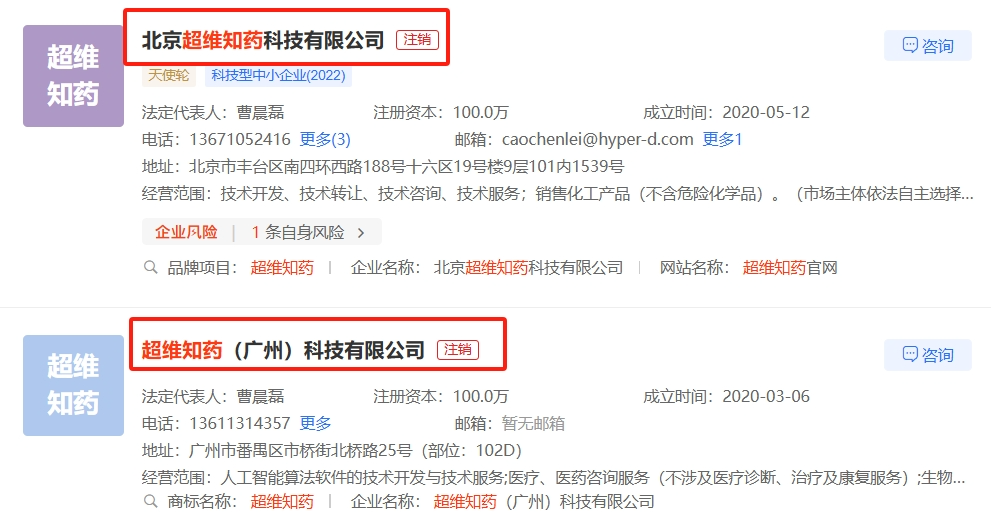
Recently, Hyper-D has foundBoth companies of the AI drug discovery enterprise Hyper-D have been deregistered.。 Hyper-D was founded in 2020, during the peak years of entrepreneurship and financing in the AI pharmaceuticals sector. As the innovative drug winter arrives, AI pharmaceutical companies that fail to secure collaborations and financing are gradually fading in presence, until they vanish from the market. Established for 4 years and received one round of financing Officially established in May 2020, co-founded by Dr. Qin Bingjie and Dr. Cao Chenlei. In the company's introduction, Hyper-D focuses onAI Small Molecule Drug Discovery and Peptide Drug Discovery, a major breakthrough has been achieved in core technology algorithms, and a brand-new molecular characterization system with proprietary core technology has been developed. Based on this, an integrated innovative drug discovery and optimization system has been completed, which encompasses capabilities such as virtual screening of drug molecules, structural optimization, and evaluation of compound drug-likeness, improving the efficiency and success rate of key steps in drug discovery. One of the co-foundersQin BingjieFormer joint Ph.D. from the Academy of Military Medical Sciences & Paris Diderot University (Paris 7), later engaged in antiviral drug research and development for many years at the Institute of Pharmacology and Toxicology, Academy of Military Medical Sciences. In 2019, Qin Bingjie became the AI + Innovative Drug R&D Director at Yuanqi Zhiyao, which was the predecessor of Hyper-D. Another co-founderCao ChenleiDoctorate in Cryptography from Beijing University of Posts and Telecommunications, an expert in the AI field, participated in several national major projects. Before starting a business, worked at Datang Telecom, during which time led the company to achieve a zero breakthrough in the AI direction. In view of the founder's background, Hyper-DAMMS, PUMC-DIHas in-depth connections. The company has not only established the "Hyper-D Institute of Materia Medica Artificial Intelligence Joint Laboratory" with the Institute of Materia Medica, but also formed multiple collaborations with the Academy of Military Medical Sciences, including the research and development of drugs for the novel coronavirus. In addition, Hyper-D has successively collaborated withICE Bioscience, Guoke ZhuoyueInnovative pharmaceutical companies such as Hyper-D are conducting joint research and development of AI-driven drugs. Public information shows that Hyper-D has only received one round of angel financing in the past four years. In July 2021, Hyper-D announced that it had received tens of millions of RMB in angel round funding, with the investor being Chunxin Changying under CITIC Capital. After this angel round of financing, Hyper-D has not disclosed any further financing information. Tens of millions in financing must not only support the company's AI platform but also advance internal pipelines. If subsequent financing falls short, the company could face cash flow exhaustion. In the official WeChat account, the updates of Hyper-D also stopped in August 2021, until Hyper-D was officially deregistered in April this year.


ArrivedWhen facing industry challenges Once, Hyper-D had a clear business plan in its operations.In business, it is comparable to Insilico Intelligence. In the short term, 1-3 years after the company's establishment, business revenue will be generated through technical services and project rights, with charges based on the difficulty and quantity of compounds in each project. In the medium to long term, over the next 3-5 years, Hyper-D plans to leverage AI to extensively develop innovative drug molecules, rapidly advance them to clinical trials, and achieve larger-scale revenue through a combination of self-developed pipelines and external licensing. This is also the development approach envisioned by many AI pharmaceutical companies, but reality has dealt these companies a heavy blow, as the actual implementation process has not been satisfactory. Whether it's self-developed pipelines or collaborations, Hyper-D has failed to deliver impressive results.。 According to the information available to Hyper-D,The unit price of BD for domestic AI pharmaceutical companies is not high, usually around several hundred thousand yuan, and orders exceeding a million yuan are already considered high-priced in the industry. A domestic AI pharmaceutical platform told Zhiyao Bureau: In China, there are only a few large pharmaceutical companies that can afford high unit prices, and companies willing to cooperate also have existing partnerships, making external business development (BD) increasingly difficult. Under the market’s widespread lack of funds, small biotech firms are even less able to afford AI technical services. Meanwhile, the overseas AI pharmaceutical listed companies that were once benchmarked by Chinese startups are also struggling, and the industry is undergoing a reshuffle. Companies such as Schrödinger, Exscientia, Relay, and Absci have seen significant gains compared to their IPO days.Stock prices have generally fallen more than 80% from their peak. As pipeline progress falters, a wave of restructuring has swept through startups and publicly listed companies, with some layoffs exceeding 50%. Recently, the mergers and acquisitions of AI pharmaceutical listed companies Relay and Recursion also indicate that industry players are beginning to collaborate, jointly save costs, advance pipelines, and cooperate. But different from companies that have already gone public for financing,In the cold winter, start-ups may have to look elsewhere for cash. That is to say, these companies not only have to weigh the pros and cons and prioritize projects, but also work hard to promote pipeline licensing and cooperation. Hyper-D observed that without multiple businesses and collaborations, the company's cash flow is heading towards depletion after two years without external financing. In short, the deregistration of Hyper-D is a signal to the industry that the sector is squeezing out bubbles. According to Biotech's survival rate, Hyper-D will not be the only AI pharmaceutical company to disappear. —The End— Recommended Reading