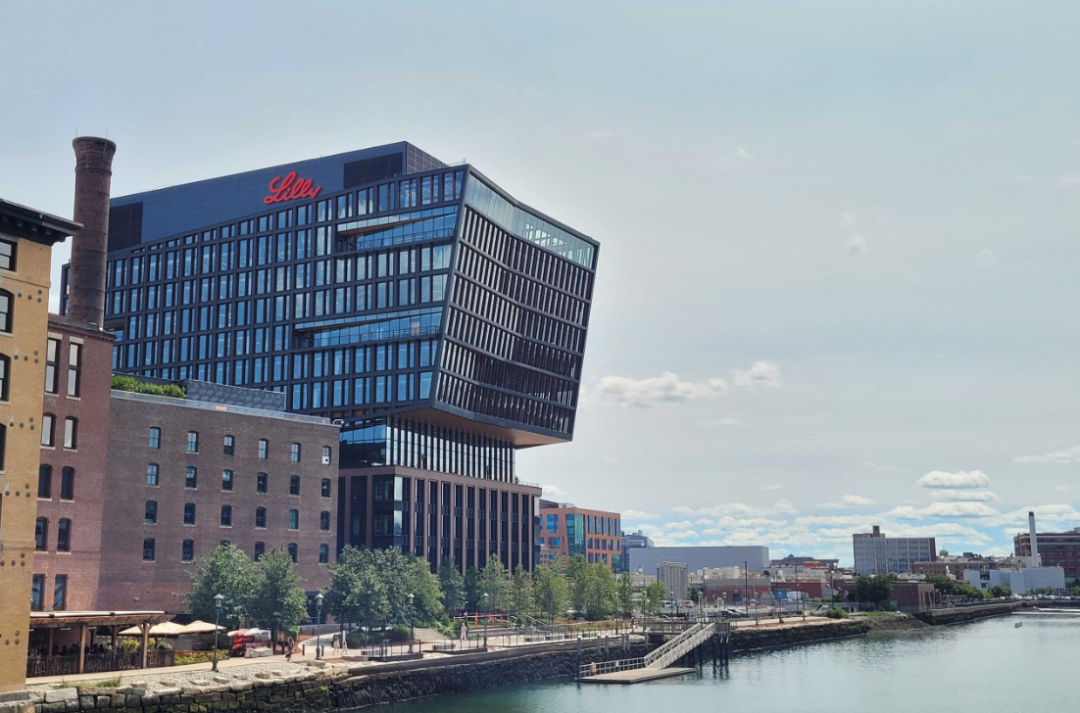
On August 13, Eli Lilly's new R&D center in Boston, which cost $700 million to build, was officially inaugurated. The center is expected to accommodate 700 people, most of whom are scientists working on Eli Lilly's early-stage genetic medicine R&D projects.It is reported that about two-thirds of the R&D center will be used as laboratory space.Researchers will study diseases including diabetes, obesity, cardiovascular disease, chronic pain, and neurodegenerative disorders here.(including Alzheimer's disease)And other related gene drugs。Eli Lilly's Biggest CompetitorNovo NordiskEarlier this year, it also opened its own R&D center in Boston, focusing on research.Diabetes and ObesityGene drug, with the goal of providing alternative or complementary treatment options for its best-selling incretin series.Eli Lilly Boston R&D CenterScreenshot source: ENDPOINTSNEWS
Notably, the new R&D center also features a startup incubator and accelerator space named "Lilly Gateway Labs," which can accommodate 15 startups and 200 scientists. Currently, four biotech companies have moved in: Amplitude Therapeutics and Tevard Biosciences, which focus on RNA; FireCyte Therapeutics, which specializes in neuroinflammation; and Solu Therapeutics, which pairs antibodies with bifunctional small molecules. These companies are not part of Eli Lilly, but they can engage in close communication with Eli Lilly’s scientists.The chief scientist of Eli Lilly stated: "More than 400 million people worldwide suffer from genetic disorders. Since 2018, Eli Lilly and Company has been focusing on the development of gene therapies, and to date, gene therapy business accounts for nearly one-third of the company’s total investment portfolio.」。In recent years, Eli Lilly and Company has been continuouslyAcquisition, Investment, and Collaboration with Small Gene Drug CompaniesBy means of these methods, the company has laid out its gene drug territory and currently owns a variety of gene therapy-related drugs, including AAV gene therapy, CRISPR base editing, short-lived RNA editing, etc.In November 2020, Eli Lilly and Company paid Precision BioSciences an upfront payment of $100 million and invested $35 million in the company to collaborate on the development of three in vivo gene-editing therapies. According to the agreement, Precision is responsible for preclinical research and IND studies, while Eli Lilly handles subsequent clinical development and commercialization, with the total collaboration amounting to up to $2.6 billion. However, in April this year, Eli Lilly announced it was abandoning the co-development of therapies including those for Duchenne Muscular Dystrophy.(DMD)Including 3 gene-editing therapies.In December 2020, Eli Lilly and Company reached a $1.04 billion acquisition agreement with gene therapy company Prevail Therapeutics, targetingNeurodegenerative DiseasesGene Therapy Layout.In December 2022, ProQR Therapeutics announced the expansion of its licensing and research collaboration agreement with Eli Lilly and Company. Through this expanded collaboration, the two companies will explore further applications of the Axiomer platform, with a focus onRNA Editing DrugsThe discovery, development and commercialization. The cooperation initially started in September 2021, and after the expanded agreement, the total amount reached up to 3.9 billion US dollars.In May 2023, Prevail, a subsidiary of Eli Lilly and Company, and Scribe Therapeutics, a gene editing company, announced a collaboration to jointly develop treatments targetingSpecific Neurological and Neuromuscular DisordersIn vivo gene editing therapy. According to the agreement, Prevail will pay Scribe an upfront fee of $75 million for exclusive rights to Scribe's "CRISPR X" editing technology. Additionally, Scribe will have the opportunity to receive milestone payments of up to $1.5 billion.On October 31, 2023, base editing company Beam Therapeutics announced an agreement with Eli Lilly and Company, under which Lilly will acquire Beam's cardiovascular base editing therapy pipeline developed in collaboration with gene editing company Verve. This includes programs targeting PCSK9, ANGPTL3, and an undisclosed liver-mediated cardiovascular target. Under the terms of the agreement, Beam will receive a $200 million upfront payment and a $50 million equity investment. The potential total transaction value could reach up to $600 million.Calculated by potential cooperation amount, Eli Lilly's cumulative total has exceeded 10 billion US dollars since it entered the gene editing track in 2020. This shows Eli Lilly's ambition to rapidly expand its gene drug portfolio.Cover Source:Corporate Logo
Disclaimer:This article is for information sharing only, and does not represent the position or viewpoint of Insight. It does not recommend or introduce any treatment plans. If you have any needs, please consult and contact正规医疗机构.PR Article Coordination: WeChat insightxbSubmissionWeChat: insightxb; Email: insight@dxy.cn
Diversified functions, traceable data……Insight Database Web Version Awaits Your Experience
Click to read the original text,ImmediatelyUnlock!