

Hansoh Pharma Enters the BTK Autoimmune Arena: Can It Outshine Novartis, Merck, Sanofi, and Roche?
Hansoh Pharma
Pharmaceutical Research, Production, and Sales

Lupeng Pharmaceutical
Developer of New Anticancer Drugs
BTK inhibitors, as a major category with significant market potential, are being explored by numerous pharmaceutical companies for popular application scenarios beyond the field of cancer treatment.
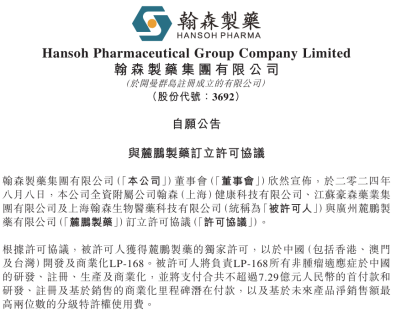
Recently, Hansoh Pharma and Lupeng Pharmaceutical jointly announced that they have reached a cooperation agreement on Lupeng Pharmaceutical's self-developed next-generation Bruton's Tyrosine Kinase (BTK) inhibitor LP-168 (Lobrutinib, Rocbrutinib). Hansoh Pharma will obtain the exclusive rights for the research, registration, production, and commercialization of all non-oncology indications of LP-168 in China (including Hong Kong, Macao, and Taiwan).
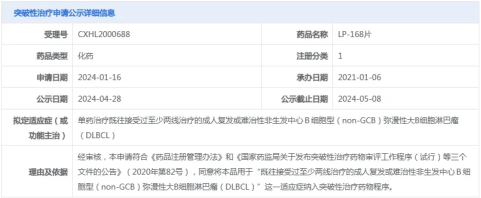
Just three months ago, the CDE website showed that LP-168 was proposed to be included in the breakthrough therapy category for relapsed or refractory non-germinal center B-cell type diffuse large B-cell lymphoma.Nowadays, the non-oncology indications have been acquired by Hansoh Pharma, further triggering widespread attention in the industry regarding the clinical value and market prospects of this product.
Market Viewpoints Suggest That,From the perspective of the global market, sales of autoimmune disease treatments in Europe and the U.S. have gradually reached levels comparable to oncology drugs. As market penetration continues to rise, the release of market potential is further driving sales growth, with more and more blockbuster drugs emerging in niche areas.Global pharmaceutical companies are scrambling to lay out strategies, making the sales proportion of autoimmune drugs increasingly larger. Could BTK become a more commercially valuable "golden track" in the autoimmune field beyond oncology?
BTK Expands into Non-Oncology Fields
Can Hansoh Pharma's Pipeline Unlock Its Potential?
It is reported that LP-168, a non-oncology indication of a BTK inhibitor, mainly focuses on autoimmune diseases such as multiple sclerosis and neuromyelitis optica. It has already demonstrated good safety and efficacy potential in preclinical studies.
In order to acquire LP-168, Hansoh Pharma will pay an upfront fee to Lupeng Pharmaceutical and has committed to paying potential milestone payments based on research and development, registration, and sales-based commercialization, with a total amount not exceeding 729 million RMB. Additionally, Hansoh Pharma will also pay tiered royalties of up to double digits based on the future product’s net sales.
Since its founding in 2018 by Dr. Fenlai Tan and Dr. Yi Chen, Lupeng Pharmaceutical has been committed to the research and development of innovative drugs for malignant tumors and autoimmune diseases. The company boasts a robust R&D pipeline, covering more than 10 projects. In fact, prior to joining Lupeng Pharmaceutical, Dr. Fenlai Tan was responsible for clinical research at Betta Pharmaceuticals, a leading company in targeted lung cancer drugs in China, where he successfully led multiple clinical trials of Icotinib Hydrochloride in patients with advanced lung cancer.
Lupeng Pharmaceutical's R&D pipeline covers multiple cutting-edge fields, including innovative drugs such as EDO-S101 targeting HDAC and DNA dual targets, potent BCL-2 inhibitors LP-108 and LP-118, in addition to LP-168.
Notably, the company has provided financial support for the LP-168 project through multiple rounds of financing and internal fund allocation, ensuring its smooth progress in research and development, production, and market promotion. Industry insiders pointed out that concentrating resources on the LP-168 project, continuously accelerating product development, and selectively transferring partial commercialization rights of the product highlights the company’s high expectations for the drug and deep understanding of its market potential, which will help accelerate LP-168 to achieve a larger differentiated competitive market share.
In fact, the autoimmune field is a key sector that Hansoh Pharma has been actively laying out. Multiple products in the R&D pipeline, such as Inebilizumab and HS-10374, target IgG4-related diseases, psoriasis, and psoriatic arthritis, respectively, demonstrating broad potential.
Inebilizumab, a drug initially developed by Viela Bio, a company focused on severe autoimmune diseases, is designed to treat neuromyelitis optica spectrum disorder (NMOSD). As a humanized monoclonal antibody with high affinity for CD19, Inebilizumab's potential in treating IgG4-related disease (IgG4-RD) is gradually emerging. Currently, the drug has entered Phase III clinical development in China for the indication of IgG4-related diseases.
Another autoimmune drug under research by Hansoh Pharma, HS-10374 tablets, has also made significant progress in the treatment of psoriasis-related diseases. TYK2, as one of the key signaling pathways in the pathogenesis of psoriasis, has become a new target for drug development. By inhibiting the TYK2 target, HS-10374 tablets are expected to open up a new therapeutic approach for psoriasis patients. Currently, the drug is in Phase II clinical trials, and its efficacy and safety will be further validated.
In April this year, Hansoh Pharma's another BD deal in the autoimmune field also drew industry attention. Previously, Hansoh Pharma announced that it had obtained exclusive rights for the research, development, production, and commercialization of all developable dosage forms and indications of QX004N antibody from Quanxin Biotech in China (including mainland China, Hong Kong, Macao, and Taiwan). According to the agreement, Quanxin Biotech will receive an upfront payment of 75 million RMB, potential milestone payments of up to 1.032 billion RMB based on development, regulatory progress, and sales-based commercial milestones, as well as tiered royalties based on future product sales.
QX004N is a recombinant humanized IgG1 monoclonal antibody independently developed by Quanxin Biotech that specifically binds to human IL-23, intended for the development of treatments for psoriasis and Crohn's disease. Currently, QX004N is undergoing Phase I clinical trials for Crohn's disease and Phase II clinical trials for psoriasis in China.

Industry insiders said that the autoimmune field has become one of the very important development directions for Hansoh Pharma. By introducing high-quality external products and enhancing its independent R&D capabilities, Hansoh Pharma is gradually building up its competitive advantages in non-oncology fields.
Multiple Sclerosis and Neuromyelitis Optica
Who Will Take the New Market Heights of BTK?
In the field of non-oncology indications, particularly in the autoimmune disease market, significant potential and attractiveness have been demonstrated. With in-depth research into the mechanism of action of the BTK signaling pathway in autoimmune diseases, the application prospects of BTK inhibitors in this area are increasingly gaining attention.
In order to seize the market opportunity, major pharmaceutical companies have accelerated the clinical trial progress of BTK inhibitors in autoimmune indications. These clinical trials are not only numerous but also rigorously designed and held to high standards, requiring significant investment in human, material, and financial resources. The goal of the pharmaceutical companies is to obtain sufficient safety and efficacy data through these trials to support drug marketing applications.
Currently, there are multiple BTK inhibitors under development globally targeting autoimmune indications. These investigational drugs come from different pharmaceutical companies, each with unique mechanisms of action and advantages, experiencing both successes and failures. Among them, multiple sclerosis (MS) and neuromyelitis optica spectrum disorder (NMOSD) are the key focus areas of research.
Multiple Sclerosis (MS) is a central nervous system (CNS) disease characterized by inflammation, demyelination, gliosis, and axonal degeneration, disrupting the flow of information within the brain and between the brain and the body, leading to damage of nerves in the spinal cord, brain, and optic nerves. This results in a series of symptoms including muscle weakness, paralysis, pain, fatigue, cognitive impairment, bladder dysfunction, and vision problems. Current primary treatments include corticosteroids, immunoglobulins, and disease-modifying therapies.
Since B cells and microglia compartmentalized in the central nervous system (CNS) are considered central to the immunopathogenesis of progressive multiple sclerosis (MS), CNS-penetrant BTK inhibitors may reduce MS disease progression by targeting immune cells on both sides of the blood-brain barrier. BTK inhibitors are expected to become the first disease-modifying treatment with brain penetrability and selectivity that targets the origin of brain damage in MS patients.
Currently, no BTK inhibitors have been approved for the indication of multiple sclerosis (MS). In terms of clinical progress, Merck's Evobrutinib, Roche's Fenebrutinib, Sanofi's Tolebrutinib, and Novartis' Remibrutinib are among the leading candidates.
Despite Evobrutinib showing some efficacy in treating patients with relapsing multiple sclerosis (RMS), it also carries a higher risk of liver injury. In contrast, Roche's Fenebrutinib achieved positive results in Phase 2 clinical trials, significantly reducing newly emerging brain lesions.
Evobrutinib, developed by Merck, is a highly selective oral CNS-penetrant covalent BTK inhibitor. Data show that in patients with relapsing multiple sclerosis (RMS) treated with evobrutinib for over 3.5 years, the annualized relapse rate (ARR) remained low and Expanded Disability Status Scale (EDSS) scores were stable. However, 26% of patients in the treatment group experienced elevated transaminase levels, indicating a higher risk of liver injury associated with evobrutinib.
Fenebrutinib is a third-generation oral, reversible, and non-covalent BTK inhibitor developed by Roche. It does not inhibit epidermal growth factor receptor or IL-2-inducible T-cell kinase, resulting in fewer toxic side effects. In May, Roche announced positive results from the Phase 2 FENopta study of fenebrutinib in treating relapsing multiple sclerosis (RMS). Compared with placebo, fenebrutinib significantly reduced the total number of new gadolinium-enhancing T1 brain lesions on MRI, achieving the primary endpoint of the trial (p=0.0022). Additionally, compared with placebo, fenebrutinib also significantly reduced the total number of new or enlarging T2 brain lesions, reaching the secondary endpoint of the trial.
Remibrutinib, developed by Novartis, is a potent, highly selective, covalent BTK inhibitor with a short plasma half-life, demonstrating favorable pharmacology and safety. Currently, two Phase 3 trials for relapsing multiple sclerosis are ongoing.
After encountering safety issues related to drug-induced liver injury, Sanofi's Tolebrutinib revised its clinical trial protocol and resumed patient recruitment. In June last year, Sanofi announced that the Phase 3 studies of its BTK inhibitor Tolebrutinib for multiple sclerosis (MS) and myasthenia gravis (MG) were placed on hold by the FDA due to drug-induced liver injury concerns identified during the trials, with participants treated for less than 60 days discontinuing dosing. Subsequently, Sanofi modified the clinical trial protocol, excluding patients with pre-existing liver dysfunction and increasing the frequency of liver function monitoring in enrolled patients. In October last year, following these adjustments, the clinical trial of Tolebrutinib for the treatment of multiple sclerosis was able to continue recruiting patients.
Norian Health's Orelabrutinib is in the second tier, having entered Phase II clinical trials, followed by Lupeng Pharmaceutical's LP-168, which has also advanced to clinical stages.
In addition, neuromyelitis optica spectrum disorder (NMOSD) is a rare chronic, autoimmune, inflammatory demyelinating disease of the central nervous system, primarily affecting the optic nerves and spinal cord. Clinically, it is characterized by recurrent attacks of optic neuritis and longitudinally extensive transverse myelitis, which may occur simultaneously or independently. NMOSD is a highly recurrent and highly disabling disease, with most patients left with severe visual impairment, limb dysfunction, or urinary and fecal dysfunction.
Hengrui Medicine's subsidiary, Rui Shi Bio, has received FDA Orphan Drug Designation for its innovative drug Edralbrutinib tablets for the treatment of NMOSD. This drug is a self-developed National Class 1 new drug in China and the first of its kind domestically. Its Phase II clinical study has completed all patient visits and is currently in the data analysis stage.
It is generally believed in the industry that with the deepening research on BTK inhibitors in non-oncology indications and the continuous accumulation of clinical data, more BTK inhibitors are expected to be approved for marketing and applied in clinical practice in the coming years.This will further intensify market competition, but at the same time provide patients with more treatment options and better therapeutic outcomes. In the future, the market competition for BTK inhibitors in autoimmune indications will place greater emphasis on the comprehensive performance of drugs in terms of efficacy, safety, patient experience, and cost-effectiveness.




www.yyjjb.com.cn
Insight into Industry Trends

"Pharmaceutical Economy Newspaper"
Academic Official Account
Focusing on the Frontiers of Oncology Academia

Terminal Official Account