AstraZeneca Submits New Indication Application for PD-L1 Inhibitor Durvalumab in China

AstraZeneca
Biopharmaceutical Manufacturer
▎WuXi AppTec Content Team Report
Today (August 16), the official website of the Center for Drug Evaluation (CDE) of the China National Medical Products Administration (NMPA) announced,AstraZeneca(AstraZeneca)HeavyweightPD-L1 InhibitorThe marketing application for a new indication of Durvalumab Injection has been accepted, but the specific indication has not been disclosed.Public information shows that Durvalumab(durvalumab)Previously approved for treatment in ChinaNon-Small Cell Lung Cancer、Extensive-Stage Small Cell Lung Cancer, Biliary Tract Cancer Indications。
Notably, on the same day (August 16),Accepted by the U.S. FDADurvalumabSupplemental Biologics License Application (sBLA) and grant itPriority ReviewQualification for the treatment of patients whose condition has not progressed after receiving platinum-based concurrent chemoradiotherapy (cCRT)Limited-Stage Small Cell Lung Cancer (LS-SCLC)Patient.
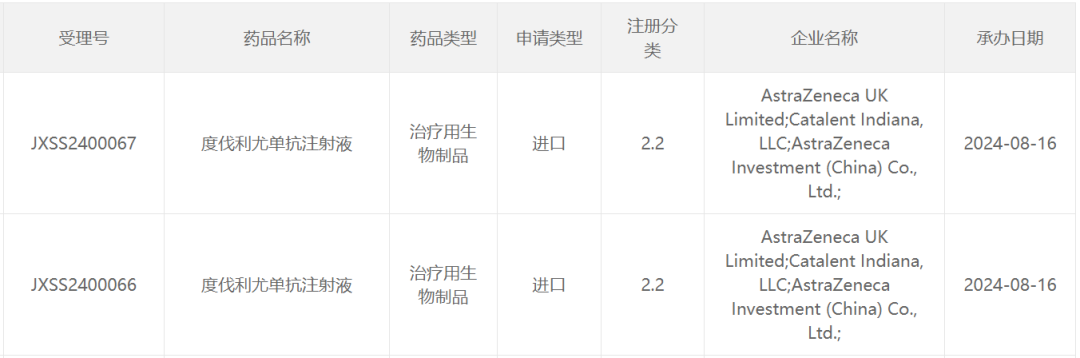
Screenshot source:CDE Official Website
Durvalumab is a humanized PD-L1 monoclonal antibody,Capable of blocking the binding of PD-L1 to PD-1 and CD80, thereby interrupting tumor immune escape strategies and restoring suppressed immune responses.. The product has been approved in multiple countries for the treatment of various types ofLung Cancer, including unresectable stage III non-small cell lung cancer with no disease progression after chemoradiotherapy, extensive-stage small cell lung cancer, and metastatic non-small cell lung cancer treated in combination with a short course of tremelimumab and chemotherapy.
In addition to the indication for lung cancer, durvalumab has also been approved in multiple countries for use in combination with chemotherapy to treat locally advanced or metastaticBiliary Tract Cancer, UnitedAnti-CTLA-4 Antibody Imjudo (tremelimumab)Treatment of unresectableHepatocellular Carcinoma. In a few countries, durvalumab has also been approved for the treatment of previously treatedAdvanced Bladder Cancer。
According to the official website of the Chinese Drug Clinical Trial Registration and Information Disclosure Platform, AstraZeneca has conducted multiple international multicenter (including China) Phase 3 clinical trials for durvalumab, with indications covering:First-line treatment for advanced biliary tract cancer, locally advanced unresectable esophageal squamous cell carcinoma, unresectable biliary tract cancer (including cholangiocarcinoma and gallbladder cancer), patients with localized hepatocellular carcinoma unsuitable for curative treatment, locally advanced cervical cancer, and advanced or recurrent endometrial cancer.And many other types of cancer.




Screenshot Source: Official Website of the Chinese Drug Clinical Trial Registration and Information Disclosure Platform
Recently,Durvalumab continues to yield positive results in clinical research.In June this year, AstraZeneca announcedPresented at the 2024 American Society of Clinical Oncology (ASCO) Annual MeetingFinishedPhase 3 ADRIATIC Clinical TrialHigh-Level Positive Results: Compared with placebo, durvalumab showed no progression after standard treatment with concurrent chemoradiotherapyIn patients with limited-stage small cell lung cancer, Both primary endpoints of overall survival and progression-free survival achieved statistically significant and clinically meaningful improvements.The results of the pre-specified interim analysis showed,Compared with placebo, durvalumab reduced the risk of death by 27%.AstraZeneca previously stated in a press release that durvalumab is the first immunotherapy to demonstrate survival benefits in LS-SCLC, a disease whose standard of care had not changed for forty years.
In January this year, AstraZeneca alsoAnnouncementDurvalumab in combination with transarterial chemoembolization (TACE) and bevacizumab for the treatment ofPatients with Hepatocellular Carcinoma (HCC) Suitable for Embolization TherapyIn the Phase 3 clinical trial, the combination therapy provided a statistically significant and clinically meaningful improvement in the primary endpoint of progression-free survival (PFS). The PFS for the combination therapy group was 15 months, compared to 8.2 months for the control group receiving TACE alone, nearly doubling the PFS. The press release noted that this is the first time a systemic therapy combined with TACE has demonstrated clinical benefit in a Phase 3 clinical trial within this patient population.
[1] Center for Drug Evaluation, National Medical Products Administration of ChinaWebsite. Retrieved Aug 16, 2024, from https://www.cde.org.cn/main/xxgk/listpage/da6efd086c099b7fc949121166f0130c
[2]Imfinzi® Combined with Chemotherapy Approved in China as the First Immunotherapy Regimen for Advanced Biliary Tract Cancer Patients. Retrieved Nov 14, 2023, from https://mp.weixin.qq.com/s/ZuVw857_0AEuAiw9vn943g
[3] Imfinzi is the first and only immunotherapy to demonstrate a survival benefit in a global Phase III clinical trial for limited-stage small cell lung cancer, reducing the risk of death by 27% compared to placebo.. Retrieved Jun 3, 2024, from https://mp.weixin.qq.com/s/xbibDHmYdnJK_N0aea1ZtQ
ThisThis article is from the content team of WuXi AppTec. Individuals are welcome to share it on their social media circles, but unauthorized reproduction by media or organizations in any form on other platforms is strictly prohibited.Reprint Authorization andFor other collaboration needs, please contact wuxi_media@wuxiapptec.com.
Disclaimer: The content team of WuXi AppTec focuses on introducing the research progress in global biopharmaceuticals and health. This article is for information exchange purposes only, and the views expressed in the article do not represent the position of WuXi AppTec, nor does it indicate that WuXi AppTec supports or opposes these views. This article is not a recommendation for treatment plans. If you need guidance on treatment options, please visit a正规 hospital.