AstraZeneca Submits New NDA in China for Durvalumab in First-Line Treatment of Advanced Ovarian Cancer

AstraZeneca
Biopharmaceutical Manufacturer

On August 16, the CDE website showed that AstraZeneca had submitted in ChinaDurvalumab InjectionNew Indication Marketing Application (JXSS2400066/7). Durvalumab is a PD-L1 inhibitor that has previously been approved for 3 indications in China. The Insight database speculates that the new indication submitted for this drug may be:Treatment of patients with newly diagnosed advanced high-grade epithelial ovarian cancer。
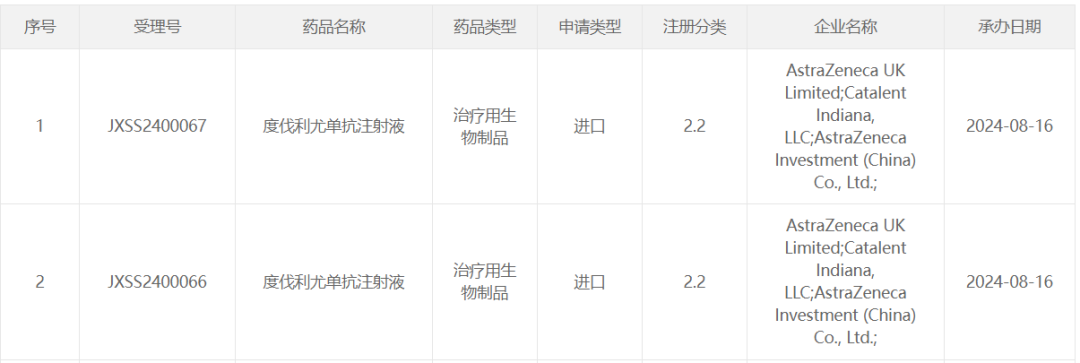
Screenshot source: CDE official website
Durvalumab has been approved for marketing in the United States, Japan, the European Union, mainland China, and other countries and regions. In China, the drug has previously been approved for three indications, respectively for the treatment ofStage III Non-Small Cell Lung Cancer (Approved in December 2019)、Extensive-Stage Small Cell Lung Cancer (Approved in July 2021)、Patients with locally advanced or metastatic biliary tract cancer (Approved in November 2023)。
Based on the progress of ongoing clinical trials for Durvalumab, the Insight database speculates that the new indication submitted in this application may be:In combination with olaparib, bevacizumab, and platinum-based chemotherapy for the treatment of newly diagnosed advanced high-grade epithelial ovarian cancer (No tumor BRCA mutation) Patient。
Durvalumab Research Progress Timeline

Screenshot from:Insight Database
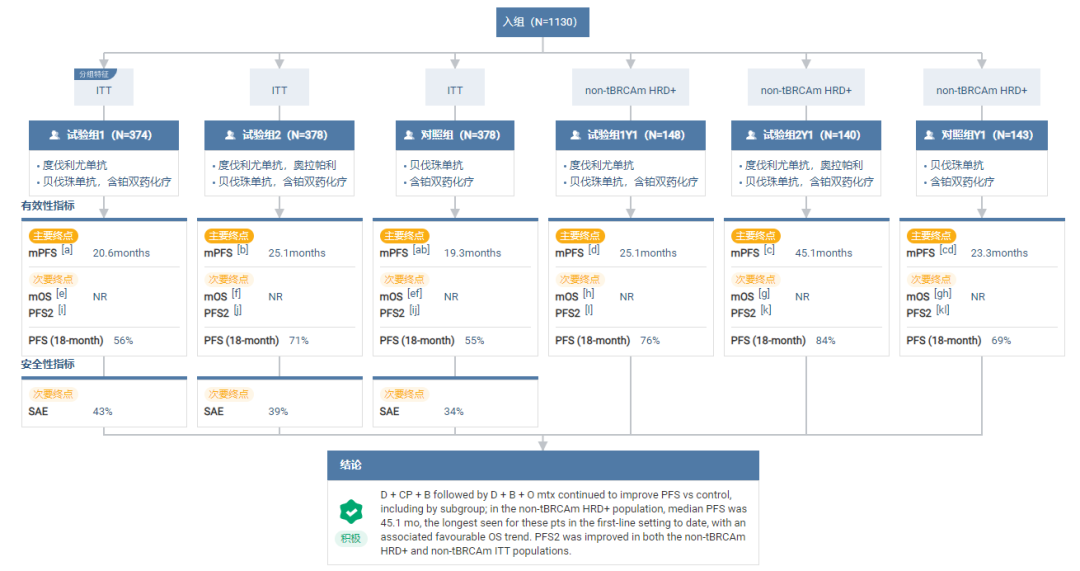
At the 2023 ASCO Annual Meeting, AstraZeneca announced the interim analysis results of the DUO-O Phase III clinical study. DUO-O is a randomized, double-blind, placebo-controlled multicenter Phase III study,Conducted in multiple countries including China, the United States, Germany, France, and Japan., aimed to evaluate inPatients with advanced ovarian cancer who are BRCA mutation-negative at initial diagnosisEfficacy and Safety of Maintenance Therapy with Durvalumab + Bevacizumab with or without Olaparib after Durvalumab + Platinum-based Chemotherapy + Bevacizumab.
Interim analysis data from the DUO-O Phase III clinical study(NCT03737643、CTR20210499):
Compared with chemotherapy combined with bevacizumab treatment,Olaparib + Durvalumab + Chemotherapy + Bevacizumab Combination Therapy Reduces the Relative Risk of Disease Progression or Death by 37%, with median PFS of 19.3 months and24.2 unitsMonth.
And in homologous recombination deficiency (HRD) In the positive subgroup of patients, compared with chemotherapy and bevacizumab alone,Olaparib + Durvalumab + Chemotherapy + Bevacizumab Combination Reduces Relative Risk of Disease Progression or Death by 51%, with median PFS values of23.0 months and37.3 months.
An exploratory analysis of the HRD-negative subgroup of patients found that, compared with chemotherapy and bevacizumab treatment,The relative risk of disease progression or death was reduced by 32% with the combination of olaparib, durvalumab, chemotherapy, and bevacizumab., with median PFS values of17.4 months and20.9 months.
Overview of DUO-O Phase III Clinical Study
Screenshot from:Insight Database
At the European Society for Medical Oncology Gynecological Cancer Annual Meeting held in June 2024 (2024 ESMO GC ), researchers have announced updated data from the DUO-O Phase III clinical trial. The updated data shows:
Compared with the control group, maintenance treatment with durvalumab + carboplatin/paclitaxel + bevacizumab followed by durvalumab + carboplatin/paclitaxel + olaparib continued to improve PFS in patients.
In the non-BRCA mutant HRD+ population, the median PFS was 45.1 months, which is the longest PFS observed to date in the first-line treatment of these patients., and has a favorable OS trend.Non-BRCA mutant HRD+ and Non-BRCA mutant intent-to-treat population (ITT) showed improvement in PFS2.
Cover Source:Company Logo
Editor:Xin Medicine
PR Article Coordination: WeChat insightxb
SubmissionWeChat: insightxb; Email: insight@dxy.cn