China Revenue Showdown Among Multinational Pharma Giants: Merck, AstraZeneca, and Roche Lead with Strong Local Performances
Johnson & Johnson
Medical Device R&D and Manufacturer
#01
Top Multinational Pharmaceutical Companies' Performance Released
Revenue from Multiple Drugs Shines in China
Entering the third quarter, global pharmaceutical companies have successively released their half-year reports for 2024. As of now, the latest performance results of large multinational pharmaceutical companies have been basically disclosed.
In terms of total revenue, Johnson & Johnson, Roche, Merck, Pfizer, and Bayer ranked in the top five in the first half of this year. Johnson & Johnson's global revenue exceeded 43.8 billion U.S. dollars, far surpassing other companies.
AbbVie, AstraZeneca, Novartis, Bristol-Myers Squibb, and Sanofi rank in the top ten. The threshold for the Top 10 is approximately $23 billion, and compared to the revenue gap of $16 billion between the Top 1 and Top 5, the revenue gap between Top 6 and Top 10 is relatively smaller, all distributed between $23 billion and $27 billion.
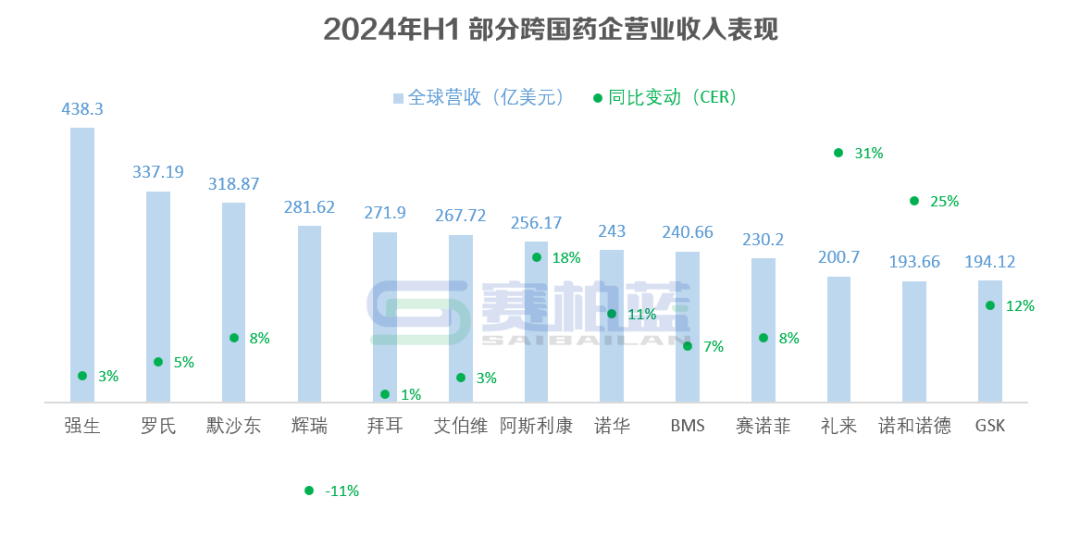
In addition, Eli Lilly and Novo Nordisk, which have garnered significant attention for their GLP-1类产品, ranked 11th and 12th with revenues of $20 billion and $19.4 billion, respectively.
In the first half of this year, among the top 10 multinational pharmaceutical companies by revenue, only AstraZeneca and Novartis achieved growth of over 10%, while the other eight saw single-digit growth or even negative growth. Meanwhile, Eli Lilly and Novo Nordisk reported respective year-on-year revenue increases of 31% and 25%, making them the two fastest-growing companies among the leading enterprises.
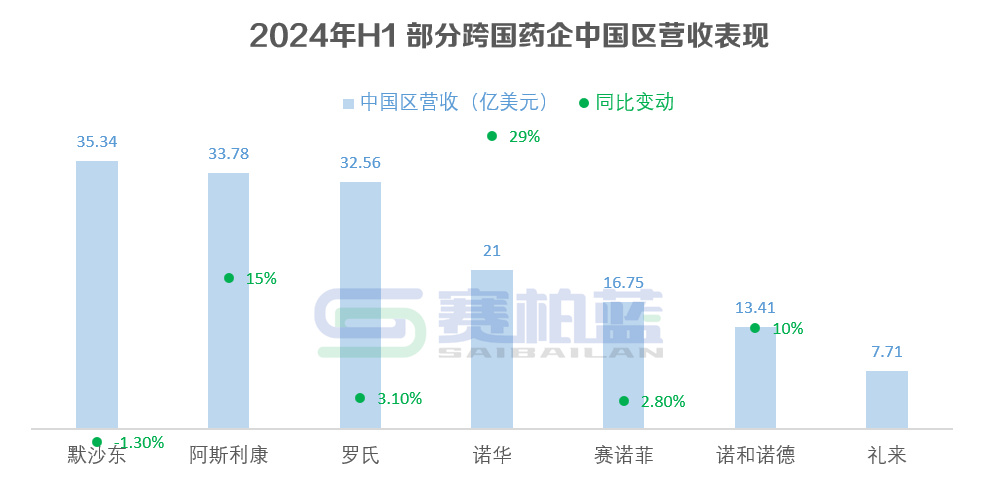
Apart from the global overall situation, some companies also announced their revenue in China. Among them, Merck, AstraZeneca, and Roche ranked top three in terms of revenue in China, all exceeding 3 billion US dollars (3.534 billion, 3.378 billion, and 3.256 billion respectively).
In the financial report, several drugs were highlighted by the company for their particularly outstanding performance in China, and some products were noted to have seen their revenue growth in China offset declines in other regions.
Including Roche's Enmetrastuzumab (Kadcyla, Herceptin), Atezolizumab (Tecentriq, Tecentriq), Faricimab (Vabysmo, Luoshijia), etc.; Merck's Olaparib (Lynparza), Letermovir (Prevymis), etc.; AstraZeneca's Durvalumab (Imfinzi), Goserelin Acetate Sustained-Release Implant (Zoladex), etc.; as well as GSK's Recombinant Zoster Vaccine (Shingrix, Shingrix).
#02
Multinational pharmaceutical companies continue to face pressure from centralized procurement
Frequent Changes in China Region Executives
While some products have performed remarkably well in China, several multinational pharmaceutical companies have collectively mentioned the pressure brought by centralized procurement in their financial reports.
Taking fulvestrant injection as an example, data from Menet shows that its sales in Chinese public medical institutions exceeded 900 million yuan in 2022, at which time the original research company AstraZeneca accounted for nearly 70% of the market share.
In the ninth round of national procurement, domestic companies were selected with prices about 15 times lower than those of the original research companies. As the procurement was implemented, the market previously dominated by AstraZeneca was impacted. Its annual report mentioned that, due to the national procurement in China and the ongoing erosion by generic drugs in Europe, the total revenue of fulvestrant declined.
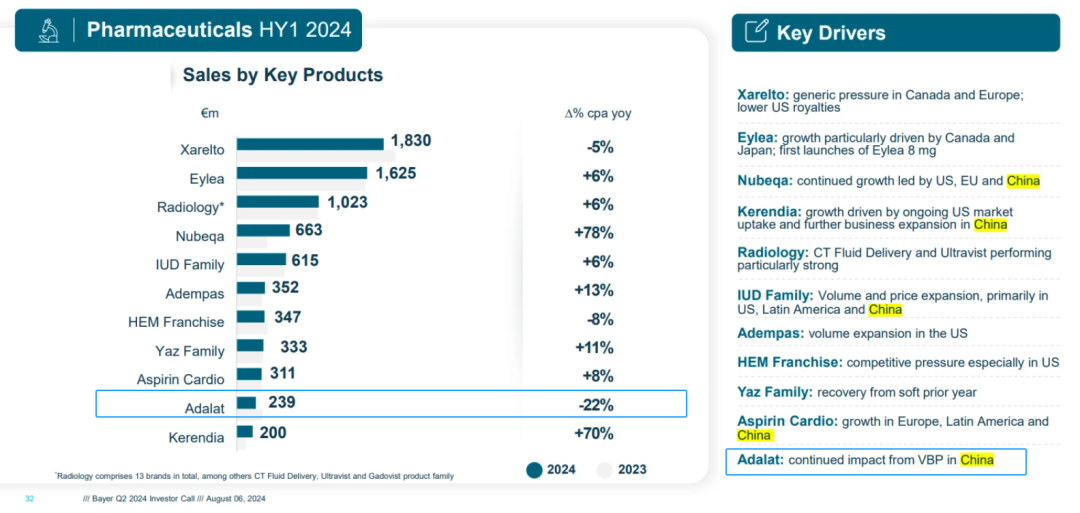
Moreover, Bayer also attributed the 22% year-on-year decrease in global revenue of its sustained-release nifedipine tablets (Adalat, Bayxin Tong) in the first half of this year to the ongoing impact of China's bulk procurement policy.
As centralized procurement becomes常态化 in China, multinational pharmaceutical companies face tougher challenges in their product strategies. They must maintain a balance in the global pricing system while also countering the compression of the hospital market. In the long term, their product portfolios and market positioning will require adjustments, including developing tiered product lines, reducing reliance on单一 products, and providing多样化 products to meet different market demands.
For example, Bayer stated that the pressure from the centralized procurement in the first half of this year was mainly offset by the strong performance of its franchised products.
In addition to changes in product performance, in recent years, the personnel turnover of multinational pharmaceutical companies has been particularly frequent. In just the past month, senior executives in the China divisions of GSK, Novartis, Johnson & Johnson, Pfizer, and Merck have experienced changes.
The continuous optimization and adjustment of pharmaceutical policies in China have placed higher demands on the adaptability of multinational pharmaceutical companies. The changes in leadership of a large number of multinational pharmaceutical companies' China branches can also be seen as one of the manifestations of enterprises actively seeking change.