

Signet Therapeutics Submits IPO Prospectus: Pioneering First-in-Class Diffuse Gastric Cancer Therapy Powered by Organoid Disease Models and AI

SIGNET
Innovative Targeted Cancer Drug Developer
The establishment of SIGNET can be traced back to an extraordinary encounter during the postdoctoral period of its founder and CEO, Dr. Haisheng Zhang. While studying at the Dana-Farber Cancer Institute at Harvard University, driven by his passion for entrepreneurial transformation, Haisheng Zhang joined the MIT-China Innovation and Entrepreneurship Forum (MIT-CHIEF). Through this process, Haisheng Zhang accumulated abundant entrepreneurial resources and experience.
At the MIT-CHIEF annual meeting held during the Thanksgiving weekend, Zhang Haisheng invited Professor George Church, a member of the three U.S. national academies, a leading figure in the "Human Genome Project," and a pioneer in personal genomics, gene editing, and synthetic biology, to be the opening ceremony guest speaker. Unexpectedly, Professor George Church did not appear at the conference site that day and canceled his presentation at the last minute. However, Zhang Haisheng did not give up and contacted him through various means. Finally, that evening, he received an apology message from the professor, who admitted forgetting to attend due to his own reasons and offered to do anything (to make up for it).
So, Zhang Haisheng once again invited Professor George Church to be the closing ceremony speaker at the second day of the annual meeting. Professor George Church arrived an hour early on the day and delivered a wonderful and successful presentation. Afterwards, Zhang Haisheng thanked Professor Church for making the annual meeting a success, and Professor Church joked that he was grateful to Zhang Haisheng for allowing him to make up for his earlier mistake, not letting down his fans. After the annual meeting, while driving the professor home, Zhang Haisheng talked about his entrepreneurial plans.Later, Professor George Church provided many important suggestions for the development of SIGNET and currently serves as a key scientific advisor to the company.
In 2020, Zhang Haisheng and his mentor, Professor Adam Bass, M.D., the chairman of the Human Gastric and Esophageal Cancer Genome Project, started their entrepreneurial journey at Harvard University. In December of the same year, Signet Therapeutics was established in the International Biomedical Industry Park of the Shenzhen-Hong Kong Science and Technology Innovation Cooperation Zone in Futian, becomingChina's first cancer innovative targeted drug R&D company based on organoid disease models + AI.Within one year of its establishment, SIGNET completed three rounds of angel financing, totaling 150 million yuan.
The critical role of applying organoid disease models that closely resemble patients' genomic characteristics in efficacy evaluation and new target discovery, combined with AI-powered screening, synthesis, and optimization of small molecule compounds, is central to SIGNET's dedication to developing first-in-class innovative targeted drugs. Currently, there are three drug pipelines under research.In June 2024, SIGNET's first pipeline received FDA approval to enter the clinical stage, marking the world's first targeted drug pipeline for diffuse gastric cancer to reach clinical trials. VCBeat specially interviewed Dr. Zhang Haisheng, founder and CEO of Signet Therapeutics.

Dr. Haisheng Zhang, Postdoctoral Fellow at Dana-Farber Cancer Institute (DFCI) of Harvard University, Associate Researcher at MIT Broad Institute, currently Founder and CEO of Signet Therapeutics (Shenzhen) Co., Ltd., and concurrently Director of the Cancer Targeted Therapy Research and Development Center at Tsinghua University Research Institute, Shenzhen.
During their time at the Dana-Farber Cancer Institute, a world-leading research hospital affiliated with Harvard University, Professor Adam Bass, M.D., and Hai Sheng Zhang primarily focused on gastric cancer research. Gastric cancer (GC) is one of the more common cancers globally, particularly with a higher incidence in Asia. According to statistics from the International Agency for Research on Cancer (IARC) in 2020, in China, the number of new cases and deaths from gastric cancer accounted for 44% and 48.6% of the global totals, respectively.
Zhang Haisheng recalled, "Early on, while pursuing a Ph.D. in Biochemistry and Molecular Biology at the Chinese Academy of Sciences, I considered starting a business in clinical development. After studying in the U.S., I was also looking for differentiated entrepreneurial opportunities—ultimately focusing on diffuse gastric cancer, a subtype of stomach cancer."Gastric cancer mainly occurs in Asia and Europe, especially in China, while its incidence and research are relatively less in the United States, leaving room for scientific breakthroughs.This malignant tumor, which is a rare disease in the United States and a major disease in China, can only be ultimately conquered by our own people.”。
Diffuse Gastric Cancer (DGC) is a highly invasive tumor derived from the Lauren classification (divided into intestinal-type gastric cancer and diffuse gastric cancer). Compared to the higher incidence but better prognosis of intestinal-type gastric cancer, diffuse gastric cancer exhibits diffuse growth, with typical characteristics of high invasiveness and poorly differentiated cancer cells. It is prone to lymph node metastasis and distant metastasis, resulting in a poor prognosis.
At the molecular level, a large-scale analysis of cancer genomics categorizes most DGCs as genomically stable tumors, as they lack hypermutation and significant chromosomal instability.On the drug front, multiple targeted drugs for intestinal-type gastric cancer, such as trastuzumab, deruxtecan, pertuzumab, and zanidatamab, have gradually entered the global market, but there are still no effective targeted drugs for the treatment of diffuse gastric cancer.
By establishing organoid models based on patient genomics and cultivating gastric organoid orthotopic injection models,Zhang Haisheng TeamFor the first time, the characteristics of disease onset and cancer cell metastasis in patients with diffuse gastric cancer were reproduced, and through modelingFirst Discovery of a Novel Target for Diffuse Gastric Cancer Worldwide — FAK (Focal Adhesion Kinase).
Innovative target discovery is the first step in drug discovery.Furthermore, SIGNET's innovative organoid+AI (BT+AI) integrated solution mainly plays a role in the design and screening phase of innovative drugs.
Organoids, which are 3D cultures of stem cells or organ cells in vitro, undergo directed cell differentiation and self-organize into organ-like structures that can mimic the structure and function of real organs. In traditional approaches, the results of AI molecular screening are validated and optimized using in vitro 2D cell lines and in vivo transplantation tumor models, but there is a lack of patient screening based on molecular markers, leading to unpredictable response rates. The three-dimensional cellular images constructed by organoids are closer to the true morphology of cells, making them more suitable for realistic drug evaluation.
In drug discovery and design, SIGNET has deeply collaborated with XtalPi, a leading AI pharmaceutical company, on "ADME/T prediction and screening based on deep neural networks" to design and synthesize a batch of highly active candidate molecules.Zhang Haisheng introduced, "After AI design, optimization, and initial screening, compounds targeting innovative targets can be narrowed down from hundreds of thousands or even millions of molecules to dozens of molecules. We not only advance the verification and optimization of traditional drug development solutions through in vitro 2D cell line and in vivo xenograft models but also rapidly promote efficacy evaluation using organoid disease models in subsequent stages."
In the efficacy evaluation, SIGNET utilizes its unique evaluation platform based on organoid disease models (screening and optimization) to better screen out molecules that closely resemble the real responses of patients. This ensures high activity and selectivity for specific disease targets, thereby significantly increasing the potential success rate of clinical trials.
Based on this platform, SIGNET can also screen target patients according to the developed companion diagnostic molecular markers, achieving a predictable high response rate and addressing potential issues in the drug pipeline during the clinical stage before they arise.
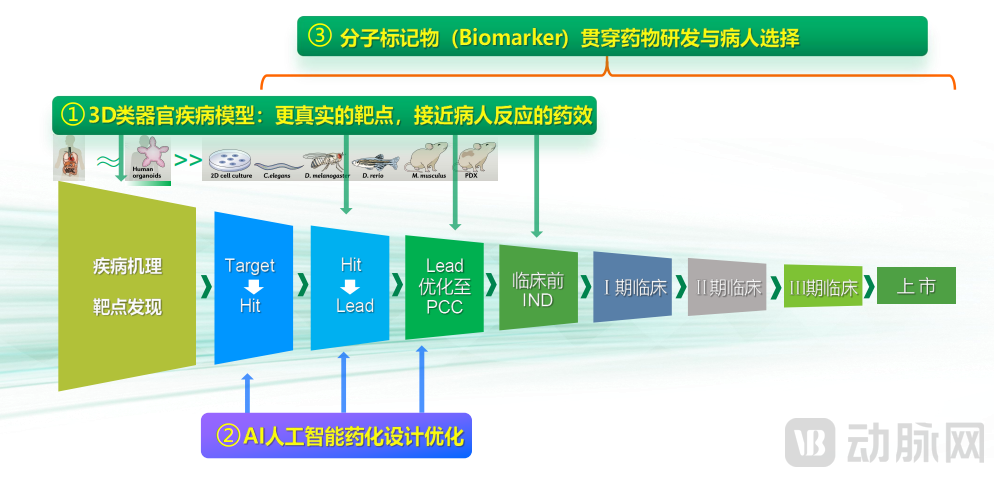
SIGNET Organoid+AI Platform Empowers Preclinical Drug Development from 3 Key Perspectives
Targeting the innovative FAK, SIGNET and XtalPi designed and optimized a candidate compound with a novel molecular structure and superior comprehensive drug-like properties in just over six months. Subsequent preclinical efficacy evaluations were conducted using a unique diffuse gastric cancer organoid model.
Overall, the drug pipeline approved for IND this time is also the world's first Class 1 innovative targeted drug developed by integrating organoid disease models + AI. It took just over three years from the discovery of a new target to the approval of the IND. The key to Signet Therapeutics' rapid advancement of its pipeline lies in its drug development model based on organoid disease models + AI.
In the traditional new drug R&D model, the entire process from drug discovery to obtaining IND regulatory approval usually takes 5-8 years, accompanied by high costs and a high failure rate. However, SIGNET, based on...The Novel Drug Development Model of Organoids + AI: Through Screening, Evaluation, and Optimization Platforms, Utilizing Organoid Disease Models and AI Models to Ensure High Activity and Selectivity for Specific Disease Targets, Thereby Enhancing the Efficiency and Success Rate of Innovative Drugs in the Preclinical Stage.
In addition, SIGNET's organoid+AI drug development model is innovating standards for exploring preclinical data and experimental auxiliary evidence. By simulating the human environment earlier through organoid disease models, it reduces the risk of failure in the clinical stage, potentially saving billions of dollars in R&D costs.
In addition to diffuse gastric cancer, the preclinical efficacy of this targeted drug also demonstrates superior single-agent efficacy in malignant metastatic cancers such as ovarian cancer, triple-negative breast cancer, and pancreatic cancer. It has also shown excellent therapeutic effects when used in combination with chemotherapy or targeted drugs for KRAS and EGFR mutations. As clinical research progresses, it is expected to play a role in more therapeutic fields.
Facing investors and industry players, Zhang Haisheng often encounters a question — with its organoid + AI platform, is Signet Therapeutics a drug development company or a platform service provider? He answers like this: "A long time ago, I thought research might be about publishing papers. But when I stepped into the front lines of entrepreneurship, I realized that academic papers can truly be transformed into drugs that enter clinical trials, turning research into treatments that save lives."Therefore, SIGNET is an innovative targeted drug R&D company. The efficacy evaluation platform based on organoid disease models is an efficient application model that the SIGNET team discovered through their in-house R&D system during the drug development process.
"A drug, taking 10 years, costing over 2 billion yuan, with a success rate of less than 5%." For both innovative pharmaceutical companies and large pharmaceutical enterprises, the enormous risks and massive investments in research and development remain the eternal core challenge of innovative drugs.SIGNET hopes to bridge preclinical models with clinical patients as much as possible through an evaluation platform based on organoid disease models, thereby providing pharmaceutical companies with data and model support for pipeline screening."The process of our pipeline entering IND and conducting clinical trials is also a side validation of the feasibility of this model pathway."
On September 29, 2022, the FDA passed the Modernization Act 2.0, eliminating the mandatory requirement for animal testing; the first new drug based on organoids was approved to enter clinical trials. This is regarded as an important milestone for organoid-related experimental data being used as evidence for drug IND or subsequent development. In the same year, China issued the "Expert Consensus on the Clinical Application of Organoid Drug Sensitivity Testing to Guide Precision Cancer Treatment." To date, the application of organoids in verifying the efficacy of new drugs and exploring preclinical and clinical trial evidence remains in a phase of diverse developments.
Perhaps due to the rigor developed from long-term dedication to scientific research, Zhang Haisheng maintains a cautious yet optimistic attitude toward the substitution of organoid models and data validation."I think the complete replacement of experimental animals with organoids is impossible to achieve in the short term."The key question now is how to enable the continuously evolving organoids to empower practical applications in the new drug development process or other fields.”
Zhang Haisheng gave an example: Cardiac safety evaluation (testing the effect of compounds on the hERG ion channel) is a crucial factor that must be assessed before any new drug enters clinical trials. It is also one of the most important and challenging aspects in the early clinical research of innovative drugs.
"Due to the low clinical accuracy, the hERG index has been controversial in its guidance for subsequent clinical trials. Our team conducted a blind test on the hERG index of some FDA-approved or Phase 2 clinical trial-completed drugs and found that the correlation between this system model and clinical outcomes was limited, with an accuracy rate of only about 40%. However, using SIGNET's 3D cardiac organoid model, which features a beating heart, the accuracy rate can be increased to 78%, and with further optimization, it can reach 85%."This breakthrough is particularly important for the screening of preclinical cardiotoxicity of drugs, especially for non-oncology drugs, as it can eliminate false positives or false negatives caused by hERG.
"Only by being down-to-earth can we go further," said Zhang Haisheng. This example is actually a reminder that while looking forward to the grand ideals of organoid applications, we should consider more achievable and tangible small goals, such as replacing, improving, and assisting in cardiac safety evaluation experiments, drug intestinal permeability prediction models, and so on.
Currently, the new drug R&D model that combines SIGNET's organoid disease models with AI has achieved small-scale commercialization. Relying on a 1200㎡ R&D site and a 500㎡ experimental animal facility, it provides support for pharmaceutical companies in screening pipelines, continuously accelerating the initial discovery and clinical translation of drugs.Meanwhile, SIGNET's first pipeline has officially entered the clinical stage, with Phase I clinical trials soon to be launched, and multiple reserve pipelines are in the preclinical research and development stage.