Enfortumab Vedotin, the First Nectin-4-Targeted ADC, Approved in China for Locally Advanced or Metastatic Urothelial Cancer

Astellas
Pharmaceutical R&D Manufacturer
Click the blue words to follow us


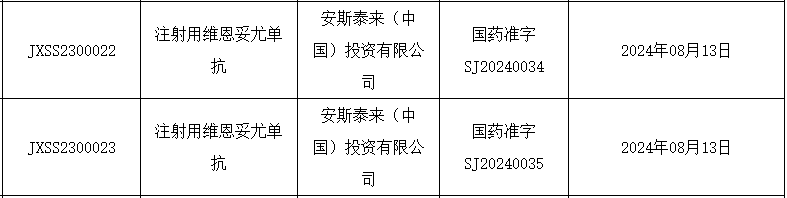
Source of the image: Official website of the Center for Drug Evaluation, National Medical Products Administration of China
August 20, 2024,Astellas Pharma Group announced that the Center for Drug Evaluation (CDE) of the China National Medical Products Administration has approved the use of Vespinib (generic name: Vinblastine Injection, hereinafter referred to as Vinblastine) for adult patients with locally advanced or metastatic urothelial carcinoma (mUC) who have previously received platinum-based chemotherapy and programmed death receptor-1 (PD-1) or programmed death ligand-1 (PD-L1) inhibitor treatment. This medication will provide a new option for patients with locally advanced or metastatic urothelial carcinoma in urgent need of treatment.This approval is based on the results of the global EV-301 study and the China-based EV-203 study, which demonstrated that enfortumab vedotin significantly improved overall survival (OS) and objective response rate (ORR) in patients previously treated with platinum-based chemotherapy and PD-1/L1 inhibitors.
Vedotin is the world's first approved Nectin-4 targeted ADC., this approval further makes it the first Nectin-4-targeted ADC to be approved in China.
Nectin-4, also known as Poliovirus Receptor-Related Protein 4 (PVRL4), belongs to the Nectins family of immunoglobulin-like molecules and is a single-pass transmembrane protein. Recent studies have found that Nectin-4 is overexpressed in various malignant tumors, such as bladder cancer, breast cancer, and lung cancer. Vedotin is a first-in-class antibody-drug conjugate (ADC) that directly targets Nectin-4, jointly developed by Astellas and Seagen, a subsidiary of Pfizer.
Non-clinical data show that vedotin by binding to Nectin-4, internalizes into cells and is cleaved by proteases in lysosomes, releasing the anti-tumor component monomethyl auristatin E (MMAE), which leads to cell proliferation arrest and induces tumor cell apoptosis, thereby exerting anticancer activity. Previously, this drug has been approved in the United States, Japan, and the European Union for the treatment of urothelial carcinoma.
More than ten Nectin-4 ADC drugs have entered the clinical stage, such as 9MW2821 developed by Mabwell, SYS6002/CRB-701 co-developed by CSPC and Corbus, SKB410/MK-3120 co-developed by Kelun-Biotech and Merck, BAT8007 developed by Bio-Thera, ETx-22/LY4101174 developed by Eli Lilly, ADRX-706 developed by Adcentrx, SHR-A2102 developed by Hengrui, etc.
The marketing application of Vinblastine Vedotin in China is based on the EV-203 trial (NCT04995419), a Phase II, multicenter, single-arm bridging study conducted in China. This study aims to evaluate the efficacy, safety, and pharmacokinetic profile of enfortumab vedotin in Chinese patients. A total of 40 patients were enrolled, and the primary endpoint was the objective response rate (ORR) confirmed by the Independent Review Committee (IRC). The results demonstrated that enfortumab vedotin exhibited a favorable benefit-risk profile, showing meaningful clinical activity and manageable safety in Chinese patients with locally advanced or metastatic urothelial cancer who had received prior treatment.
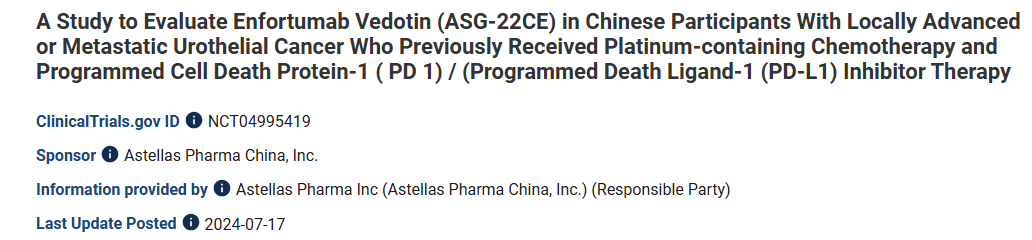
Source of the image: ClinicalTrials official website
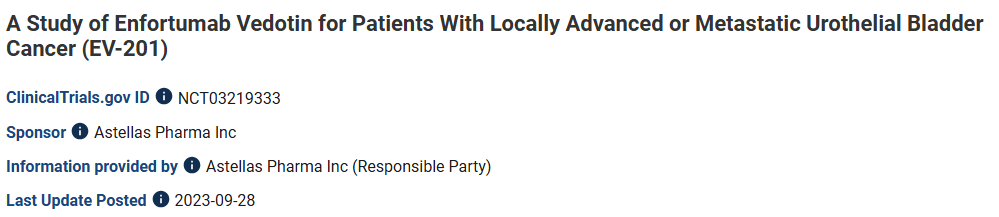
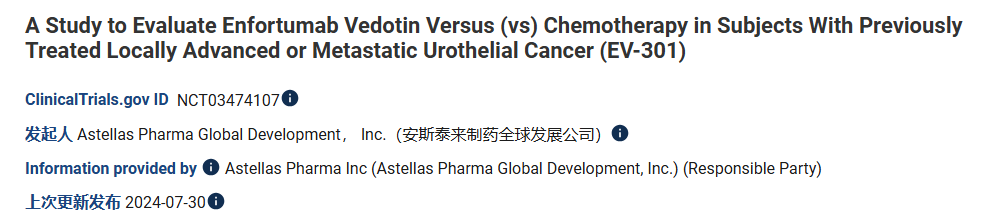
In addition, enfortumab vedotin also underwent the EV-201 trial and the EV-301 trial.
Guo Jun
Professor Guo Jun, the principal investigator of the EV-203 trial and Director of the Department of Melanoma and Genitourinary Oncology at Peking University Cancer Hospital, stated, "On August 13, 2024, the NMPA officially approved the use of intravenous Enfortumab Vedotin for adult patients with locally advanced or metastatic urothelial carcinoma who have previously received platinum-based chemotherapy and programmed death receptor-1 (PD-1) or programmed death ligand-1 (PD-L1) inhibitor treatment. This approval is based on a global Phase 3 registrational study as well as a bridging study in the Chinese population. This is a landmark event that provides patients with access to a new antibody-drug conjugate (ADC) therapy."
Ye Dingwei
Professor Ye Dingwei, the academic leader of the Urology Department at Fudan University Shanghai Cancer Center and the chief expert of the Urological Tumor MDT, stated, "Enfortumab vedotin will officially benefit UC patients in China, offering a new treatment option for la/mUC patients who have previously received platinum-based chemotherapy and PD-1/PD-L1 inhibitor therapy."
He Zhishong
Professor He Zhishong, Deputy Director of the Institute of Urology at Peking University First Hospital, stated, "Enfortumab vedotin is the world's first ADC targeting Nectin-4. The approval of its indications in China has expanded the availability of treatment options for urological oncologists and enriched therapeutic approaches."
Ahsan Arozullah
Ahsan Arozullah, MD, MPH, Senior Vice President and Head of Development for the Oncology Therapeutic Area at Astellas, stated, "We are committed to advancing science and significantly transforming the landscape of global cancer treatment. The approval of enfortumab vedotin by China's National Medical Products Administration (NMPA) Center for Drug Evaluation (CDE) provides another treatment option for patients in China with locally advanced or metastatic urothelial cancer, offering hope for better treatment outcomes." The CDE's approval of enfortumab vedotin was supported by data from the global study EV-301 and the China bridging study EV-203. The randomized Phase 3 study EV-301 supported the global registration of enfortumab vedotin. The EV-203 study (NCT04995419) is a single-arm, open-label, multicenter Phase 2 clinical trial conducted in Chinese patients with locally advanced or metastatic urothelial cancer who were previously treated with PD-1/PD-L1 inhibitors and platinum-based chemotherapy. The results showed that EV-203 met its primary endpoint, demonstrating a statistically significant improvement in the confirmed objective response rate (ORR) as assessed by an Independent Review Committee (IRC) (37.5% [n/N=15/40; 95% Confidence Interval: 22.7–54.2]) compared to historical controls in patients receiving enfortumab vedotin monotherapy. The efficacy and pharmacokinetic data from this study were consistent with global data, and safety findings indicated that most treatment-related adverse events were Grade 1-2.
References:
1. Official Website of the Center for Drug Evaluation, National Medical Products Administration of Chinahttps://www.cde.org.cn/
2. Astellas China Official Website
https://www.astellas.com.cn/zh-hans/news/14836