GSK's B7-H3 Targeting ADC GSK5764227 Receives FDA Breakthrough Therapy Designation for Extensive-Stage Small Cell Lung Cancer

GSK
Pharmaceutical R&D Manufacturer

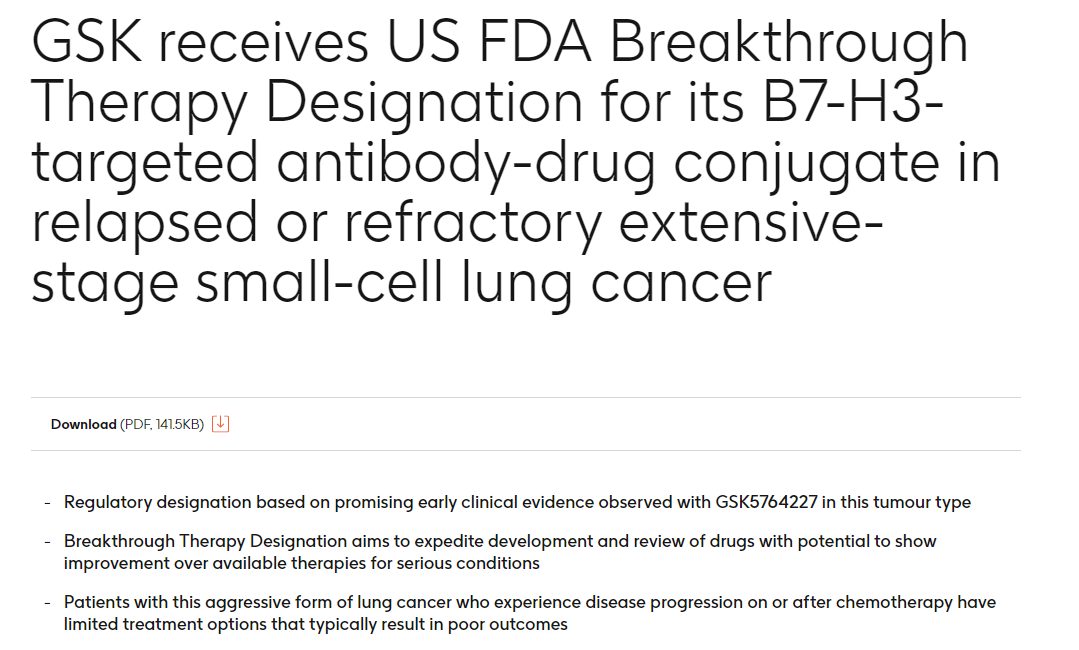
GSK Announces FDA Grants Breakthrough Therapy Designation to Investigational B7-H3 Targeting ADC GSK5764227 (HS-20093) for the Treatment of Patients with Extensive-Stage Small Cell Lung Cancer (ES-SCLC) Who Have Progressed During or After Platinum-Based Chemotherapy (Relapsed or Refractory). The Breakthrough Therapy Designation is intended to expedite the development and review of drugs that have the potential to treat serious conditions and where preliminary clinical evidence indicates a substantial improvement over existing therapies.
Lung cancer is one of the most common cancers in the world. In the United States, approximately 15% of lung cancers are small cell lung cancer (SCLC). Among patients with small cell lung cancer, 70% are in the extensive-stage, meaning the cancer has spread to one or both lungs and/or other parts of the body. Extensive-stage small cell lung cancer (ES-SCLC) is an aggressive and difficult-to-treat cancer with limited treatment options. The 5-year survival rate is about 3%. Most ES-SCLC patients experience recurrence after initial treatment, and the current standard median overall survival for ES-SCLC is 5-6 months.
Hesham Abdullah, Senior Vice President of Global Oncology R&D at GSK, said: "Extensive-stage small cell lung cancer is aggressive with a poor prognosis, and there is an urgent need for new treatment options. Today's Breakthrough Therapy Designation supports our ambition to accelerate the development of GSK5764227 for these patients, as part of our broader ADC program focused on developing new therapies with transformative and first-to-market potential."
In the field of oncology, GSK has high hopes for ADC drugs. Its first ADC drug, Blenrep, is a BCMA-targeted drug used in the hematological tumor field. It was approved for marketing by the FDA's accelerated approval pathway in 2020 for fifth-line and later treatment of r/r MM patients. However, due to the failure of its confirmatory Phase 3 DREAMM-3 clinical trial to meet the clinical endpoint, it was withdrawn from the market in December 2022.
In the field of solid tumors, GSK has rapidly built up its ADC pipeline for solid tumors through licensing-in. This includes acquiring co-development and commercialization rights to Mersana Therapeutics' XMT-2056 in 2022 for a total deal worth $1.46 billion; as well as obtaining global rights (excluding mainland China, Hong Kong, Macao, and Taiwan) to two ADC new drugs targeting B7-H4 (HS-20089) and B7-H3 (HS-20093) from Hansoh Pharma in October and December 2023, respectively. The latter drug is GSK5764227, which has recently received Breakthrough Therapy Designation from the FDA.
In October 2023, GSK entered into an exclusive licensing agreement with Hansoh Pharma for the B7-H4-targeted ADC new drug HS-20089. Under the agreement, Hansoh Pharma received an upfront payment of $85 million and is eligible to receive up to $1.485 billion in success-based milestone payments, as well as tiered royalties on global net sales. GSK obtained the exclusive worldwide rights (excluding mainland China, Hong Kong, Macao, and Taiwan) to develop and commercialize HS-20089.
In December 2023, GSK and Hansoh Pharma reached an exclusive licensing agreement for the B7-H3-targeted ADC new drug HS-20093. According to the agreement, Hansoh Pharma received an upfront payment of $185 million and is eligible to receive up to $1.525 billion in success-based milestone payments, as well as tiered royalties on global net sales. GSK obtained the exclusive worldwide rights (excluding mainland China, Hong Kong, Macao, and Taiwan) for the development, manufacturing, and commercialization of HS-20093.
The total amount of the two transactions reached 3.28 billion US dollars.
HS-20093 is a novel B7-H3-targeted ADC, covalently linked by a fully humanized B7-H3 monoclonal antibody and a topoisomerase inhibitor (TOPOi) payload.
According to data released by Hansoh Pharma at the 2023 ASCO Annual Meeting, HS-20093 demonstrated clinical activity across various tumor types. An objective response rate (ORR) of 63.6% was observed in small cell lung cancer (SCLC) patients, while ORRs in osteosarcoma/sarcoma were 17.4%/25%, with a favorable safety profile. GSK values its potential opportunities in lung cancer, genitourinary, gastrointestinal, and other tumors.
References:
Corporate Announcements, Boyao