

GE Healthcare Advances High-Quality Ultrasound Development in County-Level Hospitals to Strengthen Integrated Medical Consortiums

GE Healthcare
Digital Solution Provider
As the first line of defense in the tiered medical system, grassroots medical institutions should have played the most important role in the screening, prevention, diagnosis, and treatment of diseases. However, in reality, due to issues such as insufficient medical resources and lack of patient trust, although the value of grassroots healthcare is steadily improving, it still falls short of the initial policy objectives.
To promote the early realization of the ideal values of grassroots healthcare, the Ultrasound Physicians Branch of the Chinese Medical Doctor Association has formulated the "Thousand Counties Project" County-level Ultrasound Medicine Center Plan based on the "Comprehensive Capacity Improvement Work Plan for County Hospitals under the 'Thousand Counties Project' (2021-2025)." The plan aims to enhance the medical standards at the county level through resource integration, capacity building, and service optimization, promoting hierarchical diagnosis and treatment, and ultimately contributing to the construction of Healthy China.
Recently, the "2024 County Ultrasound Medicine Forum," hosted by the Ultrasound Physicians Branch of the Chinese Medical Doctor Association and supported by GE Healthcare, announced the latest achievements in the construction plan of the "Thousand Counties Project" County Ultrasound Medicine Center.
At the meeting, members of the "Thousand Counties Project" Expert Committee and representatives from county-level hospitals not only witnessed the unveiling of the list of members for the third batch of the "Thousand Counties Project" County Ultrasound Medicine Centers nationwide but also engaged in discussions on the development of ultrasound subspecialties and improving the quality and efficiency of diagnostic capabilities. They analyzed the difficulties in specialty development and corresponding solutions, aiming to further accelerate the high-quality development of county-level healthcare in the next phase.
From the perspective of comprehensive ultrasound medicine, ultrasound can be used for early screening and diagnosis of a wide range of diseases, as well as guiding various puncture biopsy diagnoses and interventional treatments. Therefore, ultrasound has always held an important position in clinical practice.
However, the development and application of ultrasonic medicine have always been in an uneven state. This unevenness is often reflected in the imbalance of diagnosis and treatment levels between different regions and the uneven depth of application in screening, prevention, diagnosis, and treatment.
President of the Chinese Ultrasound Doctors Association, He Wen, stated in an interview: "Many grassroots hospitals have purchased a lot of ultrasound diagnostic equipment, but their doctors only know how to use some of the main buttons and cannot fully utilize some important functions."
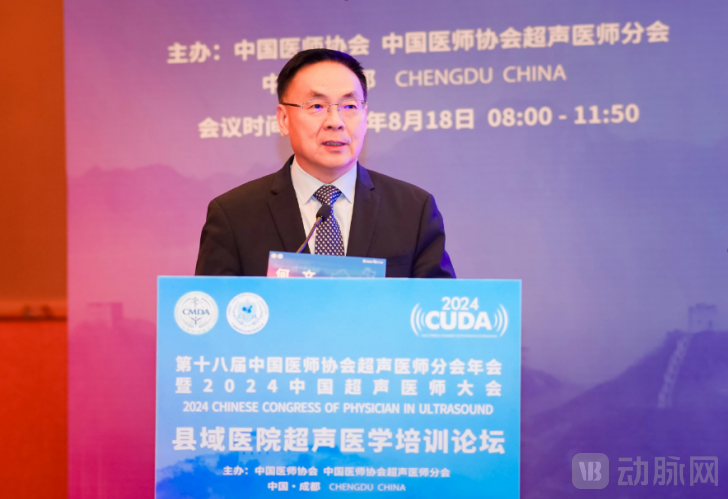
He Wen, President of the Chinese Ultrasound Doctors Association, delivered a speech at the conference.
Specifically, ultrasound medicine covers the diagnosis of multiple organs and viscera from head to toe, such as some vascular diseases of the brain, vascular and thyroid diseases of the neck, breast and heart in the chest, liver, gallbladder, pancreas, spleen, and kidneys in the abdomen, as well as gastrointestinal examinations, etc. Most ultrasound doctors can only operate basic routine ultrasounds and have not fully tapped the value of ultrasound equipment.
Another issue lies in the quality of diagnosis. He Wen stated, "Tertiary hospitals have already widely applied ultrasound in treatment, but at the grassroots level, due to many doctors’ non-standard operations and insufficient diagnostic experience, even when used for screening and preventing common diseases, missed diagnoses and misdiagnoses occur from time to time. Many doctors at grassroots hospitals want to improve their clinical skills, but they either don’t have the time or the funding to go out and study, and can only rely on self-study, lacking systematic opportunities to enhance their clinical abilities."
The establishment of the "Thousand Counties Project" County Ultrasound Medicine Center Plan aims to address the two aforementioned issues. Under the guidance of the National Health Commission and with the support of GE Healthcare, the Ultrasound Physicians Branch of the Chinese Medical Doctor Association has set up numerous ultrasound training bases in county hospitals across China, providing three-year training programs for these hospitals. During the training process, ultrasound doctors from higher-level hospitals regularly visit county hospitals to provide guidance, support, teaching, and even assist grassroots medical institutions with clinical work, research, and discipline development.
Moreover, the Chinese Medical Doctor Association's Ultrasound Physicians are calling on medical institutions and relevant departments to provide more support to ultrasound doctors, addressing their issues related to remuneration and career advancement. This would enhance their professional motivation and enable them to gain a greater sense of honor and achievement.
According to He Wen, the "Thousand Counties Project" County-level Ultrasound Medicine Center Plan has invited over 200 teaching experts, trained more than 3,000 doctors, and established over 500 county-level ultrasound medicine training bases. A large number of ultrasound doctors have not only improved their clinical skills but also gained a stronger sense of professional identity in their daily work.
In addition to systematically enhancing the clinical capabilities of grassroots ultrasound physicians, ensuring the efficient implementation of the "Thousand Counties Project" county-level ultrasound medical center plan, GE Healthcare has also put significant effort into the research and development of ultrasound equipment, endowing these devices with new capabilities and enabling physicians to use ultrasound more conveniently.
GE Healthcare China Vice President and Ultrasound Business General Manager Lei Wang stated in an interview: "Ultrasound equipment is highly reliant on the operator's technique, so the training period for ultrasound professionals tends to be longer compared to other equipment. Therefore, we hope to leverage cutting-edge technologies such as AI and 5G to lower the threshold for using ultrasound equipment and promote the interconnectivity and mutual recognition of imaging, thereby enhancing the clinical capabilities of ultrasound physicians."
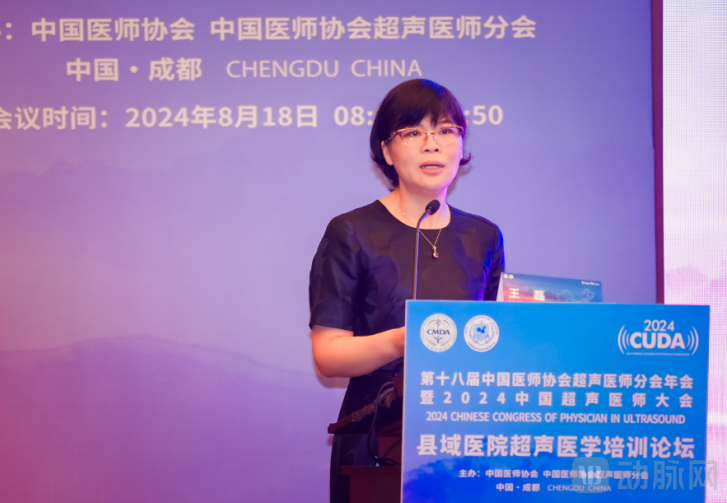 Wang Lei, Vice President of GE Healthcare China and General Manager of Ultrasound Business, Delivers Keynote Speech at the Conference
In fact, we have already integrated intelligent capabilities into the vast majority of county-level equipment in China. AI-powered ultrasound devices can assist doctors in automatically capturing frames with lesions and provide automatic contouring for doctors, thereby improving diagnostic efficiency and reducing missed diagnoses and misdiagnoses.
The integration of 5G ultrasound quality control enables real-time guidance through audio and video communication in a 5G environment, offline guidance for image review when senior experts are unavailable, imaging quality control for standardized ultrasound image quality, and demonstration training for one-on-one or one-to-many ultrasound examination techniques.
Currently, the People's Hospital of Huixian City, Henan Province, and its medical consortium have widely applied the 5G ultrasound quality control system. Through this system, doctors at county-level hospitals can initiate remote ultrasound consultations with senior experts at any time. Remote experts can simultaneously guide scanning techniques, assist in adjusting scanning parameter settings, etc., achieving standardized ultrasound image quality and mutual recognition of images, thereby promoting the improvement of grassroots ultrasound diagnostic capabilities.
In addition to the empowerment of cutting-edge technologies, GE Healthcare has also made efforts in the application depth of ultrasound equipment. During the "2024 County-Level Ultrasound Medicine Forum," GE Healthcare showcased 16 intelligent ultrasound devices at the venue that were "finely categorized" and "highly specialized." These were paired with seven vertical solutions covering subclinical whole-body, cardiac, women's health, specialized clinical, cancer prevention and treatment, minimally invasive intervention, and chronic disease management. This further optimizes medical equipment at the county level, comprehensively enhancing specialty development and primary healthcare service capabilities.
Although the "Thousand Counties Project" County Ultrasound Medicine Center Plan has initially shown success in enhancing the ultrasound clinical capabilities of grassroots healthcare, to bridge the enormous gap in primary healthcare in China, the Chinese Medical Doctor Association and GE Healthcare need to implement the plan with longer-term and deeper efforts.
According to Wang Lei, GE Healthcare continues to collaborate with the Chinese Medical Doctor Association this year to conduct county-level ultrasound training. Focused on disciplines such as cardiac, obstetrics and gynecology, and abdominal ultrasound, the program invites experts from the association and various provinces to conduct specialized ultrasound application workshops using small-class teaching methods across China. Concurrently, basic-level interconnected training and 5G remote training are being offered to establish a three-tiered 5G ultrasound network, promoting remote consultation and teaching. The initiative aims to create 30 county-level ultrasound training demonstration bases during the 2024 county ultrasound training project.
At the same time, GE Healthcare will also help medical institutions complete the "renovation and renewal of old equipment" through "Intelligent Services," achieving smart asset management and empowering the entire lifecycle renewal of equipment. For example, GE Healthcare's digital customized maintenance service for ultrasound equipment, "Ultrasound Intelligent Premium Protection," enables one-stop comprehensive management of ultrasound devices. Based on the device's years of use, it designs different maintenance and clinical function expansion services, improving the operational efficiency of each ultrasound machine, making the equipment feel newer with use.
Wang Lei stated: "As one of the earliest medical device enterprises to dedicate ourselves to grassroots healthcare, over the past decade, GE Healthcare has continuously focused on and served the grassroots. In the future, GE Healthcare will promote the platformization, segmentation, and specialization of ultrasound technology through three key areas: high-end development, intelligent innovation, and green sustainability. This will help counties enhance their specialized capabilities, promote mutual recognition of imaging results and regional collaboration, and routinely improve the specialized ultrasound capabilities at the county level."