GSK’s B7-H3 ADC Receives FDA Breakthrough Therapy Designation; Kelun-Biotech Submits TROP2 ADC NDA; Pulz Pharma Inks Global Anti-TF ADC Deal

GSK
Pharmaceutical R&D Manufacturer
Kelun-Biotech
Innovative Drug Developer

ADCendo
Developer of Novel Anti-Cancer Drugs
In recent days, moreIn China, ADC drugs have delivered good news, "going viral within the industry circle". The B7-H3 ADC drug introduced by GSK has received the FDA Breakthrough Therapy Designation; Kelun-Biotech's TROP-2 ADC drug, Luskansa Monoclonal Antibody for Injection, has submitted a new drug marketing application and been accepted; Puzhong Discovery and ADCendo regarding...ADC Drugs Reach Development and Commercialization Collaboration……
GSK's Introduced B7-H3 ADC Drug Receives FDA Breakthrough Therapy Designation
GSK AnnouncesGSK's B7-H3 Targeting ADC Drug GSK5764227 (HS-20093) Granted FDA Breakthrough Therapy Designation for the Treatment of Extensive-Stage Small Cell Lung Cancer (ES-SCLC)LC),The drug has the potential to treat serious diseases, and preliminary clinical evidence may indicate a substantial improvement over existing therapies.Breakthrough Therapy Designation Accelerates Drug Development and Review.
Kelun-BiotechLukansatuzumab (TROP-2 ADC) Submission for Marketing Approval Accepted
On August 20, the CDE website announced that the new drug marketing application for Kelun-Biotech's Lusk sand antibody injection had been accepted. Its indication is for the treatment of locally advanced or metastatic EGFR-mutated non-small cell lung cancer (NSCLC) that has failed to respond to EGFR-TKI therapy and platinum-based chemotherapy. This is the second new drug marketing application for Lusk sand antibody injection accepted by China's National Medical Products Administration (NMPA).

In terms of structure, Lukansatuzumab Linker adopts the optimized CL2A linker, which is currently the only irreversible conjugation technology at the antibody end, offering higher stability.
The payload of Lukansatuzumab is a novel topoisomerase I inhibitor containing a methyl sulfone structure, which enhances the stability of its binding with the linker, allowing more toxin to be delivered to the tumor site.PrecisionEffective release. The drug-to-antibody ratio (DAR) averages 7.43, enhancing the clinical efficacy of the drug.
Mechanism of Action: Luprocizumab (TROP2 ADC) employs a cleavable linker, binding to the antigen in the tumor site and undergoing endocytosis. Under the action of lysosomes, it releases the small-molecule toxin T030 (a novel topoisomerase I inhibitor) intracellularly, thereby killing tumor cells.
T030 hasBystander Effect,Can penetrate the cell membrane, further damaging surrounding tumor cells.,In additionCorrectTumor cells with low or no TROP2 expression alsoHas a cytotoxic effect.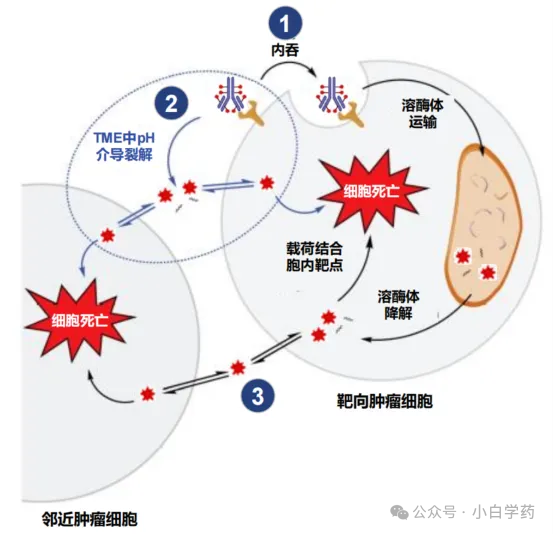
Lukang Satuzumab ( Injectable SKB264 ) was jointly developed by Kelun-Biotech and MSD.Once included four times by the CDE as a breakthrough therapy, with indications respectively:BureauLocally advanced or metastatic triple-negative breast cancer, locally advanced or metastatic EGFR-mutated non-small cell lung cancer, locally advanced or metastatic HR-positive/HER2-negative breast cancer, PD-L1-negative triple-negative breast cancer.
Puzhong Discovery & AdcendoAnti-TF ADC Drug Collaboration
On August 20, 2024, Puzhong Discovery and Adcendo ApS reached a cooperation agreement on the ADC drug targeting tissue factor (Anti-TF), code-named ADCE-T02 (Puzhong Discovery's code AMT-754). Adcendo will obtainADCE-T02Global exclusive development and commercialization rights outside of Greater China.
Puzhong Discovery will receive tens of millions of US dollars as an upfront payment. Upon achieving subsequent development, regulatory, and commercial milestones, it will receive total milestone payments exceeding 1 billion US dollars, along with sales royalties.
ADCE-T02 has been submitted for clinical trials in Australia and is expected to file for U.S. IND soon.
ADCE-T02 is a novel, highly differentiatedAnti-TF Antibody-Drug Conjugate (ADC)
Its antibody design can reduce the impact on the coagulation pathway, T1000-exatecanLinker-Payload PlatformCan amplify the "bystander effect," improve linker stability, and has the potential to overcome drug resistance. This drug demonstrates better clinical efficacy and safety while broadening the therapeutic window.
Tissue Factor (TF)
Tissue factor is a transmembrane protein involved in coagulation and is highly expressed in various tumors (Overexpressed in bladder cancer, non-small cell lung cancer, colorectal cancer, cervical cancer, esophageal cancer, head and neck cancer, and gastrointestinal cancer.),Expression is restricted in normal tissues, thereforeIs an attractiveADC TargetThe abnormal expression of TF is usually associated with tumor growth, angiogenesis, tumor metastasis, and poor clinical prognosis. Its targeted drugs are expected to meet the unmet clinical needs of various solid tumors.
*This WeChat Official Account remains neutral on all original and reproduced content, statements, and viewpoints. The shared content is for non-profit purposes only. If any reproduced works or images have incorrect author source markings or involve infringement, the original authors are kindly reminded to contact the editor for removal.
*Editorial Responsibility| Mu Yang
*Reprint Authorization | Teacher Zhang 17551939537(WeChat same number))
*Business Cooperation | PartyTeacher13262726197(WeChat same number)