

First-in-Class HIF-2α Inhibitor Welireg (Belzutifan) Demonstrates Superior Efficacy in Advanced Renal Cell Carcinoma in Phase 3 Trial Published in The New England Journal of Medicine

MSD
Pharmaceutical R&D and Manufacturer
▎WuXiEdited by Kant Content Team
Recently, the positive phase 3 trial results of Merck & Co., Inc. (MSD)'s "first-in-class" hypoxia-inducible factor-2α (HIF-2α) inhibitor Welireg (belzutifan) for the treatment of advanced clear cell renal cell carcinoma (RCC) were published in The New England Journal of Medicine. The trial results showed that belzutifan significantly outperformed the active comparator drug in terms of progression-free survival (PFS) and objective response rate (ORR). Based on these trial results, the U.S. FDA approved belzutifan for the treatment of adult patients with advanced RCC whose disease progressed after receiving immune checkpoint and anti-angiogenic therapies.According to previous press releases, belzutifan is the first HIF-2α inhibitor approved for patients with advanced RCC.

Renal cell carcinoma is the most common type of kidney cancer.10Approximately in patients diagnosed with renal cell carcinoma9The case is renal cell carcinoma. Among themMale AffectedThe Ratio of Renal Cell CarcinomaApproximately for women2Times.Most cases are incidentally discovered during imaging examinations for other abdominal diseases.Approximately15%Patients with kidney cancer are often diagnosed at an advanced stage.Anti-angiogenesis and immune checkpoint therapy are first-line treatments for patients with advanced clear cell RCC., has been proven to improve the prognosis of this patient population.When the patient's disease progresses, the patient's treatment options include vascular endothelial growth factor (VEGF) Receptor Tyrosine Kinase Inhibitor (VEGFR-TKI) Monotherapy, andVEGFRInhibitorlenvatinibAddmTORInhibitoreverolimus。
This publication reports on a multicenter, open-label, active-controlled Phase 3 trial. A total of 746 patients with Stage IV clear cell renal cell carcinoma (RCC) who experienced disease progression after prior treatment with PD-1/PD-L1 checkpoint inhibitors and VEGF-TKIs were randomized 1:1 to receive either once-daily oral doses of 120 mg belzutifan (n=374) or 10 mg everolimus (n=372) until disease progression or unacceptable toxicity. The two primary endpoints were progression-free survival (PFS) and overall survival (OS). Key secondary endpoints included the objective response rate (ORR), comprising confirmed complete responses (CR) or partial responses (PR).
The first interim analysis (median follow-up of 18.4 months) showed that the median PFS in both groups was 5.6 months; at 18 months,In the belzutifan group and the active control group, 24.0% and 8.3% of participants, respectively, survived without disease progression (P=0.002).
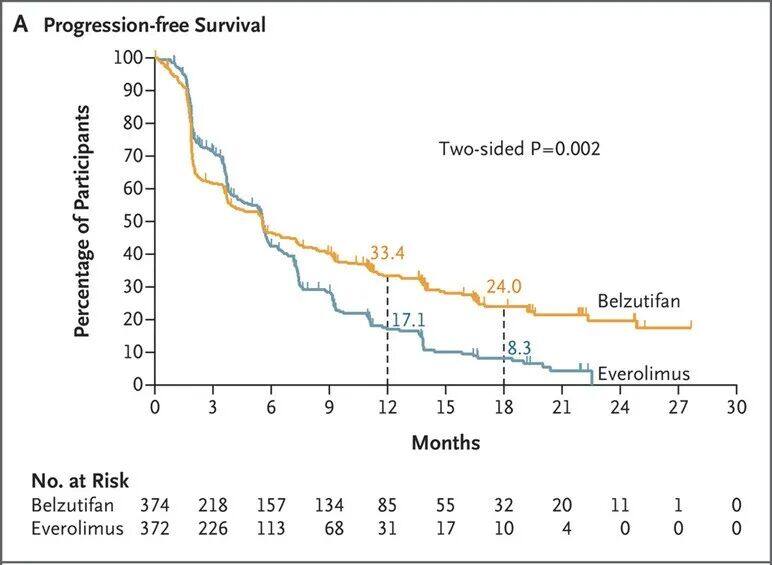
▲BPFS Results of Elzutifan in Phase 3 Trials (Image Source: Reference [1])
In addition,The objective response rate in patients treated with belzutifan exceededLiveSex ControlSix times the number of patients in the group.21.9% of patients in the belzutifan group (95% CI:17.8-26.5) achieved objective response, compared to only 3.5% (95% CI:1.9-5.9),The difference between the two is statistically significant (P<0.001).At the second interim analysis with a median follow-up time of 25.7 months, the median OS for patients in the belzutifan group and the active control group were 21.4 months and 18.1 months, respectively; at 18 months, 55.2% and 50.6% of subjects were alive, respectively (HR=0.88; 95% CI: 0.73-1.07; P=0.20).
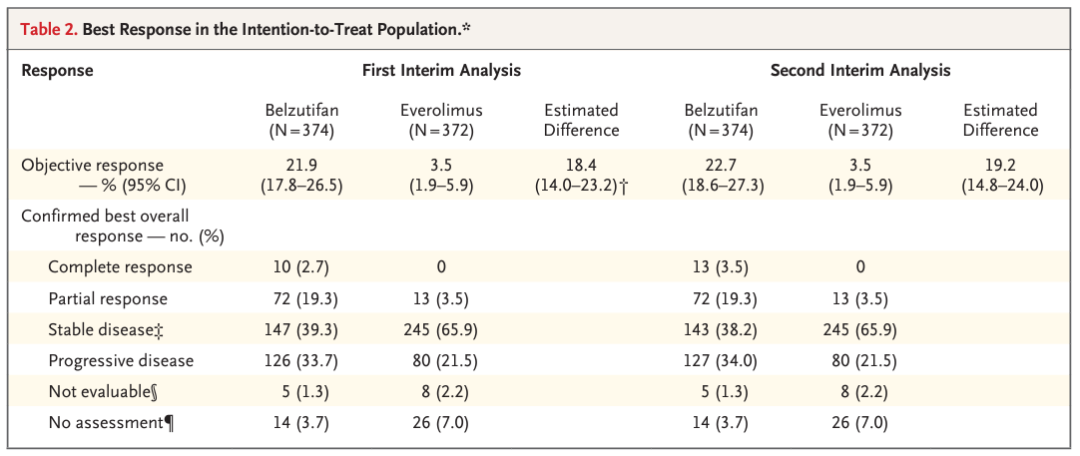
▲BSummary of elzutifan's trial efficacy results (Image source: Reference [1])
In terms of safety, 61.8% of patients in the belzutifan group (3.5% were grade 5) and 62.5% of patients in the active comparator group (5.3% were grade 5) experienced adverse events of grade 3 or higher for any reason. Treatment was discontinued due to adverse events in 5.9% and 14.7% of participants, respectively. No new safety signals were identified with belzutifan.

Belzutifan is the first HIF-2α inhibitor to receive FDA accelerated approval, which has been approved in the United States, the United Kingdom, Canada, and several other countries and regions, is indicated for adult patients with von Hippel-Lindau (VHL) disease who require treatment.DiseasePatients, particularly those with associated RCC, central nervous system hemangioblastoma, or pancreatic neuroendocrine tumors who do not require immediate surgery.In December 2023, belzutifan was approved by the U.S. FDAApprovalBecoming the first approved HIF-2α inhibitor for patients with advanced RCC.The approval of Belzutifan marks the first new mechanism therapy for advanced RCC since 2015.
Reference Reading:Covered in Tumors All Over the Body, Breakthrough Therapy Gives These Patients a New Lease on Life
MSD is also continuously expanding the application potential of belzutifan, actively promoting its use as a monotherapy or in combination with the PD-1 inhibitor pembrolizumab in RCC, endometrial cancer, esophageal cancer, liver cancer, prostate cancer, and rare cancers.Currently,Clinical trials of belzutifan for endometrial cancer, esophageal cancer, liver cancer, prostate cancer, and rare cancers have all entered phase 2., looking forward to more good news and benefiting more patients as soon as possible.
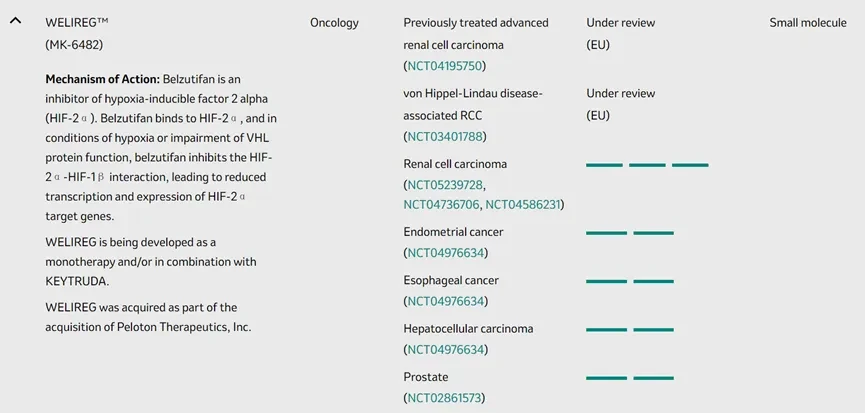
▲Clinical Development Pipeline of Belzutifan (Image Source: MSD Official Website)
In addition, the industry is also continuously advancing the development of RCC therapies. BesidesBelzutifan, there are currently multiple RCC therapies in clinical stages under development. In terms of small molecule therapies, includingDeveloped by ExelixisA New Generation of Oral TKI Therapy: Zanzalintinib.Zanzalintinib can inhibit the activity of receptor tyrosine kinases associated with cancer growth and spread, including VEGF receptors, MET, AXL, and MER.The results of the Phase 1b trial published in November last year showed,At a median follow-up time of 8.3 months,32 Treated Patients Added to the Expanded CohortClear Cell RCCAmong the patients, 12 achieved confirmed PR, with an ORR of 38% and a disease control rate (DCR) of 88%.AndHUTCHMED and Takeda jointly developedVEGFR-1, -2, and -3 inhibitorsFruzaqla (fruquintinib) is also being evaluated for its potential in treating RCC patients in registrational studies.

AndIn recent years, the rise of new molecular therapies has also brought benefits to RCC patients.Potential New Hope for Treatment.Among whichOne of the most eye-catching,That is byModerna and MSD jointly developedIndividualized mRNA Cancer Vaccine mRNA-4157 (V940), a therapy for treating RCC patientsPhase 2 study has recently been initiated. In May this year,Arsenal Biosciences Announces First Patient Dosed with AB-2100, a T-cell Therapy for the Treatment of Clear Cell RCC, in a Multicenter, Open-label Phase 1/2 Clinical TrialAB-2100 utilizes the company's CITE (CRISPR Electroporation Integration of Transgenes) technology to engineer T cells, enabling them to selectively target tumors and overcome the suppressive tumor microenvironment.These characteristics will potentially enable the patient's immune system to eliminate RCC cells without harming normal tissues. Additionally,Adicet Bio also announced in June this year that its γ-δ CAR-T cell candidate therapy ADI-270, developed for CD70-positive cancers, is planned to enter a Phase 1 clinical trial in the second half of 2024 for the treatment of relapsed/refractory RCC, to evaluate the safety and anti-tumor activity of ADI-270 in RCC patients.

▲To learn more about the application of cutting-edge technologies in the biopharmaceutical industry, please long-press and scan the QR code above to access "WuXi Live Studio" and watch live discussions and exciting replays on related topics.
References:
[1] Choueiri TK, Powles T, Peltola K, de Velasco G, Burotto M, Suarez C, Ghatalia P, Iacovelli R, Lam ET, Verzoni E, Gümüş M, Stadler WM, Kollmannsberger C, Melichar B, Venugopal B, Gross-Goupil M, Poprach A, De Santis M, Schutz FA, Park SH, Nosov DA, Porta C, Lee JL, Garcia-Del-Muro X, Biscaldi E, Manneh Kopp R, Oya M, He L, Wang A, Perini RF, Vickery D, Albiges L, Rini B; LITESPARK-005 Investigators. Belzutifan versus Everolimus for Advanced Renal-Cell Carcinoma. N Engl J Med. 2024 Aug 22;391(8):710-721. doi: 10.1056/NEJMoa2313906. PMID: 39167807.
[2] Pivotal study supports belzutifan approval for patients with advanced kidney cancer. Retrieved August 22, 2024 from https://www.eurekalert.org/news-releases/1055274
[3] FDA Approves Merck’s WELIREG® (belzutifan) for the Treatment of Patients With Advanced Renal Cell Carcinoma (RCC) Following a PD-1 or PD-L1 Inhibitor and a VEGF-TKI. Retrieved December 14, 2023 from https://www.merck.com/news/fda-approves-mercks-welireg-belzutifan-for-the-treatment-of-patients-with-advanced-renal-cell-carcinoma-rcc-following-a-pd-1-or-pd-l1-inhibitor-and-a-vegf-tki/
Disclaimer: The content team of WuXi AppTec focuses on introducing the research progress in global biopharmaceuticals and health. This article is for information exchange only, and the views expressed in the article do not represent the position of WuXi AppTec, nor does it mean that WuXi AppTec supports or opposes the views in the article. This article is not a recommendation for treatment plans. If you need guidance on treatment options, please visit a正规 hospital.
Copyright Statement: This article is from the content team of WuXi AppTec. Individuals are welcome to share it on their social media circles, but unauthorized reproduction by media or institutions in any form to other platforms is prohibited. For authorization to reproduce, please reply with "reprint" on the WeChat Official Account of "WuXi AppTec" to obtain reprint guidelines.


Share,PointLike,In View, Focusing on Global Biomedical Health Innovation