Novo Nordisk Launches Monthly Subcutaneous IL-6 Inhibitor Ziltivekimab in Phase 3 ARTEMIS Trial for Acute Myocardial Infarction in China

Novo Nordisk
Insulin Developer and Manufacturer
The official website of China Drug Clinical Trial Registration and Information Disclosure Platform recently announced that Novo Nordisk has registered to initiateA global, multi-center (including China) Phase 3 clinical trial named ARTEMIS aims to evaluate ziltivekimab versus placebo.Impact on Cardiovascular Outcomes in Patients with Acute Myocardial Infarction。
Ziltivekimab is aInterleukin-6 (IL-6) inhibitor.The ProductWith an extended half-life, it can be administered once a month via subcutaneous injection.。According to the public information, this time in China launchedARTEMISThe study plans to enroll 10,000 subjects across more than 600 research centers globally, with 100 subjects to be enrolled in China.
 Screenshot source:China Drug Clinical Trial Registration and Information Disclosure Platform Official Website
According to the pipeline information on Novo Nordisk's official website, currentlyziltivekimabForAcute Myocardial Infarction (AMI), Atherosclerotic Cardiovascular Disease (ASCVD) with Chronic Kidney Disease and Inflammation, Heart Failure with Preserved Ejection Fraction (HFpEF)All three major indications are in Phase 3 clinical trials.
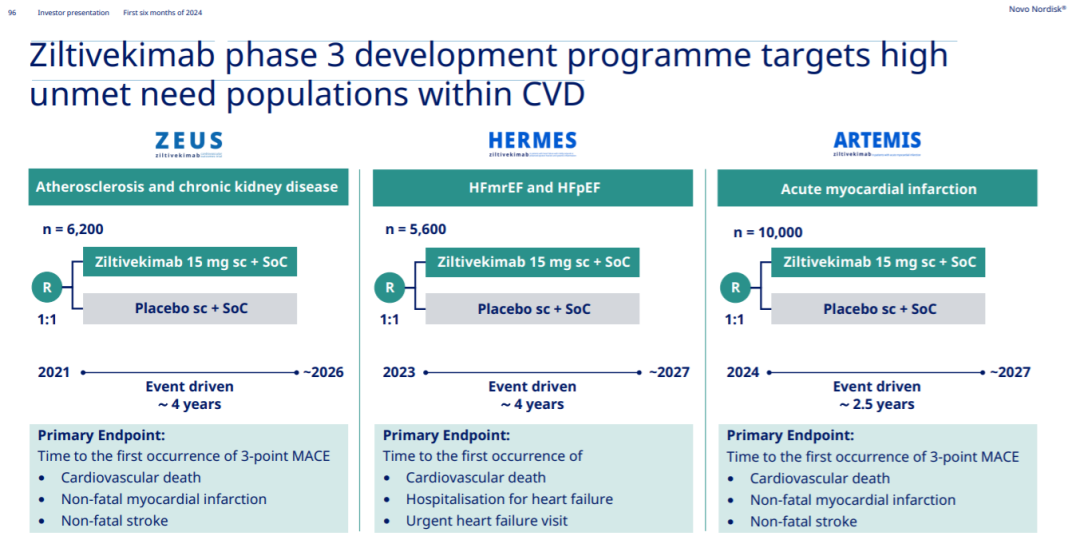 ▲Three Phase 3 clinical trials of ziltivekimab are currently underway (Screenshot source: Novo Nordisk's official website)
According to the official website of the Chinese Clinical Trials Registry and Information Disclosure Platform, Novo Nordisk has also previously initiatedTwo Phase 3 Clinical Trials of Ziltivekimab, NamelyThe Chinese part of the HERMES study and ZEUS study. This timeLaunchedNew Clinical ResearchARTEMIS Study TargetsAcute Myocardial InfarctionIndications, the studyLaunched globallyIn June 2024, it is expected to be completed in September 2026.
Acute Myocardial Infarction (AMI) is a life-threatening condition where the blood flow to the heart muscle is suddenly reduced or completely cut off by one or more blood clots in the coronary arteries. AMI often requires immediate treatment, as any delay in intervention can lead to irreversible myocardial damage and result in poor clinical outcomes. Public data shows that despite improvements in AMI management in recent decades, mortality rates remain high.
According to literature reports, an increasing number of studies and clinical evidence have now been established.Pro-inflammatory PathwayThe Importance in the Pathophysiology of Coronary Artery Disease. In recent years, the role of the pro-inflammatory cytokine IL-6 in acute inflammation post-AMI has increasingly drawn attention. Previous clinical studies have already demonstrated the preliminary efficacy of early IL-6 blockade within 6 hours after symptom onset in ST-segment elevation myocardial infarction (STEMI).
Looking Forward to IL-6 InhibitorsZiltivekimab's subsequent clinical research is proceeding smoothly, bringing new treatment options to patients as soon as possible.
[1] Official Website of the Chinese Drug Clinical Trial Registration and Information Disclosure Platform. Retrieved Aug 21, 2024, from https://www.cde.org.cn/main/xxgk/listpage/9f9c74c73e0f8f56a8bfbc646055026d
[2]Michael A Matter. et al. (2024) Inflammation in acute myocardial infarction: the good, the bad and the ugly.Eur Heart J. doi: 10.1093/eurheartj/ehad486
This article is from the content team of WuXi AppTec. Individuals are welcome to share it on their social media, but unauthorized reproduction by media or organizations in any form on other platforms is strictly prohibited.For reprint authorization and other cooperation needs, please contact wuxi_media@wuxiapptec.com.
Disclaimer: The content team of WuXi AppTec focuses on introducing the research progress in global biopharmaceuticals and health. This article is for information exchange purposes only, and the views expressed in the article do not represent the position of WuXi AppTec, nor does it indicate that WuXi AppTec supports or opposes the views in the article. This article is not a recommendation for treatment plans. If you need guidance on treatment options, please visit a regular hospital.