

Blind Box Unlocks a Jackpot: A Paradigm Shift in Lung Cancer Therapeutics

Johnson & Johnson
Medical Device R&D and Manufacturer

The third-generation EGFR-TKI may be encountering the strongest resistance.
Osimertinib sales remained strong in H1 2024, with global revenue reaching $3.2 billion, ranking fifth among all anti-cancer drugs.
The patent period for Osimertinib extends beyond 2032, but the biggest impact does not come from me-too or even me-better drugs in the same category; rather, it comes from more cutting-edge competitors.
Recently, Johnson & Johnson's EGFR-MET bispecific antibody Amivantamab successfully head-to-head defeated Osimertinib in the latest Phase III clinical trial, which may indicate the rise of a new generation of drugs led by EGFR bispecific antibodies.
Market investors used to often ponder the opportunities after osimertinib resistance. Now, even the market for osimertinib as an EGFR-TKI could face disruption from next-generation therapies. Not only amivantamab, but also more novel ADC therapies are impacting this market. The landscape of the lung cancer field is on the verge of a major shift.
01
The Successor Who Defeated the King of Lung Cancer Drugs
According to the data, non-small cell lung cancer (NSCLC) accounts for approximately 85% of lung cancer indications. The epidermal growth factor receptor (EGFR) mutation subtype represents 40% to 50% of the NSCLC population in China, dominating the field. A significant part of China's R&D history in the fight against lung cancer has been the iterative development of small-molecule EGFR-TKI targeted drugs. In the past, Icotinib, a first-generation targeted drug from Betta Pharmaceuticals, led China's innovative drug industry through its formative years. Over the past decade, the emergence of third-generation drugs like Osimertinib revolutionized the treatment landscape, sweeping through the NSCLC indication market and rapidly advancing from later-line to front-line therapy.
In November 2015, Osimertinib was approved by the U.S. FDA and launched in the United States. It was introduced to the Chinese market in 2017 and included in China's medical insurance system. In 2019, it was officially approved in China for first-line treatment of EGFR mutation-positive locally advanced or metastatic NSCLC. In China, its total sales reached 7 billion yuan in 2023. For comparison, the sales of Hansoh Pharma's Almonertinib were 3.5 billion yuan in 2023, while Elevar Therapeutics' Furmonertinib reached approximately 2 billion yuan, with Osimertinib significantly ahead.
However, there are two key future trends in the field of lung cancer. One is the subsequent treatment after osimertinib resistance, and the other is the combination use of small molecule targeted drugs in the future.
Regarding the first point, currently, whether in China or abroad, breakthroughs are being sought. In China, Tongyuan Kang Pharmaceutical, which was listed in the past few days, has already initiated Phase III clinical trials in 2022 for its core pipeline — the deuterated small molecule TKI inhibitor TY-9591 — in a head-to-head comparison with Osimertinib, targeting the top lung cancer drug. Compared to Osimertinib, one of the significant differences of TY-9591 lies in its pharmacokinetic properties, with stronger stability, a marked reduction in the production of the toxic metabolite AZD5104 (by 60%), reduced toxic side effects, and a significant increase in TY-9591 exposure in the body (73% higher than Osimertinib).
TY-9591 is expected to submit its marketing application in 2025. This drug is regarded as a new hope for later-line treatment after osimertinib resistance.
Of course, besides TY-9591, which is considered a fourth-generation EGFR-TKI, osimertinib is also seeking different approaches to address the issue of drug resistance. This includes screening for different resistance mutation gene types and combining corresponding small-molecule inhibitors in an effort to reverse osimertinib resistance.
However, if we broaden the perspective, the treatment after drug resistance may be addressed through combination with immunotherapy or ADC therapy. The combination of small molecules and next-generation immunotherapy can not only solve the problem of drug resistance but also directly expand to front-line medication, significantly increasing the market space for bispecific antibodies and smoothly making bispecific antibodies and third-generation TKI inhibitors a golden pair, bringing new therapies for NSCLC.
Johnson & Johnson's Amivantamab (Rybrevant) is a bispecific antibody targeting EGFR-MET. It, along with Lazertinib (developed by South Korea's Yuhan Corporation and manufactured by Johnson & Johnson), another third-generation targeted therapy, has gone head-to-head against Osimertinib in the global multicenter Phase III clinical trial, MARIPOSA.
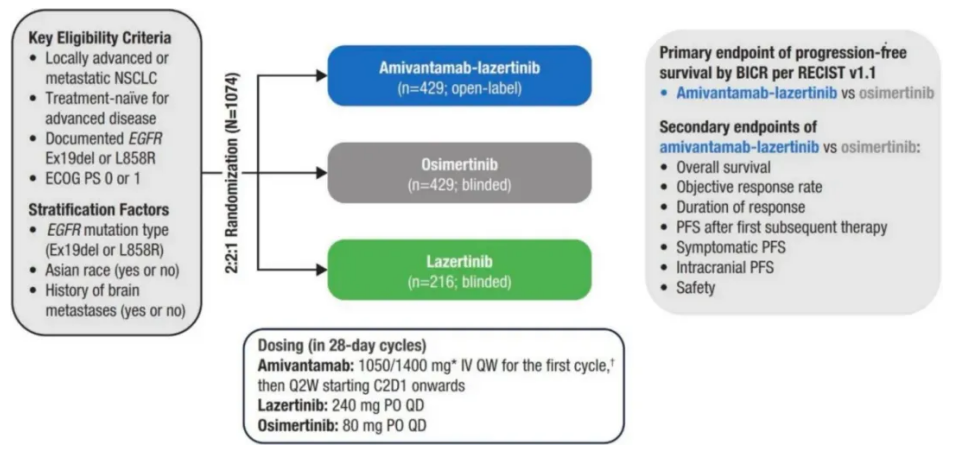
In this clinical trial, 1,074 patients were randomly assigned in a 2:2:1 ratio, with 429 patients receiving the bispecific antibody and lazertinib combination, 429 patients receiving lazertinib alone, and another 216 patients receiving osimertinib. The primary endpoint of the study is the progression-free survival (PFS) of the amivantamab + lazertinib group compared to the osimertinib group.
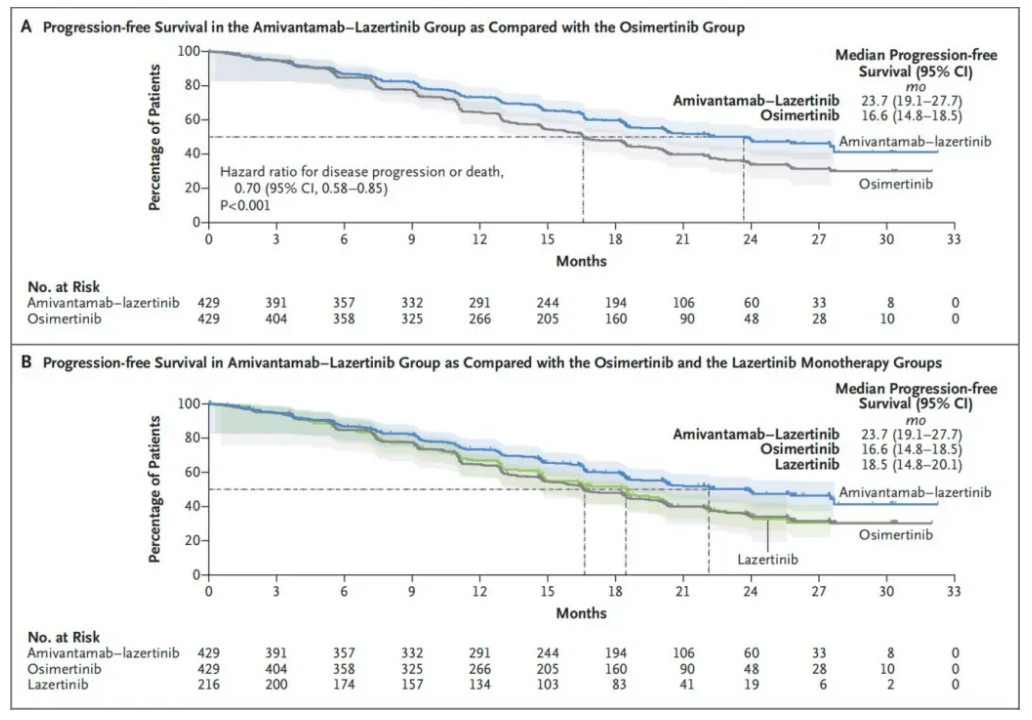
As shown in the figure, the main clinical research results were released at the ASCO conference. At the final primary endpoint of the trial, a more pronounced curve difference can be seen in PFS. The median PFS for the amivantamab + lazertinib group was 23.7 months, compared to 16.6 months for the osimertinib group, with 18-month and 24-month PFS rates of 60% vs 48% and 48% vs 34%, respectively.
Later, at the recent WCLC 2024 conference, Johnson & Johnson announced subsequent follow-up OS data, further demonstrating the significant advantage of combination therapy. The median OS for the Amivantamab + Lazertinib group has not yet been reached, while the median OS for the Osimertinib group was 37.3 months. At 24 months, the survival rates for the Amivantamab + Lazertinib group and the Osimertinib group were 75% and 70%, respectively; the corresponding values at 36 months were 61% and 53%.
In view of the significant advantages of this therapy, on August 19, the FDA approved amivantamab in combination with lazertinib for the first-line treatment of adult patients with locally advanced or metastatic NSCLC harboring epidermal growth factor receptor (EGFR) exon 19 deletions or exon 21 L858R substitution mutations.
The era of multi-resistant combination third-generation TKI inhibitors surpassing single TKI inhibitors has thus arrived.
02
Double Antibody——A New Era in Lung Cancer Treatment
Although Janssen’s Rybrevant (amivantamab) has been on the market for several years (receiving FDA accelerated approval in May 2021) for the treatment of adult patients with NSCLC harboring EGFR exon 20 insertion mutations whose disease has progressed on or after platinum-based chemotherapy, it was the world's first bispecific antibody approved for the treatment of solid tumors at that time based on promising data from its Phase II clinical trial. However, its commercial performance over the past few years has not been particularly impressive (due to the limited indication).
But Johnson & Johnson is very confident about it. In December 2023, during the Investor Day, Johnson & Johnson stated that the sales peak of Amivantamab in the lung disease portfolio is $5 billion, with a target market share of 50% in the first-line setting. Now that it has head-to-head defeated Osimertinib, and with Johnson & Johnson's global commercialization channel layout, reaching this figure is no longer a difficult task.
Of course, now that there is such a high level of certainty in this data, perhaps we should broaden our perspective from the immediate track to the vast expanse of the entire market and recognize the impact of bispecific antibodies on third-generation targeted therapies in the NSCLC market.
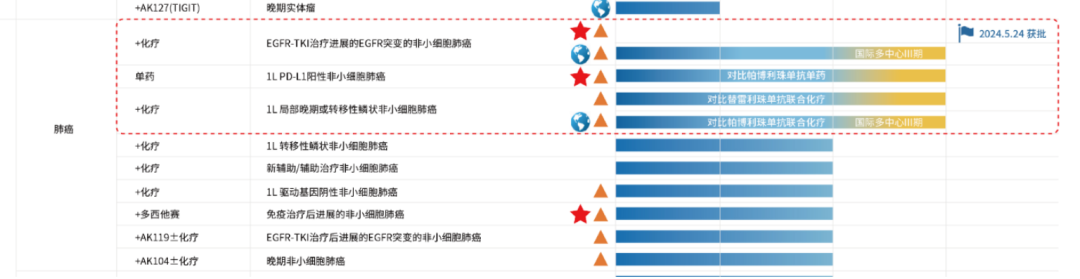
Among them, the most noteworthy is naturally Akeso's AK112. As a bispecific antibody targeting PD-1 and VEGF, AK112’s main focus is on combination immunotherapy. In May this year, its Phase III clinical data was released, accompanied by significant fluctuations in the stock price. The final outcome, which most investors have seen, showed that after gaining approval for second-line treatment of non-small cell lung cancer (NSCLC) in combination with chemotherapy, it quickly outperformed Keytruda (K-drug) in an international multicenter head-to-head Phase III clinical trial. Not only did it receive rapid approval at the end of May for second-line treatment of NSCLC, but by the end of July this year, it was directly approved for first-line treatment of NSCLC.
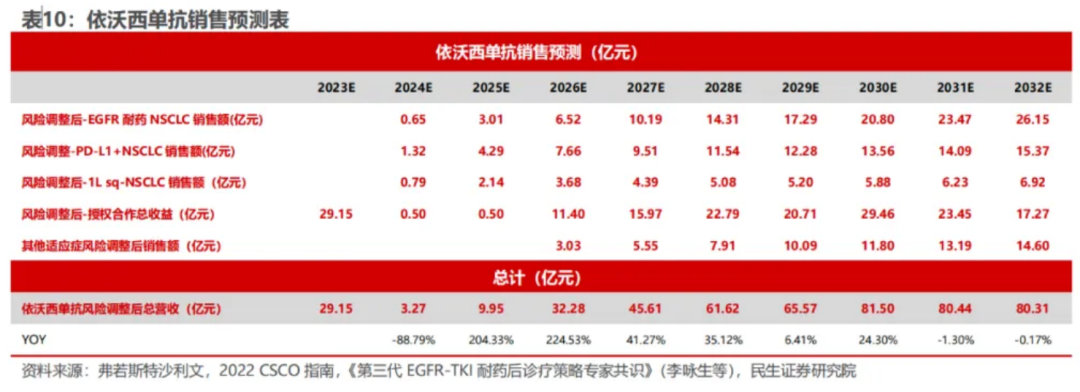
The sales model of Akeso can be broken down according to the previous model from the Minsheng Securities Research Institute. In the final sales forecast, the peak sales of later-line indications for NSCLC resistance can reach 2.615 billion yuan, while the total peak sales will reach 8.15 billion yuan by 2030. However, these peak sales figures have been discounted by a coefficient of R&D success, and now the drug's successful Phase III clinical trial has become a certainty. If not discounted, its peak sales in 2030 will reach 8.74 billion yuan.
03
Diversified Treatment is the Future
For NSCLC, the previous third-generation targeted drugs used as monotherapy have significantly extended patients' survival periods, but the types of treatment drugs are relatively limited. In the future, the scope of targets in the lung cancer field needs to be broadened—less than half of the Chinese patient population has EGFR mutations, and the remaining patients also need a chance to survive. The combination of immunotherapy with third-generation targeted drugs has indeed shown promising results, while the emergence of novel ADCs has brought more variables to the evolving landscape of lung cancer treatment.
ADCs targeting Her2, Trop2, Her3, and c-Met have shown significant progress in the field of lung cancer.
The incidence rates of HER2 mutations, HER2 amplifications, and HER2 overexpression in NSCLC patients are 1%~6.7%, 2%~22%, and 7.7%~23%, respectively. HER2-targeted ADCs were among the earliest targets to be commercialized and are currently the most successfully commercialized targets. DS-8201 was able to continue its growth after encountering a revenue plateau, thanks to the approval of the NSCLC indication in 2022.
Although the probability of HER2 mutations in NSCLC may not be as high as that of EGFR, the targets of ADC drugs are continuously expanding. For NSCLC with different mutations, there is always an ADC that can precisely target them.
Telisotuzumab Vedotin (ABBV-399) is one of the rising stars among ADCs for lung cancer. ABBV-399 primarily targets c-MET, the same as one of the antibodies in Johnson & Johnson's bispecific antibody. The overexpression of the c-Met protein occurs in 13.7%-63.7% of NSCLC cases, and the incidence of c-Met protein overexpression in patients with EGFR-mutated advanced non-small cell lung cancer who have been treated with targeted drugs is 30.4%-37.0%. Additionally, c-Met protein overexpression is associated with poor prognosis (data sourced from the 2022 Chinese Expert Consensus on MET Clinical Testing in Non-Small Cell Lung Cancer).
In January 2022, ABBV-399 was granted Breakthrough Therapy Designation by the FDA for the treatment of patients with advanced or metastatic c-Met overexpressing EGFR wild-type non-squamous NSCLC who have progressed after platinum-based therapy. The Phase III M18-868 clinical trial is expected to be completed in June 2025.
According to the results of the ABBV-399 single-arm Phase II LUMINOSITY trial announced at the end of November 2023, among 122 evaluable patients, the ORR was 36.5% in the non-squamous EGFR wild-type group and reached 52.2% in the c-Met high group.
Of course, in the field of ADC therapies, the pioneer Daiichi Sankyo is indispensable. Currently, its promising pipeline in the lung cancer field is U3-1402, which has already entered global multi-center clinical trials. The target of U3-1402 is HER3, which is expressed in approximately 83% of primary NSCLC cases and represents a rare high-quality target in NSCLC.
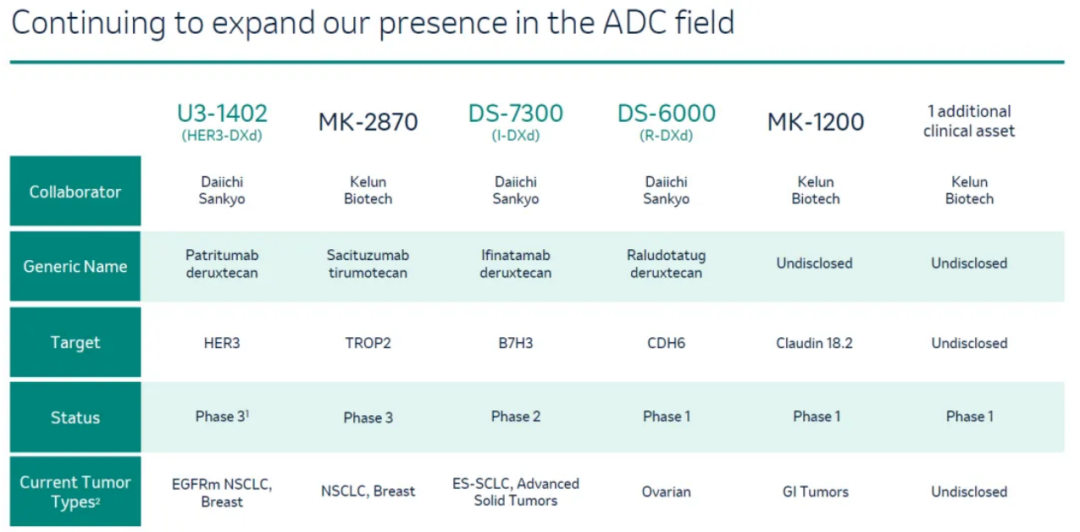
MK-2870 (also known as Kelun Biotech's SKB264) targets Trop2, which is currently the second most popular target in the ADC field. The potential of this target is no less than that of HER2, with a more diverse range of indications available for development. In October 2023, its global Phase III clinical trial for NSCLC was initiated.
Conclusion:The Treatment of Non-Small Cell Lung Cancer Over the Past Two Decades: From Uniformity to Diversity, from Single-Agent to Combination Therapy. The emergence of the first-generation TKI inhibitors broke the deadlock of chemotherapy in the past. Subsequently, TKIs have been continuously iterated, leading to the development of second- and third-generation inhibitors. Later, the advent of PD-1 brought immunotherapy into the treatment of lung cancer.
Nowadays, it is no longer the era when small-molecule inhibitors monopolized the lung cancer market. This era includes multi-specific antibodies, ADCs, and various combination therapies. These treatments interweave to form a therapeutic matrix, providing more possibilities for lung cancer patients and opening up a more diversified space for this market.

Click "PharmSnap" below to follow more exciting content.
Disclaimer
The push rules of WeChat Official Accounts have changed again. If you don't tap"Views"Or not set to"Star Mark", we might just dissipate in the vast sea of text~ Click here, don't miss out on the latest news from PharmaDJ!??