

Novartis Inks Nearly $1 Billion Deal to Advance Subcutaneous Monoclonal Antibody Delivery Technology with Lindy Biosciences

Lindy Biosciences
Protein Therapeutics Developer

Novartis
Drug Development and Manufacturing
On August 28, 2024, it was reported that Lindy Biosciences, a biotechnology company specializing in innovative drug formulation and delivery technologies, announced an exclusive global licensing agreement and strategic collaboration with Novartis AG, a subsidiary of Novartis. The focus of this collaboration is to leverage Lindy Biosciences' proprietary technology to transform certain innovative drugs from Novartis’ portfolio into more convenient self-administered subcutaneous injections. It is reported that by providing high-concentration biologics, Lindy Biosciences' proprietary technology platform significantly increases the maximum dosage for a single subcutaneous injection, which is expected to reduce healthcare costs while improving patient comfort, convenience, and treatment adherence.
According to the agreement, Lindy Biosciences will receive an upfront payment of $20 million and is eligible for up to $934 million in milestone payments and tiered royalties, with a cumulative amount approaching $1 billion.
Currently, over half of the antibody therapeutics in clinical settings are administered via intravenous injection, primarily because the required therapeutic doses are typically high and cannot be formulated into a volume suitable for subcutaneous injection. However, Lindy Biosciences' proprietary platform technology has the potential to change this paradigm, enabling patients to self-administer medication at home using pre-filled syringes or auto-injectors.
Duke University Research Commercialization Project Directly Addresses Pain Points in Monoclonal Antibody Delivery
According to the official website of Lindy Biosciences, the company was founded in 2016 and is headquartered in Morrisville, North Carolina, USA. It was initially funded by a loan from the North Carolina Biotechnology Center (a $200,000 Small Business Research Loan) and was incubated based on a patent technology from Duke University. Initially, the company further developed its core technology platform at Southeast TechInventures, an innovation lab, and received over $800,000 in Small Business Innovation Research (SBIR) grants from the U.S. National Science Foundation and the U.S. National Institutes of Health.
Currently, Lindy Biosciences has completed a US$1.6 million Series A financing round, led by Alumshares and BlueTree Allied Angels, with participation from IAG Capital Partners and Next Act Fund.
Dr. Deborah Bitterfield, founder and CEO of Lindy Biosciences, holds a Ph.D. in Materials Science from Duke University and has over 10 years of experience in the pharmaceutical/biotech industry, with business spanning a wide range of strategic and operational areas including biotherapeutics and medical devices. Notably, prior to founding Lindy Biosciences in 2017, Bitterfield joined Southeast TechInventures, collaborating with university researchers to further develop promising biotechnologies. Subsequently, she naturally initiated projects at Duke University and brought scientific research results to fruition by establishing the emerging company Lindy Biosciences.
The growth process of Lindy Biosciences has witnessed a significant increase in global bio-based therapeutic applications and internal technology transformation trends. Major changes are occurring in the drug development and manufacturing processes of pharmaceutical companies and manufacturers. However, the main challenge these biologics face is the difficulty in maintaining shelf life or storage stability.
According to a paper published by the Lindy Biosciences research team in the Journal of Pharmaceutical Sciences, despite the widespread use of freeze-drying and spray-drying technologies in the biopharmaceutical industry, producing solid-state biologics remains a challenging task. The challenges include protein stability (thermal stress), high capital costs, particle design/controllability, reduced processing time, and manufacturing difficulty factors (scalability, yield improvement, aseptic operations, etc.). Therefore, the research team must continuously strive to improve existing methods and explore novel dehydration/powder formation technologies.
Lindy Biosciences' self-developed platform, Microglassification™, is a dehydration technology platform that uses solvent extraction to rapidly dehydrate protein formulations at ambient temperature. This eliminates the thermal stress encountered by biologics during traditional lyophilization and spray drying, gently removing water from protein or other biologic solutions to form solid, spherical, amorphous microbeads. In this dried state, biologics are stable enough for long-term storage, transportation, or incorporation into drug delivery formulations.
In addition, unlike preservation methods such as lyophilization, Microglassification™ has no requirements for processing conditions and is almost universally applicable to various scenarios. At the same time, unlike precipitation or crystallization processes, the particle size, dehydration rate, and density of protein formulations are not significantly affected by molecular solubility during the Microglassification™ dehydration process. The R&D team at Lindy Biosciences also compared the molecular stability of a monoclonal antibody formulation processed by lyophilization with the same formulation processed using Microglassification™. Both powders were stored at 40°C for 3 months and at 25°C for 6 months. Both dehydration methods exhibited similar chemical stability, including monomer percentage, charge variants, and antigen binding. These results indicate that Microglassification™ can be used to produce stable solid-state monoclonal antibody formulations.
Currently, Microglassification™ has been able to ensure the production of high-concentration biologics. Taking monoclonal antibodies (mAbs) as an example, dissolving the antibody in a small enough volume for subcutaneous injection can result in a solution that is too viscous to pass through a needle or too unstable to maintain a reasonable shelf life. The Microglassification™ platform, by combining the stability of solid mAbs with the beneficial properties of injectable suspensions, can significantly improve the administration of biologic therapeutics.
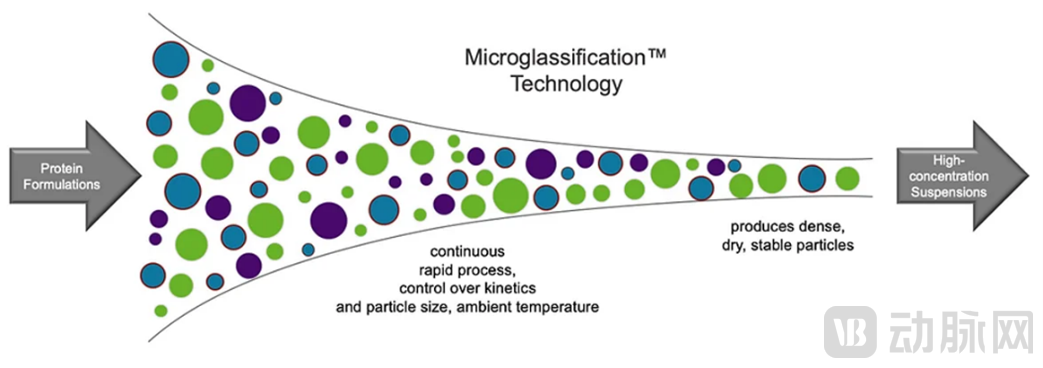
Schematic diagram of the Microglassification™ technology platform, image sourced from the Lindy Biosciences official website
In this way, it becomes possible for subcutaneous injections to replace intravenous injections on a large scale, offering greater convenience and broader applicability. Lindy Biosciences hopes that through its core technology platform, a wide range of antibody therapies can be self-administered at home via subcutaneous injection, rather than relying on slow intravenous (IV) infusions in acute care settings. This approach will reduce the cost of drug administration, improve patient comfort and compliance, and enable new high-dose molecules to enter the market.
Improved Drug Delivery Joins Competition, Novartis' Self-Injectable Medication Becomes New Growth Point
Currently, monoclonal antibodies have become one of the most important therapeutic proteins and are used to treat a variety of diseases, such as cancer, inflammation, and autoimmune diseases. However, the identification of new drug targets is a major challenge in antibody development. Moreover, monoclonal antibody drugs also have limitations that affect their clinical use. The most prominent challenge is the short pharmacokinetic properties and stability issues of monoclonal antibodies during manufacturing, transportation, and storage, which may lead to aggregation and protein denaturation. However, the development of protein formulations, especially long-acting protein formulations, must maintain protein stability and be able to provide a sufficiently large dose over an extended period. Therefore, exploring various strategies to improve antibody formulations and dosage forms to enhance efficacy and expand the clinical application scope of monoclonal antibodies has become another trend in innovative drug development.
As of now, approximately 200 antibody therapies have been approved by at least one country's pharmaceutical regulatory agency worldwide. Most of these are administered via intravenous injection, while some are delivered through intraperitoneal injection (e.g., Catumaxomab Injection), intramuscular injection (e.g., Palivizumab Injection), or intravitreal injection (e.g., Ranibizumab Injection). Notably, in recent years, subcutaneous injection has been proven to be a safe and effective method of administration for an increasing number of drugs.
From the perspective of patient medication convenience, subcutaneous injection saves infusion time for patients receiving treatment and has relatively lower medical costs. Moreover, subcutaneous administration can promote home-based medication, alleviating pressure on the healthcare system and reducing the burden on patients.
From the perspective of micro-innovation in drug formulation, subcutaneous injection is also an important part of pharmaceutical companies' patent layout.
In the field of oncology, which accounts for the highest revenue proportion (reaching 42.71%) of Novartis, the development of subcutaneous monoclonal antibody formulations has become a popular trend and is expected to promote the implementation of home-based treatments. Existing studies have shown that the home-based treatment potential of subcutaneous formulations of atezolizumab is significant, especially in remote areas far from hospitals. This expectation is likely to dominate future trends in anti-cancer drug development.
In the autoimmune field, Novartis' Secukinumab and Eli Lilly's Ixekizumab have occupied a dominant position. Especially Secukinumab, which has become one of the key sales products of Novartis' innovative drugs since its launch. This IL-17A monoclonal antibody's initial formulation was a subcutaneous injection, which helped it successfully gain FDA approval for the treatment of various diseases, once dominating the autoimmune market.
At the same time, Novartis has also launched some self-injectable drugs. One of the products in its portfolio around secukinumab is an auto-injector pen called Sensoready, which patients can self-administer after appropriate training. In addition, Novartis' rapidly growing multiple sclerosis drug Kesimpta (ofatumumab) also uses the same device technology. A key highlight during its early market launch was its long-acting formula and at-home injection capability. Both secukinumab and ofatumumab exceeded sales expectations in the second quarter of 2024, indirectly prompting Novartis to raise its full-year profit forecast. Ofatumumab’s annual sales are expected to reach $4 billion.
At a time when the modification of drug delivery routes has become one of the important ways of innovation, formulation development is an integral part of drug product development. Regardless of the form of the drug substance, it must be closely integrated with the final container and drug delivery method to enhance compatibility between the active ingredients and structural materials. Considering Novartis' clear existing product pipeline and promising blockbuster products in the future, continuous focus on innovative drug research and development in four major areas while strengthening drug delivery technology undoubtedly aligns with its strategic details.