

Johnson & Johnson Submits First BLA for Nipocalimab in Generalized Myasthenia Gravis

Johnson & Johnson
Medical Device R&D and Manufacturer
▎WuXiEdited by Kant Content Team
Johnson & Johnson announced today that it has submitted a Biologics License Application (BLA) to the U.S. FDA, seeking the world's first approval for its investigational neonatal Fc receptor (FcRn)-targeted antibody therapy, nipocalimab, for the treatment of generalized myasthenia gravis (gMG). According to previous press releases, this therapy, when used in combination with standard of care (SOC) in antibody-positive gMG patients (including anti-AChR+, anti-MuSK+, and anti-LRP4+ patients), demonstrated improvements in the Myasthenia Gravis Activities of Daily Living (MG-ADL) score.Significantly superior to placeboThe first FcRn blocker.Due tonipocalimabHas the potential to treat a variety of autoimmune diseases,This therapy was listed by the industry media Evaluate earlier this year.Top 10 Potential Blockbuster Therapies in DevelopmentOne of.

Myasthenia gravis is a rare chronic autoimmune disease that affects approximately 700,000 patients worldwide.The pathogenic mechanism of this disease involves immunoglobulin G (IgG) antibodies in the patient's body, which disrupt synaptic transmission between nerves and muscles, leading to muscle weakness and, in severe cases, even life-threatening conditions. More than 85% of patients will develop generalized myasthenia gravis within 24 months after onset, characterized by extreme fatigue and significant difficulties in facial expressions, speech, swallowing, and mobility.
This submission is primarily based on data from the Vivacity-MG3 Phase 3 clinical trial. This double-blind, placebo-controlled study enrolled patients with a broad spectrum of anti-AChR+, anti-MuSK+, and/or anti-LRP4+ antibodies, which account for approximately 95% of the gMG patient population. Analysis showed that the trial met its primary endpoint, demonstrating improvement compared to baseline at weeks 22, 23, and 24.Patients receiving nipocalimab combined with SOC treatment showed an average improvement of 4.70 points in MG-ADL scores., significantly higher than the 3.25 points in patients treated with placebo combined with SOC (P=0.002).For gMG patients, a 1 to 2-point change in MG-ADL score may mean the difference between normal eating and frequent swallowing difficulties, or between shortness of breath at rest and the need for a ventilator.

In addition to achieving this primary endpoint, the trial also met key secondary endpoints:
In Week 22 and Week 24,Quantitative Myasthenia Gravis (QMG) score measurements show,Compared with placebo combined with SOC,Nipocalimab combined with SOC showed significantly greater improvements in strength and function across different muscle groups (P<0.001).
At weeks 22, 23, and 24, nipocalimab combined with SOC showed a significantly higher MG-ADL response (≥2-point improvement from baseline) compared to placebo combined with SOC (P=0.021), further highlighting the potential of nipocalimab treatment in reducing the impact on daily life for patients with gMG.
In the trialnipocalimabThe safety and tolerability were consistent with other trials. The overall incidence of adverse events, serious adverse events, and adverse events leading to discontinuation was similar to that in the placebo combined with SOC group.
According to the press release, nipocalimab is the first FcRn blocker to demonstrate sustained disease control by improving MG-ADL scores over a six-month continuous treatment period (once every two weeks) on the basis of SOC, compared with placebo plus SOC.This is also the longest safety and efficacy assessment of FcRn blockers in the field.
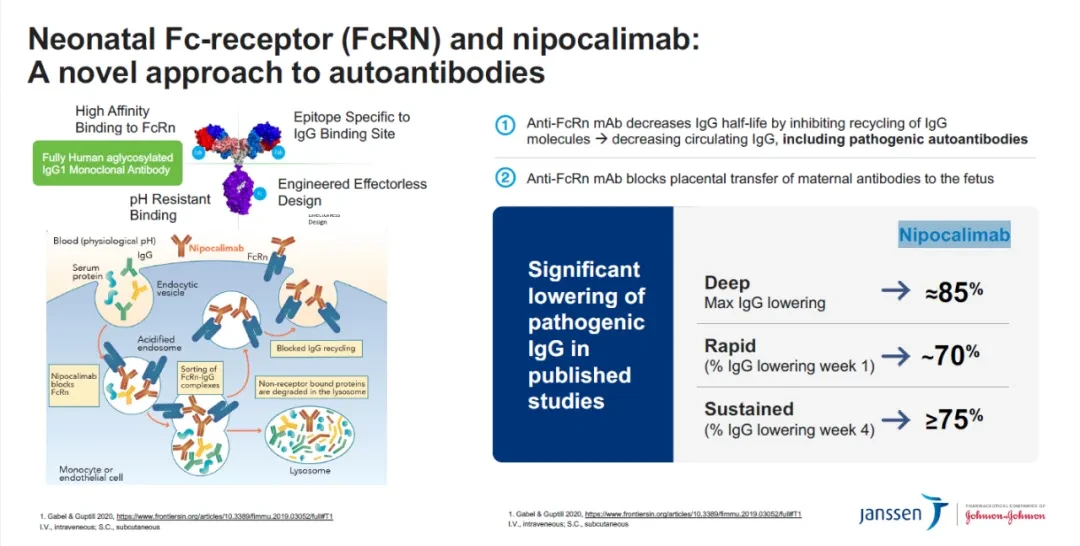
▲Introduction to Nipocalimab (Image Source:Johnson & Johnson Official Website)
Nipocalimab is a potential "best-in-class" antibody therapy targeting the neonatal Fc receptor. By binding to FcRn, it prevents autoantibodies ingested by monocytes and endothelial cells from being released back into the bloodstream, instead degrading them within the cells.Research has shown that it can reduce IgG levels, including pathogenic autoantibodies in the bloodstream, by more than 75%. This antibody therapy has the potential to treat various autoimmune antibody-mediated immune diseases. The FDA has granted this therapy Breakthrough Therapy Designation for treating pregnant women at high risk of severe Hemolytic Disease of the Fetus and Newborn (HDFN), as well as Fast Track designation for treating HDFN, gMG, warm antibody autoimmune hemolytic anemia (wAIHA), and Fetal Neonatal Alloimmune Thrombocytopenia (FNAIT).
In recent yearsMyasthenia GravisThe development of therapies continues to innovate.June 2023, U.S. FDAApprovalByDeveloped by argenxVyvgart Hytrulo Subcutaneous Injection Launched for the Treatment of Adult gMG Patients with Positive Anti-AChR Antibodies. The press release noted,This is the first subcutaneous injection therapy approved by the FDA for this patient population.In October of the same year,Developed by UCBZilbrysq (zilucoplan) alsoObtained US FDAApproval, becomingThe first approved for treatmentgMGA novel macrocyclic peptide C5 complement inhibitor administered subcutaneously once daily to patients.
It is worth noting that, with the application of CAR-T cell therapy gradually expanding from the field of oncology to autoimmune diseases, there are currently multiple treatmentsMyasthenia GravisCAR-TThe therapy is being clinically evaluated. In March this year,Caribou Biosciences Announces Full-human Targeting BCMA CAR-T Cell Product Idecabtagene Vicleucel Injection for TreatmentResults of refractory myasthenia gravis patients published inEMBO Molecular MedicineJournal.Clinical symptoms of 2 subjects continued to improve for more than 18 months; limb strength and vital capacity significantly improved starting from 3 months after the infusion of Idecabtagene Vicleucel Injection, with MG-ADL,QMGMultiple scores continue to improve.In July this year,Cartesian TherapeuticsAnnouncing itsPotential "First-in-Class" mRNA-Engineered CAR-T Cell TherapyDescartes-08 ingMGPhase 2b Clinical Trial in Patients Shows Positive ResultsTop-line Results。The trial met its primary endpoint, with 71% (10/14) of patients receiving Descartes-08 treatment achieving a composite score for myasthenia gravis at month 3.Score(MGC) improved by 5 points or more, while this proportion was only 25% (3/12, p=0.018) in the placebo group.And this month,Kyverna Therapeutics Announces Second Quarter 2024 Financial ResultsAnnouncement,Accept its main productAutologous CD19-Targeted CAR-T TherapyKYV-101The clinical disease symptoms of myasthenia gravis patients disappeared one year later.KYV-101 was granted Regenerative Medicine Advanced Therapy (RMAT) designation by the U.S. FDA for the treatment of patients with Stiff Person Syndrome and Myasthenia Gravis.

▲To learn more about the application of cutting-edge technologies in the biopharmaceutical industry, please long press and scan the QR code above to access "WuXi Live Studio" and watch live discussions and exciting replays on related topics.


Share,PointLike,In Progress, Focus on Global Biomedical Health Innovation