Hansoh Pharma Reports H1 Innovation Drug Sales Surge and Holds Cash Reserves Exceeding RMB 21.7 Billion
Hansoh Pharma
Pharmaceutical Research, Production, and Sales

Hansoh Pharma, which started with generic drugs, has achieved a good start in the transition to innovative drugs.
Recently,Hansoh Pharma Releases 2024 Interim Financial Report: Revenue in the First Half of the Year Reached Approximately 6.506 Billion Yuan, a Year-on-Year Increase of About 44.2%; Net Profit was Approximately 2.726 Billion Yuan, a Year-on-Year Increase of 111.5%. The financial report stated that the increase in revenue and net profit was mainly due to the growth in revenue from innovative drugs and collaborative products, attributed to increased sales of innovative drugs and upfront payments from partner GSK.
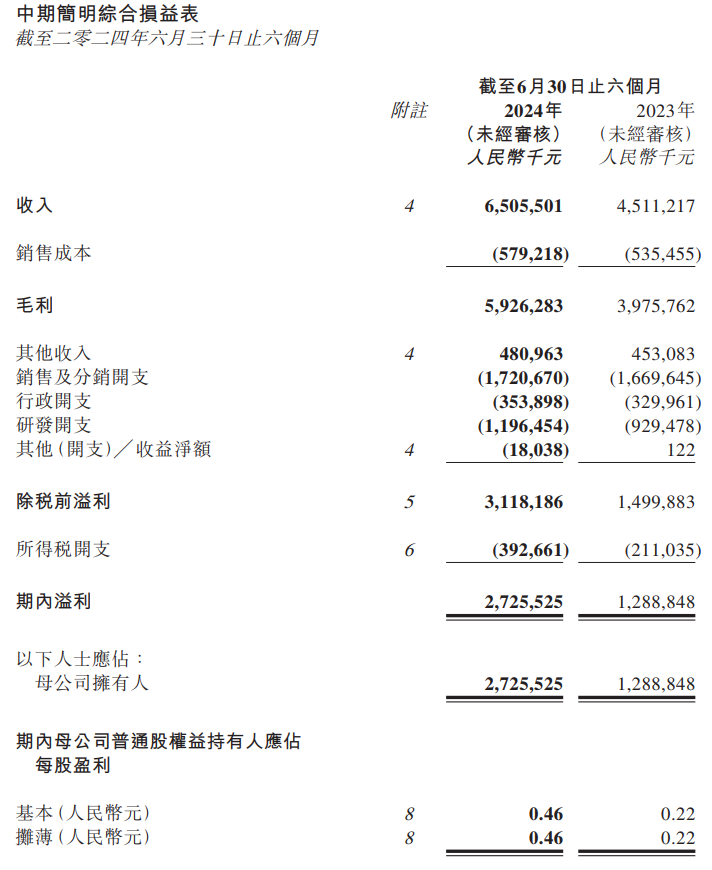
In the first half of 2024, the performance of Hansoh Pharma's innovative drugs and collaborative products reached approximately 5.032 billion yuan, representing a year-on-year increase of about 80.6%, with the proportion of revenue rising to 77.4%.
Among them, in terms of cooperative products, the financial report stated that during the reporting period, the Group incurred a total of BD project expenses which were recorded as R&D expenditures amounting to approximately RMB 130 million, according to the licensing agreement entered into between the Group and GSK in December 2023 (Hansoh Pharma and GSK Reach Exclusive Licensing Agreement for Hansoh Pharma's Self-Developed ADC New Drug HS-20093; Hansohn Pharma to Receive $185 Million Upfront Payment and is Eligible for up to $1.525 Billion in Milestone Payments Upon Achievement of Related Events for This Product) The upfront payment of BD license fee received from GSK, a partner, was recorded as collaboration revenue of US$185 million (approximately RMB 1.3 billion).
In terms of innovative drugs, the financial report stated that during the reporting period, Hansoh Pharma received approval for seven innovative drugs—Almonertinib Mesylate Tablets (Ameile), Flumatinib Mesylate Tablets (Haosen Xinfu), Peglopristide Injection (Fulaimai), Aimitinovir Tablets (Hengmu), Inebilizumab Injection (Xinyue), Pegmoceptide Injection (Shengluolai), and Morinidazole Sodium Chloride Injection (Mailingda)—and their corresponding nine indications have all been included in the National Medical Insurance Catalog.
Among them, Aumolertinib is the star innovative drug of Hansoh Pharma. Aumolertinib is China's first domestically developed third-generation EGFR-tyrosine kinase inhibitor (TKI) innovative drug. In March 2020, it was approved for patients with locally advanced or metastatic NSCLC who had progressed after prior EGFR-TKI treatment and were positive for the T790M mutation; in December 2021, it was approved as a first-line treatment for adult patients with locally advanced or metastatic NSCLC harboring EGFR exon 19 deletions or exon 21(L858R) substitution mutations.
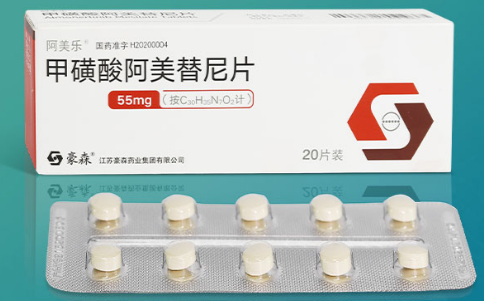
Image Source:Hansoh PharmaOfficial Website
As the first third-generation EGFR inhibitor produced in China, the emergence of Almonertinib has broken the long-term monopoly of AstraZeneca's Osimertinib in the Chinese market and secured a significant first-mover advantage, driving Hansoh Pharma's revenue to continuously increase. In 2023, Hansoh Pharma's total annual income reached 10.104 billion yuan, of which Almonertinib’s annual sales were approximately 3.5 billion yuan, accounting for about one-third of the total revenue. In the first half of this year, Hansoh Pharma's oncology business revenue was about 4.475 billion yuan, accounting for approximately 68.8% of total revenue, with Almonertinib being the main contributor.
However, the first-mover advantage of Ameitinib is gradually being eroded. Following its launch, several other drugs have been approved and started to carve up the market: Furmonertinib from Alis, Befotertinib from Betta Pharmaceuticals/Yifang Biotech, Rezivertinib from Beiruda Pharmaceuticals, and Reveletinib from Sunho Pharmaceuticals. In August this year, the China Drug Trial Registration and Information Disclosure Platform revealed that Alis registered a Phase III clinical trial to evaluate the efficacy and safety of Furmonertinib in combination with platinum-based doublet chemotherapy compared to AstraZeneca's Osimertinib for treating non-squamous non-small cell lung cancer (NSCLC) patients with brain metastases who are positive for epidermal growth factor receptor (EGFR) sensitive mutations. This indicates that Alis' Furmonertinib has initiated a "head-to-head" challenge against Osimertinib, aiming to further capture market share. The drug achieved sales of 1.972 billion yuan in 2023, marking a strong growth of 137.68% year-on-year.
However, Hansoh Pharma is also continuously expanding the indications for Aumolertinib. According to financial reports, in July this year, the third NDA for Aumolertinib was accepted by the NMPA for adjuvant treatment in adult patients with NSCLC who have EGFR exon 19 deletions or exon 21(L858R) substitution mutations after tumor resection; In August, the fourth NDA for Aumolertinib was accepted by the NMPA for the treatment of unresectable locally advanced NSCLC patients with EGFR exon 19 deletions or exon 21(L858R) substitution mutations who have not shown disease progression after platinum-based radical chemoradiotherapy.
In addition, Hansoh Pharma currently has more than 30 innovative drugs undergoing over 50 clinical trials. Key R&D products such as HS-20093 (B7-H3 ADC), HS-20094 (GLP-1/GIP receptor dual agonist), and HS-10370 (KRAS G12C inhibitor) have achieved several critical clinical advancements.
In terms of external cooperation, the financial report shows that Hansoh Pharma reached three BD cooperation agreements in 2024, including the expansion of cooperation with Promab in March regarding the HS-20117 (EGFR/c-Met ADC) drug within the global cooperation region; in April, cooperation with Quanxin Biotech was reached to develop and commercialize the HS-20137 monoclonal antibody in China (including Hong Kong, Macao, and Taiwan); in August, Hansoh obtained the rights for non-oncology indications of LP-168 (BTKi) from Lupeng Pharma in China (including Hong Kong, Macao, and Taiwan).
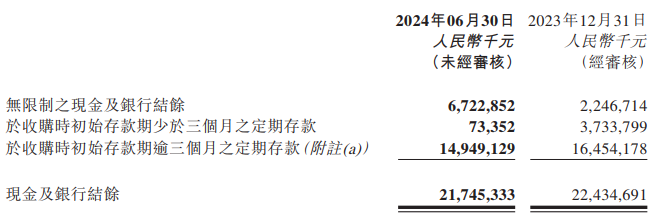
Notably, the financial report also disclosed that as of June 30, 2024, Hansoh Pharma had cash and bank balances totaling 21.745 billion yuan, which can support the company's continued investment in innovative drug research and development in the future. In the current downturn, where many pharmaceutical companies are experiencing tight cash flows, Hansoh Pharma is undoubtedly enviable.
Recommended Reading



For advertising, conference cooperation, corporate communication, etc., please contact 400-689-7892.