Amivantamab Plus Lazertinib Demonstrates Superior Overall Survival Over Osimertinib in First-Line EGFR-Mutated Advanced NSCLC: MARIPOSA Phase 3 Trial Update

Johnson & Johnson
Medical Device R&D and Manufacturer
At WCLC2024, Johnson & Johnson disclosed longer follow-up OS data from the MARIPOSA study:
Amivantamab, as an EGFR-MET bispecific antibody, uses low fucose expression to enhance ADCC effects. Lazertinib, as a 3rd-generation EGFR TKI, is capable of penetrating the central nervous system. In the primary analysis of the Phase 3 MARIPOSA study (NCT04487080), with a median follow-up of 22.0 months, Amivantamab + Lazertinib significantly improved progression-free survival (PFS) compared to Osimertinib in treatment-naïve, EGFR-mutated advanced NSCLC patients, as assessed by blinded independent central review. The interim overall survival (OS) analysis preliminarily indicated a favorable trend in the Amivantamab + Lazertinib group compared to the Osimertinib group.
Method: MARIPOSA randomly assigned 1,074 treatment-naïve patients with EGFR-mutated (exon 19 deletion or exon 21 L858R substitution) locally advanced or metastatic NSCLC in a 2:2:1 ratio to receive open-label Amivantamab + Lazertinib (n=429), blinded Osimertinib (n=429), or blinded Lazertinib (n=216).
Results: As of May 13, 2024 (median follow-up of 31.1 months), 44% (185/421) of patients in the Amivantamab-lazertinib group and 34% (145/428) in the osimertinib group were still receiving treatment. A total of 155 patients in the Amivantamab-lazertinib group and 233 patients in the osimertinib group experienced investigator-assessed disease progression and discontinued treatment. Among these patients, 72% (111/155) and 74% (173/233), respectively, initiated subsequent therapy, with carboplatin-pemetrexed being the most common first subsequent treatment in both groups (Amivantamab-lazertinib, 26% [29/111]; osimertinib, 28% [48/173]). Progression-free survival after the first subsequent treatment (i.e., PFS2) favored the Amivantamab-lazertinib combination group (HR, 0.73; 95% CI, 0.59-0.91; nominal P=0.004). Compared with osimertinib, patients treated with Amivantamab-lazertinib had significantly longer median time to treatment discontinuation and time to subsequent therapy. Intracranial PFS showed a trend favoring the Amivantamab-lazertinib group over the osimertinib group.Although there was no formal significance test, the median OS in the Amivantamab-lazertinib group has not been reached, while it was 37.3 months in the osimertinib group (HR, 0.77; 95% CI, 0.61-0.96; nominal P=0.019).At 24 months, 75% and 70% of patients in the Amivantamab-lazertinib group and osimertinib group were alive, respectively. The corresponding values at 36 months were 61% and 53%.
Conclusion: Compared with Osimertinib, Amivantamab-Lazertinib continued to show a trend of improving OS, while also improving outcomes after disease progression, which again confirmedAmivantamab-Lazertinib can be used as a first-line standard treatment for EGFR-mutated advanced NSCLC.
Based on this result, the landscape of first-line treatment for EGFR-mutated advanced NSCLC patients will change in the future. However, it should be noted that IV injection...Amivantamab can cause severe injection reactions and thrombosis, necessitating more refined clinical management strategies. This may also impact the promotion of this therapy to a certain extent. However, the subcutaneous formulation developed by Johnson & Johnson can significantly reduce thrombosis and injection reactions.
In the frontline treatment of EGFR-mutated advanced NSCLC, AstraZeneca has always been a dominant player. Under such circumstances, AstraZeneca has launched multiple combination clinical trials with osimertinib, and currently, the combination with chemotherapy is at the forefront.On April 5, 2024, AstraZeneca registered the Phase III clinical trial TROPION-Lung14 on the Clinicaltrials.gov website, evaluating osimertinib with or without the Trop2 ADC novel drug Dato-DXd as a first-line treatment for EGFR mutation-positive non-small cell lung cancer. At the same time, AstraZeneca is also conducting clinical trials of osimertinib in combination with EGFRxcMET ADC (AZD9592). Not long ago, they also introducedA preclinical EGFR degrader, also for combination use with Osimertinib.
FLAURA2 Study: A Phase III Randomized Clinical Trial of Osimertinib Combined with Chemotherapy as First-Line Treatment for EGFR-Mutated Advanced NSCLC – Clinical Trial Results Announced. PFS results showed that, whether assessed by investigators or BICR, the PFS of the osimertinib plus chemotherapy group was extended by approximately 9 months compared to the osimertinib monotherapy group. The median PFS assessed by BICR in the two groups were 29.4 months vs 19.9 months (HR=0.62; P=0.0002), and the median PFS assessed by investigators were 25.5 months vs 16.7 months (HR=0.62; P<0.0001), reducing the risk of disease progression or death by 38%. Preliminary OS data already shows an advantage.
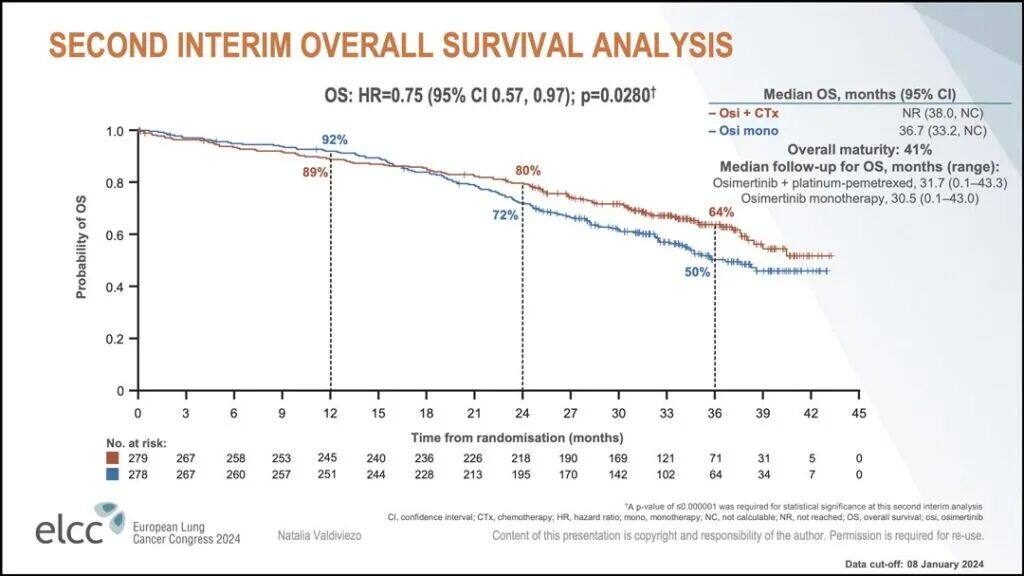
This therapy, as a combination regimen with chemotherapy, may significantly reduce the preference of both patients and doctors, unless individual patients require faster tumor reduction. However, due to the side effects of chemotherapy, it may be rejected by patients.
Therefore, as a chemotherapy-free combination therapyThe Amivantamab-Lazertinib treatment regimen will have a more favorable competitive edge, becoming a new option for first-line EGFR-mutated advanced NSCLC patients.



Warm Tips

Simple steps to star ⭐️ Pharma Insights, and receive our updates第一时间.