| Sam Ajizian, Chief Medical Officer of Medtronic's Acute Care and Monitoring division, announced his departure on LinkedIn Thursday. The executive had been working in the patient monitoring business before Medtronic merged the team with its respiratory division, canceling its spin-off plan announced in October 2022. In a post on Friday, Ajizian stated he would begin a new role as Chief Medical Officer at Inflammatix, a startup developing tests for infections and sepsis.Sam Ajizian has worked at Medtronic for over nine years, holding various positions. In 2020, the company appointed Ajizian as the Chief Medical Officer of the Patient Monitoring division. In 2022, Medtronic outlined a plan to spin off its monitoring and respiratory interventions businesses into a new connected care company. The Medtronic division where Ajizian works sells products including pulse oximeters, brain monitoring, and perfusion monitoring solutions.Medtronic canceled the plan in February this year, chose to exit the ventilator market, and integrated the remaining patient monitoring and respiratory businesses into a new team.Sam Ajizian became the new Chief Medical Officer of Acute Care and Monitoring Business earlier this year.Now, the executive has left Medtronic. 
Dr. Sam Ajizian Joins Inflammatix as Chief Medical Officer After Nearly a Decade at Medtronic, Serving as CMO for Acute Care and Monitoring. He oversees a $2 billion GAR global business, serving over 115 million patients annually across more than 70 countries. Sam acts as the medical lead for business development and licensing activities, identifying targets and bringing cross-functional teams together to create agile and efficient inorganic enhancements for the portfolio. A globally recognized leader in the medical device community, he collaborates with key global medical societies and drives product adoption through research, guidelines, and education. A commercially oriented CMO, Sam is driven by customer needs and how best to meet them using the C-suite with clear focus and execution.Focus on Acute Infections and Sepsis DetectionInflammatix is a molecular diagnostics company reimagining diagnostics by reading the immune system to deliver rapid results, improving patient care and alleviating major public health burdens. The company’s initial focus is on acute infections and sepsis, with its tests combining proprietary biomarkers and advanced machine learning to help physicians quickly provide the right treatment for the right patients. Each test is being developed to run on the company’s sample-to-answer isothermal instrument platform, Myrna, within 30 minutes, enabling the power of precision medicine at the point of care. The Burlingame, California-based company is backed by Khosla Ventures, Northpond Ventures, D1 Capital Partners, Think.Health Ventures, Stanford StartX Fund, and OSF Ventures.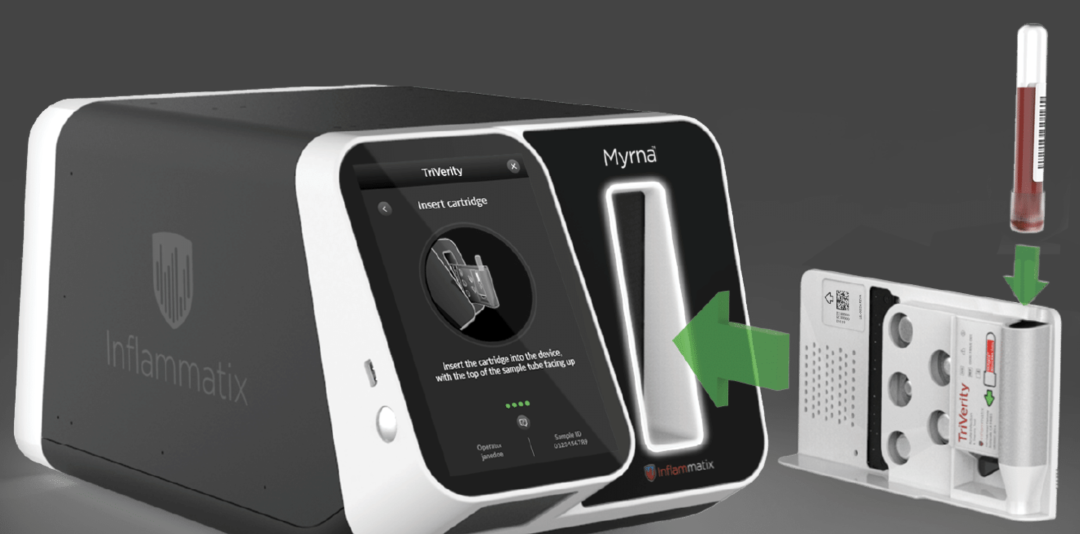
Molecular diagnostics company Inflammatix has completed the technical development of its TriVerity Acute Infection and Sepsis Testing System, which includes the Myrna instrument and TriVerity cartridge. TriVerity is designed for use in emergency departments for patients suspected of acute infection and sepsis to assess the likelihood of bacterial infection, viral infection, and the risk of acute decompensation (requiring ICU-level care)."Myrna will become the world's highest multiplex point-of-care system capable of quantifying RNA, allowing us to bring 'precision medicine' into acute care settings," said Timothy Sweeney, MD, CEO and co-founder of Inflammatix. "Completing the technology development brings TriVerity one step closer to FDA submission and release, enabling us to conduct pivotal clinical studies."The company stated that the Myrna instrument can quantitatively analyze up to 30 messenger RNAs (mRNA) in whole blood or other sample types within approximately 64 minutes, providing a sample-to-answer solution. It is designed to be exempt from Clinical Laboratory Improvement Amendments (CLIA) for point-of-care deployment. The single-use cartridges are expected to remain stable at room temperature for up to 12 months."With the completion of the testing system, we look forward to further exploring partnerships to introduce existing RNA signatures into the Myrna ecosystem," Sweeney said. "Given the anticipated regulatory changes for laboratory-developed tests and the growing reliance on biomarker-driven approaches in immunotherapy development, this could be a particularly viable pathway."TriVerity Acute Infection and Sepsis Test is Inflammatix's leading product, comprising a set of 29 mRNAs used to "read" the body's immune response, thereby aiding in the diagnosis of patients suspected of having acute infections and sepsis. It is designed to potentially enhance the diagnosis of patients with suspected infections visiting emergency departments in the United States. Based on an internal analysis of the Agency for Healthcare Research and Quality (AHRQ) Healthcare Cost and Utilization Project (HCUP) database, Inflammatix estimates that approximately 20 million patients visit emergency departments annually due to symptoms consistent with suspected infections.The company has resumed and completed its clinical studies, including the SEPSIS-SHIELD study (NCT04094818) required for the submission of the TriVerity test system to the U.S. Food and Drug Administration (FDA). This multicenter study has enrolled 955 of the estimated 1,500 patients needed. Inflammatix estimates that the study will be completed and the FDA submission will be made in the spring of 2024.The TriVerity Acute Infection and Sepsis Detection System is a product currently under development, not for sale, and has not received marketing approval or clearance from any regulatory authority in any jurisdiction.x: Latest Financing of $100 MillionMarch 16, 2021, IInflammatix Secures $102 Million in Series D Funding Led by D1 Capital Partners to Commercialize Novel Host Response Diagnostics.D1 Capital Partners led this round of financing. The company's existing investors include Northpond Ventures, Khosla Ventures, Think.Health, and OSF Healthcare Ventures."We are delighted to lead this round of financing and look forward to the upcoming commercialization of the first of these novel testing methods, as well as playing a role in the continued development of other indications for this unique diagnostic approach."Before the COVID-19 pandemic, sepsis caused more than 5 million deaths globally each year, and severe COVID-19 has been recognized as viral sepsis.Moreover, antibiotic resistance directly leads to more than 700,000 deaths globally each year.Traditional methods for diagnosing acute infections are slow and often inaccurate because they only look for pathogens in the blood, even though most infections never enter the bloodstream.As a result, patients with suspected infections often receive inappropriate antibiotic treatments, leading to antibiotic resistance.Sepsis is often completely overlooked.Inflammatix's diagnostic capabilities use machine learning algorithms to rapidly assess a patient's immune response to infection through multiple mRNA biomarkers. The company’s tests can identify the presence and type of infection (viral or bacterial), as well as the risk of severe disease (including severe COVID-19), enabling physicians to make more informed decisions. These tests are designed to run on the company’s sample-to-answer, cartridge-based point-of-care Myrna™ testing system, which delivers results in 30 minutes.The funds will be used for the regulatory approval and global commercialization of the Myrna system, as well as for InSep™ Acute Infection and Sepsis Testing, which aims to improve triage and decision-making in emergency departments and other acute care settings. The funding will also support the ongoing development of the company’s diagnostic testing pipeline, including ViraBac EZ™ Acute Infection Testing. ViraBac EZ is designed to identify whether a suspected infection is bacterial or viral through a simple fingerstick, helping physicians in primary care, urgent care, and other outpatient clinical settings determine when to prescribe antibiotics.D1 Capital Partners analyst James Rogers said, "We are excited about the transformative potential of Inflammatix's host response diagnostic approach, which could significantly improve two major issues in today’s healthcare: the inefficient and often inaccurate diagnosis of infections and sepsis, as well as the overprescription of antibiotics. We are thrilled to lead this round of financing and look forward to the commercialization of the first of these novel tests, as well as playing a role in the continued development of additional indications for this unique diagnostic method."Inflammatix CEO and co-founder Tim Sweeney, M.D., said, "We are delighted to welcome D1 Capital Partners to our strong consortium of investors and look forward to bringing host response diagnostics to the market. By rapidly providing actionable information about diseases, Inflammatix aims to enable physicians to make better clinical decisions, benefiting both patients and healthcare systems."X: Luxurious Executive Team Lineup
Tim Sweeney, M.D.,Co-founder and CEO of InflammatixDr. Sweeney helped invent the core Inflammatix technology and is a licensed physician and data scientist. He completed his MD/PhD at Duke University, then spent time training in the general surgery residency program at Stanford University. While training as a surgeon, he became frustrated with the current tools for diagnosing infections. During his residency research, he completed a postdoctoral master’s degree in biomedical informatics, during which he collaborated with Dr. Khatri to identify a new method for diagnosing infections based on "reading" the immune system. Their work designing custom informatics algorithms to screen heterogeneous large datasets led to the core technology upon which Inflammatix is based.Jonathan Romanowsky,Co-founder and Chief Business Officer of InflammatixMr. Romanowsky has over 15 years of experience in the commercialization of novel, high-value molecular diagnostics. Diagnostics can provide an incredible impact for dedicated healthcare professionals to improve patient care while delivering significant value to both public and private payers, which drives Jonathan’s focus on diagnostics. He has held commercial leadership roles at Telomere Diagnostics, Veracyte, CardioDx, and CareDx. He has successfully brought product concepts from launch to becoming the standard of care. He has led numerous commercialization efforts in product management, marketing, operations, reimbursement, and sales both in the U.S. and internationally. Previously, Jonathan pioneered electronic prescribing at iScribe (now part of CVS) and served as a business strategy consultant at Bain & Company. Jonathan earned a Bachelor of Science in Political Economy from the University of California, Berkeley, and an MBA from Stanford University with a focus on healthcare technology innovation.
Dr. Purvesh Khatri, Co-founder and Chief Scientist of InflammatixDr. Khatri has over 15 years of experience in bioinformatics, computational biology, and translational medicine. He is renowned for his work in ontology and pathway analysis of high-throughput molecular, genomics, and proteomics data. Dr. Khatri developed the first ontology tool for analyzing microarray data, named Onto-Express, which has been expanded into a suite of web-based open-access tools called Onto-Tools.His recent work has focused on developing computational methods to conduct integrative, multi-cohort analyses of publicly available data in order to increase sample size and better account for the heterogeneity observed in real-world patient populations. Using these methods, he has identified highly specific and sensitive biomarkers for the following conditions: (1) infectious diseases (sepsis, respiratory infections, tuberculosis), (2) acute solid organ transplant rejection, and (3) cancer (pancreatic cancer, small cell and non-small cell lung cancer, mesothelioma). Dr. Khatri has authored or co-authored over 140 papers and holds more than 30 patents.
Member of the Board of Directors, Inflammatix, Inc.
| 





