

Bispecific Antibodies Are Truly on Fire: Overview and Pipeline Highlights as Company Files IPO Prospectus

Johnson & Johnson
Medical Device R&D and Manufacturer
Akeso
Innovative Antibody Drug Developer
Bispecific antibodies (bsAbs) are innovative biologics that can simultaneously bind to two different antigens or epitopes, demonstrating unique therapeutic potential. Compared with traditional monoclonal antibodies, bsAbs offer higher specificity, potentially greater efficacy, and the possibility of reducing drug-related side effects.
2023 marks a breakthrough point for bispecific antibody products, with many products being launched in bulk. Particularly, large multinational companies such as Roche and Johnson & Johnson are beginning to see returns on their investments in this field.Roche has achieved remarkable results in the Chinese market, with its CD20/CD3 bispecific antibody Glofitamab and ophthalmology bispecific antibody Faricimab both approved. Johnson & Johnson's EGFR/c-MET bispecific antibody Amivantamab has shown great potential in the treatment of EGFR-mutated non-small cell lung cancer (NSCLC) and has submitted multiple indications for marketing applications in China.
Bispecific antibodies have shown great potential in the treatment of both hematologic malignancies and solid tumors, and have even opened up new avenues in ophthalmology treatment, continuously driving market growth. As domestically produced bispecific antibodies enter a period of concentrated harvest in the coming years, the bispecific antibody market is expected to experience even greater growth.
In 2023, Akeso achieved annual profitability through its bispecific antibody products, with Eveci (PD-1/VEGF bispecific antibody) receiving a $500 million upfront payment, andCadonilimab, as the first domestically produced bispecific antibody in China, achieved sales of 1.358 billion yuan.。Meanwhile,Sales of Akeso's PD-1 antibody, Penpulimab, dropped by 56% year-over-year to just RMB 273 million, reflecting a directional shift in the antibody drug market. 。
The development and application prospects of bispecific antibodies are broad, playing a significant role not only in the field of cancer treatment but also showing potential in other areas such as ophthalmology and hematological diseases. With advancements in technology and the expansion of the market, the "golden age" of bispecific antibody drugs has arrived.
"Double Antibody" Ready to Launch
Raymond J Deshaies, an academician of the National Academy of Sciences of the United States, once published a review in Nature, believing thatMulti-specific drugs represented by bispecific antibodies are expected to lead the "fourth pharmaceutical revolution"。
May 31,AkesoAkeso announced landmark clinical trial results: its self-developed Ivonescimab (PD-1/VEGF bispecific antibody) achieved the primary endpoint of progression-free survival (PFS) in a registrational Phase III clinical study for the first-line treatment of PD-L1 positive locally advanced or metastatic non-small cell lung cancer, compared with Pembrolizumab (K-drug)."Akeso's Ivonescimab becomes the world's first and only drug to demonstrate significantly superior efficacy over Pembrolizumab in a Phase III monotherapy head-to-head clinical trial." Its PD-1/CTLA-4 bispecific antibody has also been approved for marketing, with sales reaching 1.358 billion RMB in 2023.
On July 25, the official website of the Center for Drug Evaluation (CDE) of the China National Medical Products Administration (NMPA) announced,AbbVieThe clinical trial application for ABBV-706 lyophilized powder for injection has been accepted. Public information shows that ABBV-706 is an antibody-drug conjugate (ADC) targeting SEZ6, with TOP1i as the payload. It is currently in Phase 1 clinical research internationally.This is the first time that the SEZ6-targeted ADC drug candidate has been submitted for clinical trials in China.
August 9,Merck & Co. and Tongrun BioPharmaceuticalsIt was announced that the two companies have reached a final agreement,Merck pays $700 million upfront to acquire CN201, a novel bispecific antibody in clinical stage for the treatment of B-cell-related diseases, through its subsidiary.。
August 21,Johnson & JohnsonAnnounce,The U.S. FDA approved the combination of its EGFR/MET bispecific antibody amivantamab and the third-generation EGFR-TKI oral drug Lazcluze (lazertinib) for the first-line treatment of adult patients with locally advanced or metastatic non-small cell lung cancer (NSCLC) whose tumors have EGFR exon 19 deletions or exon 21 L858R substitution mutations as detected by an FDA-approved test.Previously, the trial results showed that, compared with the active control drug, this combination therapy reduced the risk of disease progression or death in patients by up to 30%.
August 26,Regeneron PharmaceuticalsAnnounced an important medical advancement:Its innovative bispecific antibody drug Odronextamab has been approved for marketing in the EU.. This approval marksOdronextamab Becomes the World's First Bispecific Antibody Therapy for Treating Relapsed or Refractory Diffuse Large B-Cell Lymphoma (R/R DLBCL) and Follicular Lymphoma (R/R FL) in Patients Who Have Received at Least Two Systemic TherapiesOdronextamab, as an off-the-shelf treatment option that can be administered in an outpatient setting, offers convenience to patients and is expected to help them achieve complete remission, which is of great significance for improving treatment outcomes and quality of life.
August 27,Navigator MedicinesCompany AnnouncesCompleted a $100 million Series A financing round, with the funds to be used for advancing its lead product NAV-240 (previously known as IMB101) and other monoclonal and bispecific antibody drugs targeting OX40L.NAV-240 is a potential best-in-class bispecific antibody currently in Phase I clinical research. It simultaneously targets OX40L and TNFα, both of which play critical roles in the pathogenesis of various inflammatory diseases. The dual-target mechanism may enhance therapeutic efficacy, offering a new treatment option for complex autoimmune diseases. RA Capital Management and Forbion co-led this round of financing, which will accelerate the clinical research progress of NAV-240, with a multi-dose Phase Ib trial expected to begin in the second half of this year. Additionally, IMBiologics will receive an upfront payment of $20 million and is eligible for up to $925 million in development and commercial milestone payments.
At the 2024 ASCO Annual Meeting, companies in China also presented several innovative bispecific antibody products and their clinical data.Innovent BiologicsDisclosed data on its innovative bispecific antibody products IBI389 and IBI363. IBI389 is a bispecific antibody targeting CLDN18.2/CD3, which has completed the first patient dosing in a Phase I clinical trial for the treatment of advanced malignant tumors. Preclinical results indicate that even in cell lines with low CLDN18.2 expression, IBI389 can still bind to tumor cells, demonstrating significant anti-tumor effects. IBI363 is a PD-1/IL-2 bispecific antibody that has shown preliminary efficacy and safety in patients with melanoma and colorectal cancer.
China BiopharmaceuticalsDisclosed data on its CD137/PD-L1 bispecific antibody FS222 in melanoma, showing that FS222 demonstrated excellent anti-tumor activity across various tumor types, particularly in melanoma patients previously treated with PD-1 antibodies, with an overall response rate of 47.4% and a disease control rate of 68.4%.
These data indicate that,China-produced innovative varieties have made remarkable progress in the bispecific antibody field, and are expected to become a key area for overseas licensing in the future.。
Bispecific Antibody Drug Market Size
In 2024Break Through the 10 Billion Dollar Mark
In the first half of 2024, the global bispecific antibody drug market size grew significantly, reaching 6 billion US dollars.The biggest driver of this growth is Roche's VEGF/Ang2 bispecific antibody, which achieved sales of $21.54 billion in just the first half of the year. Although bispecific antibodies are mainly used for cancer treatment, the combined sales of Roche’s two non-oncology bispecific antibodies — the FIX/FX bispecific antibody for hemophilia and the VEGF/Ang2 bispecific antibody for ophthalmic diseases — reached $48 billion, accounting for 80% of the entire bispecific antibody market. In terms of market size, according to data from Market.us, the global bispecific antibody drug market size was $57.3 billion in 2022 and $80 billion in 2023. It is expected to grow at a compound annual growth rate (CAGR) of 37.5% from 2024 to 2033, reaching approximately $1,926 billion by 2033.
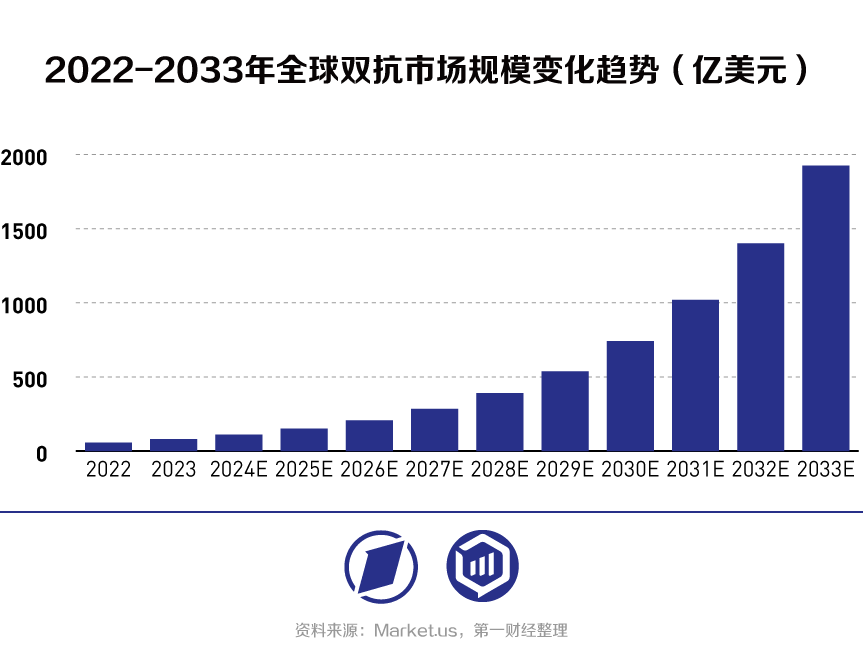
(Image Source: Market.us Data)
As of the end of 2023, the global bispecific antibody drug market continues to maintain a growth trend. Among the approved bispecific antibody drugs, those targeting CD3 account for more than two-thirds, demonstrating the widespread application and importance of the CD3 target in the bispecific antibody field. These CD3 bispecific antibody drugs exert a powerful synergistic anti-tumor effect by simultaneously targeting tumor cells and immune cells, achieving significant clinical outcomes particularly in the treatment of hematologic malignancies and certain solid tumors.
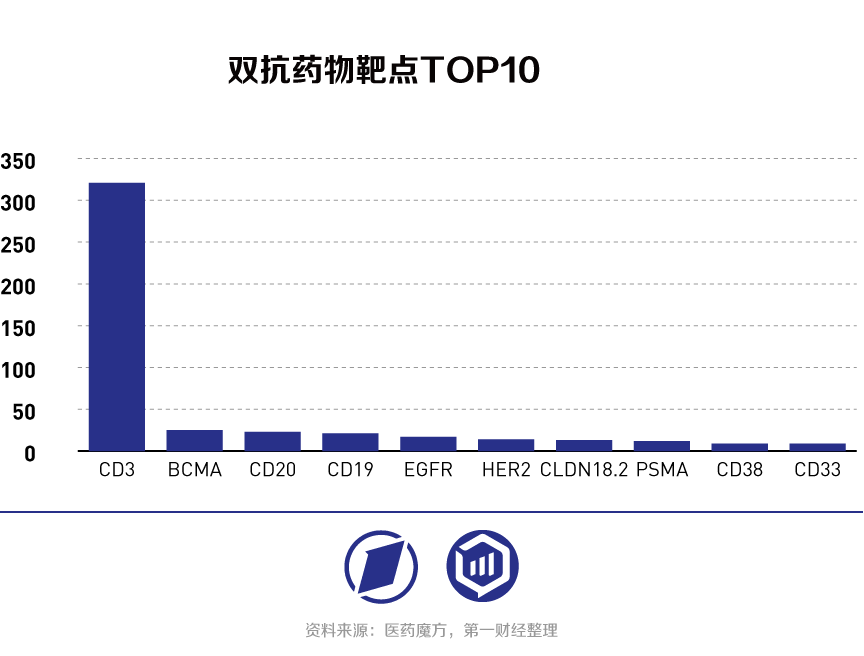
(Image Source: Market.us Data)
Currently,Globally, 15 bispecific antibody drugs have been approved for marketing., among which Akeso's two bispecific antibody products have performed particularly outstandingly, markingChinese innovative drug companies have already occupied an important position in the global bispecific antibody field.With the advancement and innovation of technology, the bispecific antibody field has attracted a significant amount of resource investment, covering multiple directions such as tumor immunotherapy bispecific antibodies, CD3 bispecific antibodies, autoimmune target combination bispecific antibodies, breakthroughs of CD3 bispecific antibodies in solid tumors, and bispecific antibody-drug conjugates (ADCs).
Looking ahead, bispecific antibodies, due to their mechanistic diversity and differentiated design, are expected to achieve more breakthroughs in clinical settings and become the next generation of biologic therapies for treating cancers, autoimmune diseases, and infectious diseases. With the continuous expansion of the bispecific antibody market and the ongoing maturation of R&D technologies, this field is anticipated to embrace more development opportunities and promising clinical applications.
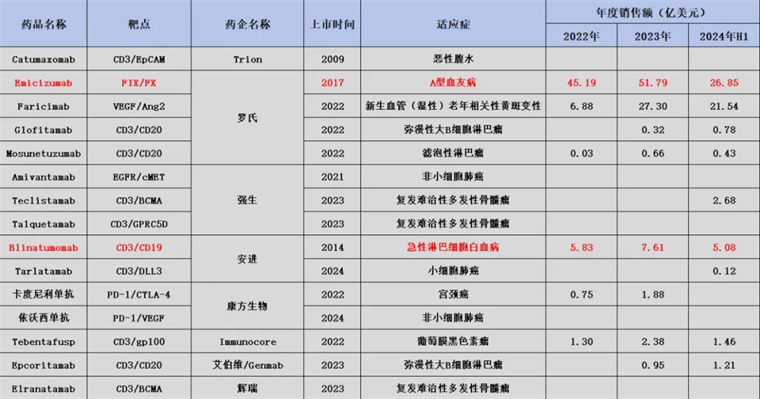
(Image Source: Yi Yao)
"Multi-field Advancement of 'Dual Antibody'"
The explosion of bispecific antibody drugs in the medical field is mainly concentrated in the following aspects:
1.Tumor Treatment:Bispecific Antibody Drugs Show Great Potential and Therapeutic Effects in Cancer Treatment. For example, Akeso's Eveci (PD-1/VEGF bispecific antibody) demonstrated significantly superior efficacy compared to Keytruda in a Phase III clinical trial for first-line treatment of locally advanced or metastatic non-small cell lung cancer with positive PD-L1 expression. In addition, the underlying technology of bispecific antibody drugs is no longer a barrier, and many pharmaceutical companies are actively advancing their research and development efforts in hopes of discovering new and impressive drug structures.
2. Treatment of Autoimmune Diseases:Bispecific antibodies also have significant therapeutic potential in the field of autoimmune diseases. They can achieve enhanced efficacy through combinational and multi-mechanistic pathways by simultaneously targeting two different antigens or two different epitopes of the same antigen.
3. Ophthalmic Disease Treatment:Roche's VEGF/Ang2 bispecific antibody has made breakthrough progress in the treatment of ophthalmic diseases, with sales reaching $2.154 billion, demonstrating the commercial value and application potential of bispecific antibodies in the field of ophthalmology.
4.Hemophilia Treatment:Emicizumab, as a bispecific antibody drug for the treatment of Hemophilia A, bridges FIXa and FX to promote thrombin generation and restore the coagulation process in patients, offering a new therapeutic option for hemophilia patients.
5. Non-Small Cell Lung Cancer (NSCLC) Treatment:Johnson & Johnson's Rybrevant (EGFR/c-MET bispecific antibody) has demonstrated breakthrough efficacy in treating patients with metastatic non-small cell lung cancer (NSCLC) harboring EGFR exon 20 insertion mutations, becoming the first FDA-approved drug targeting this specific mutation.
6.Bi-specific ADC Drugs:Bispecific ADC, as an emerging tumor treatment strategy, demonstrates higher tumor selectivity and therapeutic efficacy by combining the advantages of bispecific antibodies and ADC, making it one of the current hotspots in research and development.
In summary, bispecific antibody drugs have demonstrated significant therapeutic potential and market value in the fields of oncology, autoimmune diseases, ophthalmic diseases, hemophilia, and non-small cell lung cancer, becoming a new hotspot in pharmaceutical research and development. With continuous technological advancements and the launch of more bispecific antibody drugs, more clinical breakthroughs and market growth are expected in the coming years.
Future Outlook
Looking ahead, bispecific antibodies, as the rising stars in the medical field, are showing strong momentum.
First, bispecific antibody drugs significantly enhance therapeutic effects by simultaneously targeting two different signaling pathways or antigens. Particularly in the field of cancer treatment, the PD-1/PD-L1 bispecific antibody strategy not only relieves T-cell immunosuppression but also effectively inhibits tumor angiogenesis, bringing more significant clinical benefits to patients.
Secondly, with the continuous advancement of technology and the scaling up of the industry, the production cost of bispecific antibody drugs is expected to gradually decrease, making these highly effective therapeutic drugs more affordable for more patients and significantly improving drug accessibility.
Moreover, the application fields of bispecific antibody drugs are rapidly expanding, from cancer treatment to autoimmune diseases, ophthalmic diseases, hemophilia, and more. Their therapeutic potential is continuously being explored, indicating that they will demonstrate unique therapeutic effects in more disease areas in the future.
Moreover, the innovation and advancement of bispecific antibody technology, such as the combination with bispecific antibody-drug conjugates (ADC), not only enhance the breadth and effectiveness of treatment but also reduce the risk of drug resistance and trigger diverse anti-tumor mechanisms, offering more possibilities for clinical therapy.
With the acceleration of the commercialization of bispecific antibody drug projects, it is expected that more bispecific antibody drugs will be approved for marketing in the future. The market size will continue to grow and is projected to reach approximately USD 192.6 billion by 2033. This not only brings significant market opportunities for pharmaceutical companies but also provides patients with more treatment options.
However, with the development of bispecific antibody drugs, ethical and social issues such as drug pricing and accessibility cannot be ignored. It is necessary to balance commercial interests with social responsibility during the new drug research and development process, ensuring that every patient can benefit from advancements in medical technology.
In summaryThe future development of bispecific antibody drugs is full of potential. With continuous technological breakthroughs and in-depth clinical research, we have reason to maintain confidence in the progress of bispecific antibody technology and the hope it brings to patients, and look forward to its contribution to human health.。
Source: Official Media / Online News
Disclaimer
1. Some articles in "Huihui Pharma" are reproduced from the Internet for the purpose of conveying more information, and do not imply endorsement of their viewpoints or confirmation of the authenticity of their content. If you have any questions about the content, please contact our company in a timely manner.
2. "Huihui Pharma" is committed to providing reasonable, accurate, and complete information, but does not guarantee the reasonableness, accuracy, or completeness of the information, and assumes no responsibility for any loss or damage caused by unreasonable, inaccurate, or omitted information.
3. All information on "Huihui Pharma Talk" is for reference only and should not be used as a basis for any commercial transactions or medical services. If there are any discrepancies arising from the independent use of the content on "Huihui Pharma Talk," our company assumes no responsibility, including but not limited to legal liability or compensation.
4. For issues not covered in this statement, please refer to relevant national laws and regulations. In the event of any conflict between this statement and national laws and regulations, the latter shall prevail.