

AstraZeneca China Announces Major Organizational Restructuring and Strategic Reinforcement in Key Therapeutic Areas

AstraZeneca
Biopharmaceutical Manufacturer
01
AstraZeneca Increases Investment in the Chinese Market
Xinkangjie learned that,This adjustment involves AstraZeneca ChinaBiopharmaceuticalsBusiness BBU and Omni-Channel Business Unit, these two departments will officially merge to establish a new AstraZeneca.China BiopharmaceuticalsBusiness (BBU).
In addition, the Respiratory Inhalation Business Unit, RespiratoryThe Nebulization Business Department and the Digestive Business Department will also merge to become the Respiratory and Digestive Business Division;
The Biologics Business Unit, along with the Vaccines and Immunotherapies and Autoimmunity Business Units, have merged to establish the Respiratory and Autoimmunity Biopharmaceuticals, Vaccines, and Immunotherapies Division.
The above series of adjustmentsWill begin on October 1 this year。
It is reported that AstraZeneca ChinaBiopharmaceuticalsThe business was officially established at the beginning of this year and is led by Lin Xiao, Vice President of AstraZeneca China, Head of the Respiratory, Inhalation and Biologics Business Unit, and Head of Hong Kong and Macao regions.。
Following this organizational restructuring, Lin Xiao will also be responsible for the new AstraZeneca China.BiopharmaceuticalsBusiness: The heads of the four major business teams—omnichannel, county, retail, community, and Feiying—now report directly to him.
Since the beginning of this year, including the adjustment of the oncology team in June, AstraZeneca's operations in China have undergone at least three major internal restructuring exercises. Meanwhile, as the organizational structure is being adjusted, the company’s business investment activity in the Chinese market is also increasing.
In March 2024, AstraZeneca China announced an investment of $475 million to build a small molecule drug manufacturing plant in Wuxi. Following the construction of a new production and supply base in Qingdao in March last year, at the end of August this year, the company once again announced an increase in investment for the Qingdao inhalation aerosol production and supply base project to $750 million, further expanding production capacity and continuing to develop world-class intelligent, green, and sustainable pharmaceutical manufacturing facilities.
In July, prior to this, the "AstraZeneca CICC (Qingdao) Venture Capital Fund," established through the cooperation of AstraZeneca with Qingdao High-tech Zone and CICC Capital, was also completed. The fund, with a scale of 1 billion yuan, will focus on early and mid-stage investments in areas such as healthcare.
At the product level, AstraZeneca China reached a licensing agreement with Harbour BioMed in May for a preclinical monoclonal antibody project, with a total transaction value exceeding US$575 million.
At the AstraZeneca China Ecosystem Conference held in the same month, AstraZeneca, together with five Chinese local innovative enterprises—Genetron Health, GritMed, and LinkDoc Technology—announced a biopharmaceutical enterprise cooperation overseas expansion plan. At the conference, Leon Wang, Executive Vice President of AstraZeneca Global, President of International Business and China, stated that in the past year, AstraZeneca has reached global licensing cooperation agreements with seven Chinese innovative pharmaceutical companies, with a total amount reaching approximately USD 6 billion.
Xinkangjie learned that,Since the beginning of 2023, AstraZeneca has successively reached BD cooperation agreements with Connaught Biotech, Lepu Biopharma, Limin Pharmaceuticals, Coreland Pharmaceuticals, and Chiral BioPharma. The projects involved include ADC drugs, GLP-1 drugs, EGFR drugs, etc., with development progress mainly before Phase II clinical trials. Additionally, AstraZeneca spent $1.2 billion to acquire Gracell Biotechnologies.
Behind the large-scale and continuous investment is the increasing contribution of the Chinese market to AstraZeneca's revenue and the growing importance of its business.
In AstraZeneca's global revenue of approximately US$45 billion in 2023, the Chinese market contributed US$5.876 billion, accounting for about 13%, making it the company's second-largest market globally.
By the first half of 2024, AstraZeneca's revenue in the Chinese market once again achieved a 15% year-on-year increase, reaching 3.378 billion US dollars.
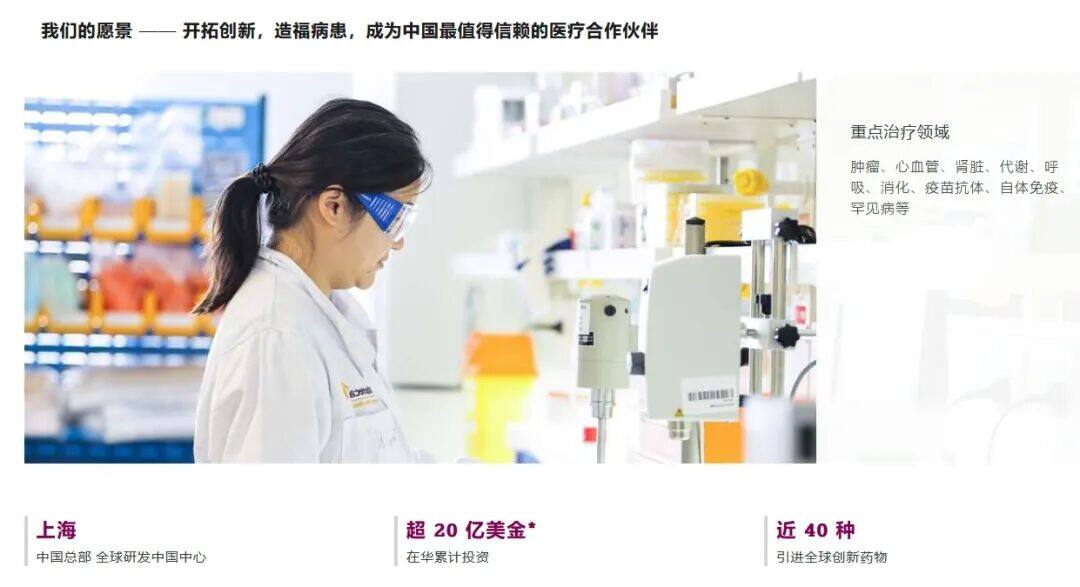
Although it is a multinational pharmaceutical company, AstraZeneca has gradually localized its business development since entering the Chinese market in 1993. In addition to pipeline layout, three major global production and supply bases located in Wuxi, Taizhou, and Qingdao, as well as logistics centers and the Global R&D China Center, have successively been established. AstraZeneca's investment in China has exceeded 2 billion US dollars (excluding R&D investment), and more than 40 innovative drugs have been introduced to the Chinese market.
02
The Addition and Subtraction of Multinational Pharmaceutical Companies in the Chinese Market
Analysis points out that, after more than a decade of rapid development, China's pharmaceuticals industry has demonstrated enormous potential in terms of market scale, consumption levels, and the technical capabilities of pharmaceutical enterprises, establishing itself as a significant market on a global scale.
And as the market potential continues to be tapped, the status of the China region in the development process of major multinational pharmaceutical companies is becoming increasingly important.Like AstraZeneca, Bayer, Novartis, Novo Nordisk, and Takeda Pharmaceutical, other multinational pharmaceutical giants have also been increasing their investment and layout in the Chinese market in recent years.。
FirstNovo NordiskIn March this year, AstraZeneca announced an investment of approximately 4 billion yuan in Tianjin to build a sterile formulation expansion project. Prior to this, at the beginning of 2023, the company had already announced.Invested 1.18 billion yuan to initiate the expansion project of the finished product workshop, and now its Tianjin production plant has also become one of the company's global strategic production bases.
Subsequently, Bayer also signed a contract with the Jiangsu provincial government to invest in the construction of a new Bayer HealthCare Consumer Products Qidong Supply Center, with the first phase investment reaching 600 million yuan, expected to commence operations by 2028. Meanwhile, Bayer plans to establish a China Collaboration and Innovation Center in Shanghai this year, with an anticipated investment of 20 million euros.
Takeda Pharmaceutical, which has now established a complete pharmaceutical value chain in the Chinese market encompassing drug discovery, manufacturing, supply chain management, and commercial operations, relocated its Asia-Pacific R&D headquarters to Shanghai in 2022. The company also announced plans to elevate China to its second-largest market by 2030.
But while most multinational companies are "adding" to the Chinese market, they are also affected by factors such as China's centralized procurement price cuts, medical insurance cost control, increasingly fierce product competition, and changes in market logic.Some multinational pharmaceutical companies have chosen to "subtract" in the Chinese market by divesting assets, transferring ownership, and other means.
Japanese pharmaceutical company Kyowa Kirin officially announced at the beginning of August that it would sell its entire mainland China business, including five well-known established brands, to Chinese innovative pharmaceutical company Hong Kong Winhealth Pharma Group for 720 million yuan.
The company stated in its 2023 financial report that the revenue of its key product, Granocyte (Gran), was affected by the implementation of centralized procurement in some regions of China, showing a downward trend. Coupled with the downturn in markets such as Japan and Europe, this would have an adverse impact on the company's future growth. Therefore, some believe that this is also one of the reasons for its sale of its China business.
Recently, the sale of five mature Chinese products by UCB, a foreign-funded company, as well as the entire domestic drug production base, has also sparked heated discussions in the industry.
The transaction involvesLevetiracetam, Lacosamide, and Rotigotine Patch: Three Neurological Medications, andCetirizine Hydrochloride Tablets, Levocetirizine Hydrochloride Tablets: Two Allergy Medications, andProduction base located in Zhuhai。
Most of the above medicines are old varieties that have been included in China's national centralized procurement, and while prices are reduced, they also need to face competition in China.Intense competition in generic drugs; in 2023, these five products accounted for only 2.49% of UCB's total revenue. For UCB, the pressure may now outweigh their revenue contribution.
After selling these five products, UCB will have only one main product left in the Chinese market: the certolizumab pegol injection for treating rheumatoid arthritis.
Nowadays, the reform of China's healthcare market has gradually entered the deep-water zone, with changes involving the sales end, payment end, and R&D end. The logic of market development is also changing. Coupled with the overall downturn in the environment, performance pressure is increasing for both local pharmaceutical companies and multinational corporations.
Therefore, there is an industry perspective that,The Chinese market is both complex and holds enormous potential for development, making it difficult for companies to win the competition by "going it alone."Looking at the development strategies of several major multinational pharmaceutical giants, seeking partners and leveraging resources and channels will be the key to success.
—END—
Highlights:
Sales of 2.5 billion yuan worth of essential drugs in short supply plummeted by over 50% after centralized procurement
Tasly Surges to Limit Up Before Market Opens! Gained Control by China Resources Sanjiu for 6.2 Billion
Another老牌中药企业 may change hands
2024 National Reimbursement Drug List Preliminary Review Announced: Multiple Key Innovative Drugs Included
◆Xinkejie widely solicits contributions, which can cover topics related to the pharmaceutical industry such as medical policies, R&D trends, and the capital market. Please send your submissions to (hejing@sinohealth.cn) and include your contact information.
◆ For business cooperation/reprint authorization, please contact 18823242014 (same number for WeChat).