AstraZeneca to Present Over 130 Abstracts at 2024 WCLC and ESMO Highlighting Breakthroughs in Early Cancer Intervention and Next-Generation ADCs

AstraZeneca
Biopharmaceutical Manufacturer

At the 2024 World Conference on Lung Cancer (WCLC) hosted by the International Association for the Study of Lung Cancer (IASLC) from September 7 to 10, 2024, and the European Society for Medical Oncology (ESMO) Annual Congress held from September 13 to 17, 2024, AstraZeneca will reinforce its ambition to transform cancer care with new research data from its diverse and industry-leading portfolio and pipeline.
At these two conferences,AstraZeneca to Present Over 130 Abstracts, Covering 17 Approved Drugs and Potential New Medicines, Including 5 Chair Symposia and 41 Oral Presentations。
Susan Galbraith, Executive Vice President of AstraZeneca and Head of Oncology R&D, stated: "At these two conferences, our presentations have strongly advanced AstraZeneca's long-term strategy to revolutionize cancer diagnosis and treatment. At the World Conference on Lung Cancer, we will showcase the results of our computational pathology platform, which we are currently using in antibody-drug conjugate combinations to develop predictive biomarkers, precisely enhance patient selection, and improve treatment outcomes. Additionally, we will share advancements in targeted therapies."Research Data on TROP2 Antibody-Drug Conjugate Datopotamab Deruxtecan in Combination with Durvalumab for the Treatment of Early-Stage Lung Cancer,This is the first time we have disclosed the data obtained from the clinical trials of two antibody-drug conjugates independently developed by the company, and the data is highly encouraging."Moreover, our next-generation immunotherapy has also made significant progress."
David Fredrickson, Executive Vice President of AstraZeneca and Head of Oncology, stated: "The data we are presenting at the World Conference on Lung Cancer and the European Society for Medical Oncology Annual Meeting will showcase AstraZeneca's achievements in driving several major trends that are transforming cancer treatment today and may continue to do so in the future."In the NIAGARA clinical trial for the treatment of muscle-invasive bladder cancer, durvalumab achieved positive results, highlighting the importance of perioperative immunotherapy in this population. Meanwhile, research data on datopotamab deruxtecan and trastuzumab deruxtecan for various types of lung cancer will be emphasized, with antibody-drug conjugates showing potential to replace traditional chemotherapy in the treatment of multiple cancer conditions.。」
Key Trend: Early Intervention, Transforming Outcomes in Early Cancer Treatment
At the ESMO Presidential Symposium, AstraZeneca will present the results of the NIAGARA Phase III trial, a clinical study designed to evaluate the effects of neoadjuvant chemotherapy combined with durvalumab before cystectomy and adjuvant monotherapy with durvalumab after surgery in patients with muscle-invasive bladder cancer. This durvalumab-based treatment regimen demonstrated favorable outcomes, showing statistically significant and clinically meaningful improvements in event-free survival (EFS) and overall survival (OS), making it the first perioperative immunotherapy regimen to demonstrate extended survival in a Phase III trial for bladder cancer.
In the field of lung cancer treatment, several reports presented at two conferences will highlight the significant progress we have made in early-stage treatment, including:
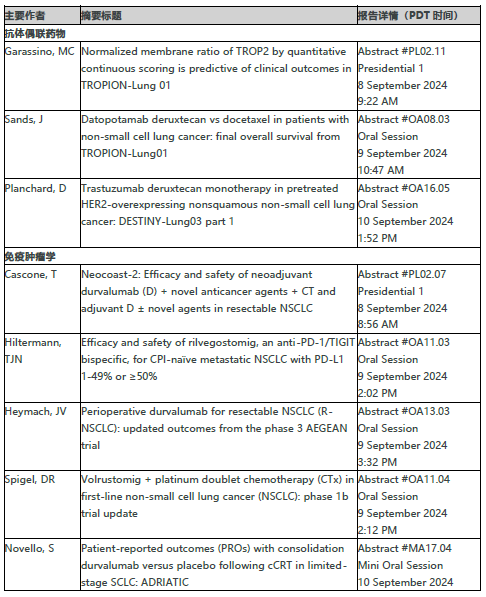
Efficacy and safety data from the NeoCOAST-2 Phase II platform clinical trial will be presented at the "Late-Breaking Presidential Symposium" of the World Conference on Lung Cancer. This study aims to evaluate the efficacy of durvalumab in various novel combination therapies during the perioperative period for patients with resectable early-stage non-small cell lung cancer (NSCLC), including its combination with datopotamab deruxtecan. The AEGEAN Phase III clinical trial demonstrated the efficacy of durvalumab in the perioperative setting and was recently approved in the United States.
Results from the second interim analysis of the AEGEAN III clinical study will be presented as an "oral presentation on the latest breakthrough" at the WCLC, analyzing the efficacy of perioperative treatment regimens based on durvalumab for patients with early-stage resectable (IIA-IIIB) NSCLC. These data cover event-free survival in subgroups of patients (regardless of whether pathological complete response was achieved), as well as the latest disease-free survival and overall survival. In another oral presentation at ESMO, circulating tumor DNA (ctDNA) detection data from AEGEAN will be introduced, providing insights into patients' responses to the treatment regimen.
ADRIATIC Phase III Clinical Trial to Present Brief Oral Report at World Lung Cancer Conference on Outcomes of Durvalumab Treatment in Limited-Stage Small Cell Lung Cancer Patients Without Disease Progression After Concurrent Chemoradiotherapy (CRT). Additionally, treatment outcomes for key subgroups will be presented in an oral report at ESMO.
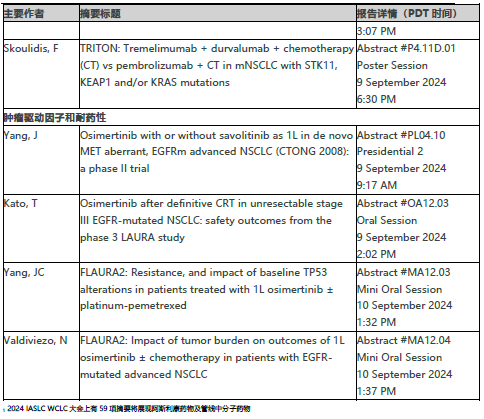
LAURA III Phase Clinical Study to Be Presented as a Brief Oral Report at the World Lung Cancer Conference: Analysis of the Efficacy of Tagrisso (Osimertinib) in Central Nervous System and Distant Metastases in Patients with Unresectable Stage III EGFR Mutation-Positive Non-Small Cell Lung Cancer Following Radical Chemoradiotherapy. Additionally, safety data from the LAURA clinical study will be presented at the WCLC, while efficacy and safety results from the China cohort will be showcased as a poster at ESMO.
Key Trend: Novel Antibody-Drug Conjugates (ADCs) Replace Systemic Chemotherapy
At the "Presidential Symposium on Latest Breakthroughs" of the WCLC, exploratory analysis of tissue samples collected from TROPION-Lung01 using AstraZeneca's proprietary computational pathology platform — Quantitative Continuous Scoring (QCS) — will make TROP2, as calculated by QCS, a promising predictive biomarker for treatment with datopotamab deruxtecan.
In addition, the overall survival data from the TROPION-Lung01 Phase III clinical study will be presented as a "late-breaking oral presentation." This study aims to evaluate the efficacy of datopotamab deruxtecan in treating patients with previously treated locally advanced or metastatic NSCLC. In May this year, a series of high-level positive results showed that, compared to docetaxel (the current standard chemotherapy drug), datopotamab deruxtecan demonstrated a clinically meaningful improvement in overall survival among patients with advanced non-squamous NSCLC who had previously received immunotherapy or targeted therapy.
At WCLC, the data from the first part of the DESTINY-Lung03 Phase Ib trial will be presented orally, highlighting the efficacy and safety of trastuzumab deruxtecan. This trial builds on data from the DESTINY-Lung01 Phase II clinical study, with patients being those previously treated for HER2-overexpressing unresectable locally advanced or metastatic NSCLC.
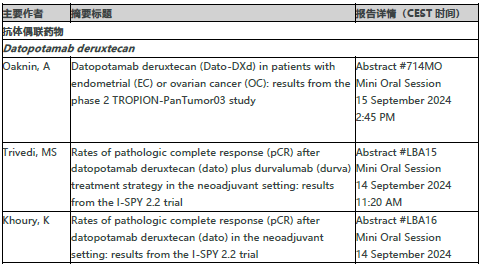
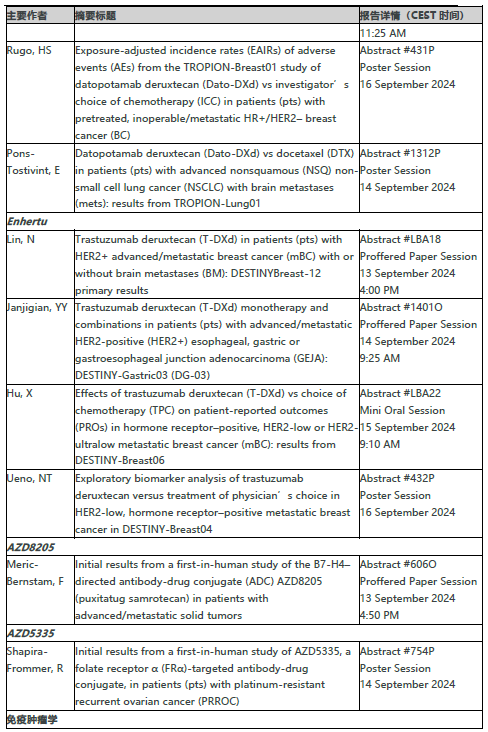
At ESMO, the potential efficacy of trastuzumab deruxtecan in treating pretreated HER2-positive metastatic breast cancer patients with brain metastases in the DESTINY-Breast12 IIIb/IV clinical trial will be presented as a late-breaking oral presentation. Additionally, an oral presentation from the DESTINY-Gastric03 Ib/II clinical trial will highlight the safety and efficacy of trastuzumab deruxtecan combined with chemotherapy and pembrolizumab as a first-line treatment for HER2-positive gastric and gastroesophageal junction (GEJ) cancers.
A brief oral report will be presented at ESMO, unveiling for the first time the initial treatment results of datopotamab deruxtecan from the TROPION-PanTumour03 Phase II clinical study in endometrial and ovarian cancers.
AstraZeneca to Present Multiple Reports at ESMO, Showcasing the Company’s Emerging ADC Proprietary Technology Strength. Including:
Through the selection of written reports, the dose escalation results of B7-H4 ADC AZD8205 in the BLUESTAR I/IIa phase clinical study for the treatment of advanced solid tumors expressing B7-H4 are shared. B7-H4 is overexpressed in a variety of solid tumors and is considered a promising ADC target. AZD8205 is the first ADC to enter clinical trials, carrying a proprietary novel topoisomerase I inhibitor (TOP1i) payload linked by a linker. It has previously been reported that AZD8205 exhibits potent anti-tumor activity in preclinical models of B7-H4 expression across various tumor types.
First Disclosure of AZD5335 FONTANA Phase I/IIa Clinical Trial Dose-Escalation Results via Poster. The study results showed that AZD5335 demonstrated favorable clinical activity, pharmacokinetic properties, and manageable safety in patients with platinum-resistant recurrent ovarian cancer. This ADC, which conjugates a FRα-targeting antibody with a proprietary TOP1i payload, has previously been reported to exhibit potent antitumor activity in preclinical models expressing FRα and resistant to another FRα ADC carrying a microtubule inhibitor payload.
Key Trends: Driving the Next Wave of Immuno-Oncology Drugs
Several reports will highlight the company's commitment to advancing a comprehensive bispecific antibody program:
A poster presentation reported for the first time the overall response rate and safety data from the Phase II clinical trial GEMINI-Gastric Sub-Study 2. The trial evaluated the efficacy of rilvegostomig (AZD2936), a PD-1/TIGIT bispecific immune checkpoint inhibitor, in combination with chemotherapy as a first-line treatment for patients with HER2-negative locally advanced unresectable or metastatic gastric cancer or gastroesophageal junction (GEJ) cancer.
In addition, at the WCLC, two high-profile oral presentations will highlight efficacy and safety data from the Phase I ARTEMIDE-01 trial of rilvegostomig in patients with metastatic NSCLC, as well as data from the Phase Ib/II trial of volrustomig (PD-1/CTLA-4) in combination with chemotherapy for first-line treatment of patients with advanced NSCLC.
Key Trend: Powerful Combination Therapy, Attacking Cancer from Multiple Angles
In addition to the novel therapies DESTINY-Lung03, DESTINY-Gastric03, and NeoCOAST-2, we are further evaluating combination therapy approaches to improve patient outcomes:
An externally investigator-initiated FLOWERS II trial will be presented at the "Late-Breaking Presidential Symposium," evaluating the efficacy of osimertinib with or without savolitinib as first-line treatment for locally advanced or metastatic NSCLC with EGFR sensitizing mutations and primary MET amplification or MET overexpression.
At WCLC, two key short oral presentations will highlight new data from the FLAURA2 Phase III trial evaluating the efficacy of osimertinib in combination with chemotherapy in patients with advanced EGFR mutation-positive NSCLC, including efficacy in patients with high tumor burden and those carrying TP53 mutations at baseline.
A Brief Oral Presentation Will Introduce the 5-Year OS Exploratory Analysis Data from the HIMALAYA Phase III Trial: The Efficacy of the STRIDE Regimen (Single Tremelimumab Regular Interval Durvalumab) in First-Line Treatment of Patients with Unresectable Hepatocellular Carcinoma (HCC) Who Have Not Received Prior Systemic Therapy and Are Unsuitable for Local Treatment. These data represent the longest survival follow-up results reported to date in Phase III clinical studies treating this population.
Collaboration in the scientific field is crucial for improving patient treatment outcomes. AstraZeneca is collaborating with Daiichi Sankyo to develop and commercialize trastuzumab deruxtecan and datopotamab deruxtecan; with Merck to develop and commercialize olaparib; and with Hutchmed to develop and commercialize savolitinib. Rilvegostomig is a bispecific antibody drug targeting PD-1 + TIGIT, derived from Compugen's investigational anti-TIGIT antibody COM902. Through a co-development and commercialization agreement initiated in 2015, AstraZeneca obtained full oncology rights to monalizumab from Innate Pharma in October 2018.
AstraZeneca's Key Reports During the 2024 WCLC:
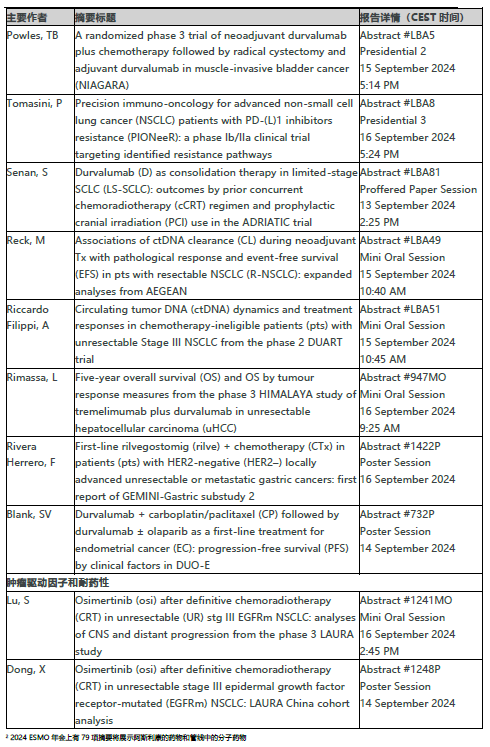
AstraZeneca's Key Presentations During the 2024 ESMO Annual Meeting:
Scan the WeChat QR code to add the editor of the Antibody Circle.Those who meet the requirements can join the Antibody Circle WeChat group!
Please indicate: Name + Research Direction!