Innovative and High-Quality Pharmaceutical Developer
GENRIX BIO
Developer of Novel Monoclonal Antibody Drugs

Johnson & Johnson
Medical Device R&D and Manufacturer

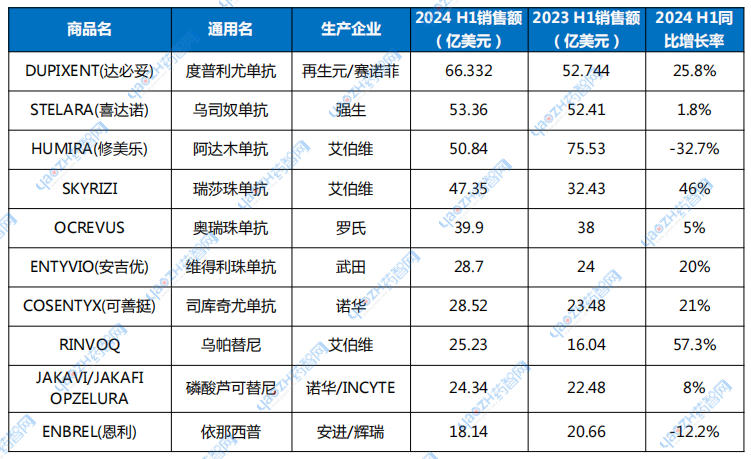
Recently, the IL-17A monoclonal antibodies from Hengrui Pharma and GENRIX BIO were approved for marketing on the same day, once again sparking widespread attention and heated discussions in the industry regarding the autoimmune drug market. Autoimmune diseases, which are related to immune system disorders, encompass over 100 different types, most of which are chronic conditions requiring costly long-term care, including major diseases such as atopic dermatitis (AD), ulcerative colitis (UC), and Crohn's disease (CD). From a global market perspective, autoimmune drugs represent the second-largest pharmaceutical market after oncology and are fertile ground for blockbuster drugs. According to the TOP100 best-selling drugs globally in H1 2024, autoimmune drugs account for 20%, with combined sales exceeding $50 billion in half a year. Among them, the top ten autoimmune drugs generated a total of $38 billion in sales in the first half of this year, with an entry threshold surpassing $1.8 billion. Table 1 Top 10 Autoimmune Drug Sales in H1 2024Data Source: Collation of Publicly Available Corporate Data The Old King Fades, the New King Rises This year, Dupixent has become the new "blockbuster drug" in the autoimmune field. Dupixent (dupilumab), jointly developed by Regeneron and Sanofi, is an anti-IL-4 monoclonal antibody with indications including atopic dermatitis, prurigo nodularis, asthma, eosinophilic esophagitis, and chronic rhinosinusitis with nasal polyps. This year, Dupixent has gained several new indications, including FDA approval in January for the treatment of eosinophilic esophagitis in pediatric patients, approval by Japan's Ministry of Health, Labour and Welfare for the treatment of chronic spontaneous urticaria, and in July, it was successfully approved as an add-on maintenance treatment for patients with chronic obstructive pulmonary disease (COPD), becoming the first biologic for this condition. With the support of multiple major indications, Dupixent's sales exceeded $10 billion in 2023. In the first half of this year, its sales increased by 26% year-on-year, reaching $6.6 billion. Ranking second is Johnson & Johnson's Stelara (ustekinumab). This drug is an IL-12/IL-23 monoclonal antibody developed by Janssen, a former subsidiary of Johnson & Johnson. It was first approved by the European Medicines Agency (EMA) in January 2009 and subsequently received approval from the U.S. Food and Drug Administration (FDA) in September 2009. Its currently approved indications include psoriasis, Crohn's disease, and others. Stelara's sales exceeded $10 billion in 2023, but this may be the drug's last moment of glory. In the first half of this year, Stelara's revenue was $5.3 billion, a slight year-on-year increase, but has already started to decline quarter-on-quarter. In September 2023, a key patent for Stelara expired. Although Johnson & Johnson has reached agreements with competitors Alvotech and Teva to delay the launch of biosimilars, this can only slow down the competition. Moreover, according to the recently announced negotiation results of the U.S. government's Inflation Reduction Act (IRA), Stelara will see a 66% price reduction, with the new price taking effect on January 1, 2026. Approximately one-third of Stelara's sales revenue comes from the U.S. market, and there is no doubt that its sales will accelerate their decline once the negotiated price is implemented. In addition, Amgen/Pfizer's Enbrel (etanercept) is also among the first round of IRA negotiations, with a reduction of 67%. The drug may soon drop out of the TOP10 list. The former "blockbuster drug" Humira (adalimumab) has seen a rapid decline in sales after its patent expiration, with biosimilars from companies such as Boehringer Ingelheim, Pfizer, Samsung Bioepis, Mylan, and Sandoz quickly capturing and eroding its market share. In the first half of this year, Humira's sales amounted to only $5 billion, marking a 33% year-over-year decline, ranking it third. However, we also see that AbbVie has two other autoimmune drugs on the list besides Humira, including Skyrizi, ranked fourth, and Rinvoq, ranked eighth. The sales of these two rising stars are growing rapidly, with a combined revenue of $7.258 billion in the first half of this year, which will soon fill the gap left by Humira's decline. Skyrizi (risankizumab) is an IL-23 inhibitor that met the endpoints in a Phase III clinical trial comparing it with ustekinumab and adalimumab, with a higher proportion of patients achieving PASI90 compared to the control group. It also achieved the primary endpoint and all secondary endpoints in a head-to-head study with secukinumab for the treatment of plaque psoriasis. Skyrizi was approved for marketing in the United States in April 2019 for the indications of plaque psoriasis and psoriatic arthritis. It has since been approved for Crohn's disease and ulcerative colitis. Skyrizi's sales in the first half of this year were $4.7 billion, a year-on-year increase of 46%, and AbbVie expects its peak sales to surpass Humira. Rinvoq (upadacitinib) is a selective JAK1 inhibitor and one of only two small molecule drugs on the TOP10 list, the other being ruxolitinib from Novartis/INCYTE. The drug was first approved for marketing in 2019 and has since been approved for indications including ulcerative colitis, psoriatic arthritis, atopic dermatitis, rheumatoid arthritis, and ankylosing spondylitis. Rinvoq's sales in the first half of this year reached $2.5 billion, with growth exceeding 50%. Other products with rapid sales growth on the list include Novartis' COSENTYX (secukinumab), which achieved sales of $2.85 billion in the first half of this year, representing a 21% year-on-year increase; and Takeda Pharmaceutical's ENTYVIO (vedolizumab), with sales reaching $2.87 billion, marking a 20% year-on-year increase. In addition, multiple sclerosis is also a fertile ground for the birth of major autoimmune drugs. Roche's OCREVUS (ocrelizumab) achieved sales of $4 billion in the first half of this year, ranking fifth. Novartis' KESIMPTA (ofatumumab), although not on the list, has reached $1.4 billion in half-year sales with a high year-on-year growth rate of 64%, making it a potential candidate for the future TOP10 list. Conclusion Currently, the global autoimmune drug market has produced dozens of blockbuster drugs with annual sales exceeding one billion US dollars, and even several super blockbusters with sales surpassing ten billion US dollars. But in China, due to weak treatment awareness, low diagnosis rates, and payment issues, the autoimmune drug market size is far smaller than that of the US and European markets. Nevertheless, Chinese pharmaceutical companies are still actively entering this market and have started to enter the harvest phase. For instance, Crown Bioscience's Benvelumod cream successfully gained FDA approval for marketing in the US in 2022. This product is the first and only steroid-free topical drug approved by the FDA in its category, as well as the first new molecular entity topical drug approved in the US for treating psoriasis in 25 years. In August this year, Hengrui Pharma and GENRIX BIO’s IL-17A monoclonal antibody received NMPA approval for marketing to treat moderate to severe plaque psoriasis, breaking the monopoly of foreign pharmaceutical companies on IL-17A monoclonal antibodies and filling the gap in China-produced biologics for psoriasis. In the future, with breakthroughs in the understanding of autoimmune disease mechanisms, more blockbuster drugs may emerge. Source: Pharma Intelligence NetworkWorkAuthor: White Paper Fan