Daiichi Sankyo and Merck's Ifinatamab Deruxtecan Demonstrates 54.8% Objective Response Rate in Phase II Trial for Heavily Pretreated Extensive-Stage Small Cell Lung Cancer

Daiichi-Sankyo
Pharmaceutical R&D Developer
Ifinatamab deruxtecan, co-developed by Daiichi Sankyo and Merck, achieved an objective response rate of 54.8% in pretreated patients at the 12mg/kg dose level.
12mg/kg was identified as the optimal dose for the Phase II IDeate-Lung01 expansion study and the recently initiated Phase III IDeate-Lung02 study.
TOKYO and BASINGSTOKE, N.J. – (September 2024) – The interim analysis of the dose optimization portion of the ongoing Phase II IDeate-Lung01 study indicates that ifinatamab deruxtecan (I-DXd) continues to demonstrate a favorable objective response rate in patients with previously treated extensive-stage small cell lung cancer (ES-SCLC). The study data will be presented as an oral report at the 2024 World Conference on Lung Cancer (#WCLC24) hosted by the International Association for the Study of Lung Cancer.
Ifinatamab deruxtecan is a potential first-in-class antibody-drug conjugate (ADC) targeting B7-H3, designed using proprietary technology. It was discovered by Daiichi Sankyo and is being co-developed by Daiichi Sankyo and Merck.
Small Cell Lung Cancer (SCLC) is the second most common type of lung cancer, accounting for approximately 15% of all lung cancer cases. SCLC is highly aggressive and prone to rapidly progressing to advanced metastatic stages, with a five-year survival rate of only 3%. Approximately 65% of SCLC tumors exhibit moderate to high levels of B7-H3 protein expression, and high expression of this target is associated with disease progression and poor prognosis.
Charles M. Rudin, MD, Chief of the Thoracic Oncology Service at Memorial Sloan Kettering Cancer Center and Co-Director of the Fiona & Stanley Druckenmiller Lung Cancer Research Center, stated: "Most small cell lung cancer patients experience rapid disease progression after treatment, and there remains a significant unmet need in later-line therapies. The interim analysis of the first part of the IDeate-Lung01 study shows that ifinatamab deruxtecan could play an important role in treating patients with extensive-stage small cell lung cancer who have been previously treated, and further research is needed to confirm its efficacy."
According to blinded independent central review (BICR), in patients with ES-SCLC treated with ifinatamab deruxtecan, the confirmed objective response rates (ORR) were 54.8% (95% CI: 38.7–70.2) and 26.1% (95% CI: 14.3–41.1) for the 12mg/kg (n=42) and 8mg/kg (n=46) dose groups, respectively. In the 12mg/kg dose group, 23 patients achieved partial response (PR). In the 8mg/kg dose group, 1 patient achieved complete response (CR) and 11 patients achieved PR. The median duration of response (DoR) was 4.2 months (95% CI: 3.5–7.0) and 7.9 months (95% CI: 4.1–NE) for the 12mg/kg and 8mg/kg dose groups, respectively, and the disease control rates (DCR) were 90.5% (95% CI: 77.4–97.3) and 80.4% (95% CI: 66.1–90.6), respectively. The median treatment durations were 4.7 months (range: 0.03–15.2) and 3.5 months (range: 0.03–13.9) for the 12mg/kg and 8mg/kg dose groups, respectively, the median progression-free survival (PFS) was 5.5 months (95% CI: 4.2–6.7) and 4.2 months (95% CI: 2.8–5.6), respectively, and the median overall survival (OS) was 11.8 months (95% CI: 8.9–15.3) and 9.4 months (95% CI: 7.8–15.9), respectively. The 12mg/kg dose has been selected for the dose expansion phase of the study. As of the data cutoff date of April 25, 2024, the median follow-up times were 15.3 months (95% CI: 13.6–16.2) and 14.6 months (95% CI: 13.4–16.5) for the 12mg/kg and 8mg/kg dose groups, respectively.
In the subgroup of patients with baseline brain lesions, according to the assessment by the central nervous system (CNS) BICR, the intracranial ORR for the 12mg/kg (n=10) and 8mg/kg (n=6) dose groups were 50.0% (95% CI: 18.7–81.3) and 66.7% (95% CI: 22.3–95.7), respectively. In this subgroup, two patients in each dose group achieved complete intracranial response. In the 12mg/kg group, three patients achieved partial intracranial response and five patients achieved stable disease, while in the 8mg/kg group, two patients achieved partial intracranial response and two patients achieved stable disease.
The safety profile of the IDeate-Lung01 study was consistent with the safety data observed in previous ifinatamab deruxtecan studies, with no new safety signals identified. Treatment-emergent adverse events (TEAEs) of Grade 3 or higher were reported in 50.0% and 43.5% of patients in the 12mg/kg and 8mg/kg dose groups, respectively. The most common TEAEs (occurring in over 20% of participants) across both dose groups included nausea (50.0% and 28.3%), decreased appetite (42.9% and 17.4%), anemia (35.7% and 13.0%), decreased neutrophil count/neutropenia (33.3% and 10.9%), leukopenia (21.4% and 4.3%), and fatigue (21.4% and 13.0%). According to confirmation by an independent central adjudication committee, interstitial lung disease (ILD) related to treatment occurred in 5 cases (11.9%) in the 12mg/kg group (n=42) and 4 cases (8.7%) in the 8mg/kg group (n=46). Most ILD events (12mg/kg–4 cases, 8mg/kg–3 cases) were low-grade (Grade 1 or 2). One Grade 3 ILD event occurred in the 12mg/kg group, and one Grade 5 ILD event occurred in the 8mg/kg group. As of the data cutoff date of April 25, 2024, there were no pending ILD events for adjudication. In the 12mg/kg and 8mg/kg dose groups, 16.7% and 6.5% of subjects, respectively, discontinued treatment due to adverse events.
In the IDeate-Lung01 study, the median number of prior treatment lines for patients in the two dose groups was second-line, with the majority (76.1%) having received immunotherapy. The median treatment durations for the 12mg/kg and 8mg/kg groups were 4.7 months (range: 0.03–15.2) and 3.5 months (range: 0.03–13.9), respectively.
Summary of IDeate-Lung01 Study Results
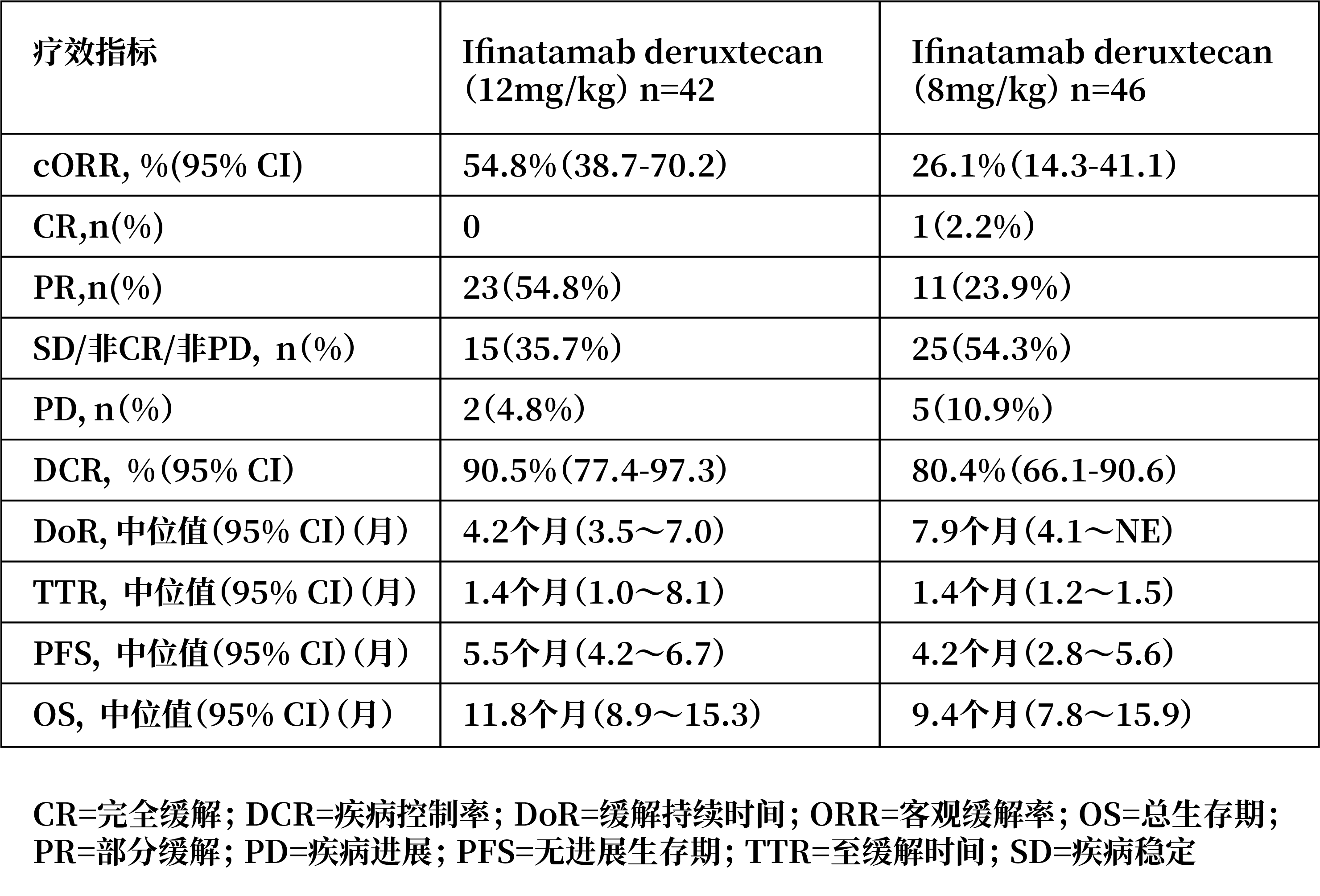
Image Source: Daiichi Sankyo Official WeChat
About IDeate-Lung01 Study
IDeate-Lung01 is a global, multicenter, randomized, open-label Phase II study to evaluate the safety and efficacy of ifinatamab deruxtecan in patients with ES-SCLC. The study is divided into two parts: in the first part (dose optimization), patients had previously received at least one line of platinum-based chemotherapy and up to three lines of treatment. In the second part (dose expansion), patients had previously received at least two lines of systemic therapy.
In the first part of the study, patients were randomly assigned in a 1:1 ratio to receive either 8 mg/kg or 12 mg/kg of ifinatamab deruxtecan. In the second part of the study, patients received ifinatamab deruxtecan at the recommended expansion dose (12 mg/kg).
The primary endpoint was the ORR assessed by BICR. Secondary endpoints included DoR, PFS, OS, DCR, TTR, and overall safety. Intracranial ORR assessed by BICR was analyzed exploratorily.
The IDeate-Lung01 study is recruiting patients from Asia, Europe, and North America. For more information about this study, please visit ClinicalTrials.gov.
About B7-H3
B7-H3 is a transmembrane protein belonging to the B7 protein family, which binds to the CD28 receptor family, including PD-1[11,12]. B7-H3 is overexpressed in various cancer types, including small cell lung cancer, and its overexpression has been shown to correlate with poor prognosis, making B7-H3 one of the promising therapeutic targets[4,12,13,14,15]. Currently, there are no drugs targeting B7-H3 approved for the treatment of any cancer.
About Ifinatamab Deruxtecan
Ifinatamab deruxtecan (I-DXd) is an investigational potential first-in-class B7-H3-targeted ADC. Ifinatamab deruxtecan is designed using Daiichi Sankyo's proprietary DXd ADC technology and consists of a humanized anti-B7-H3 IgG1 monoclonal antibody linked through a cleavable tetrapeptide linker to multiple topoisomerase I inhibitor payloads (a derivative of exatecan, DXd).
Currently, ifinatamab deruxtecan is being evaluated in global development programs, including IDeate-Lung01, a Phase II monotherapy study in previously treated ES-SCLC patients; IDeate-Lung02, a Phase III study comparing it with investigator’s choice of chemotherapy in patients with recurrent SCLC; IDeate-Lung03, a Phase Ib/II study assessing this product in combination with atezolizumab, with or without carboplatin, as first-line induction or maintenance therapy in ES-SCLC patients; and IDeate-PanTumor01, a Phase I/II first-in-human study conducted in collaboration with the Sarah Cannon Research Institute (SCRI) in patients with advanced malignant solid tumors. The supervision and execution of this study are managed by SCRI Development Innovations, an early-phase oncology clinical research organization based in Nashville, Tennessee.
Ifinatamab deruxtecan was granted Orphan Drug Designation by the U.S. Food and Drug Administration in April 2023 and by the European Commission in February 2024 for the treatment of SCLC.

Editor: Mu Mian
Disclaimer: This article is a reprint from Yaozhi.com. The images and text are the original property of their respective owners. The purpose of the reprint is to convey more information and does not represent the views of this platform. If there are any issues regarding the content, copyright, or other aspects, please leave a message on this platform, and we will address it promptly.