

Sanofi Enters Nuclear Medicine Arena with €3.2B Deal for AlphaMedix, a Next-Gen Targeted Alpha Therapy for Rare Cancers
Radiomedix
Targeted Radiopharmaceuticals Developer

Orano Med
Radiopharmaceuticals Developer

Sanofi
Pharmaceutical R&D Developer
On September 12 local time, Sanofi, RadioMedix, and Orano Med announced a licensing agreement for the next generation of radioligand therapy (RLT) for rare cancers.This collaboration will focus on RadioMedix's leading project in the field of radioligand therapy for rare cancers, AlphaMedix (212Pb-DOTAMTATE). AlphaMedix is a Targeted Alpha Therapy (TAT) consisting of a somatostatin receptor-targeting peptide complex radiolabeled with lead-212 (Pb-212), serving as an in vivo generator of alpha particles.
Under the terms of the agreement, RadioMedix and Orano Med will receive an upfront payment of 100 million euros and sales milestone payments of up to 220 million euros (totaling 320 million euros, approximately 2.51 billion Chinese yuan), and are eligible for tiered royalties. After the partnership is finalized, Sanofi will be responsible for the global commercialization of the project, while Orano Med will oversee the production of AlphaMedix through its global industrial platform.
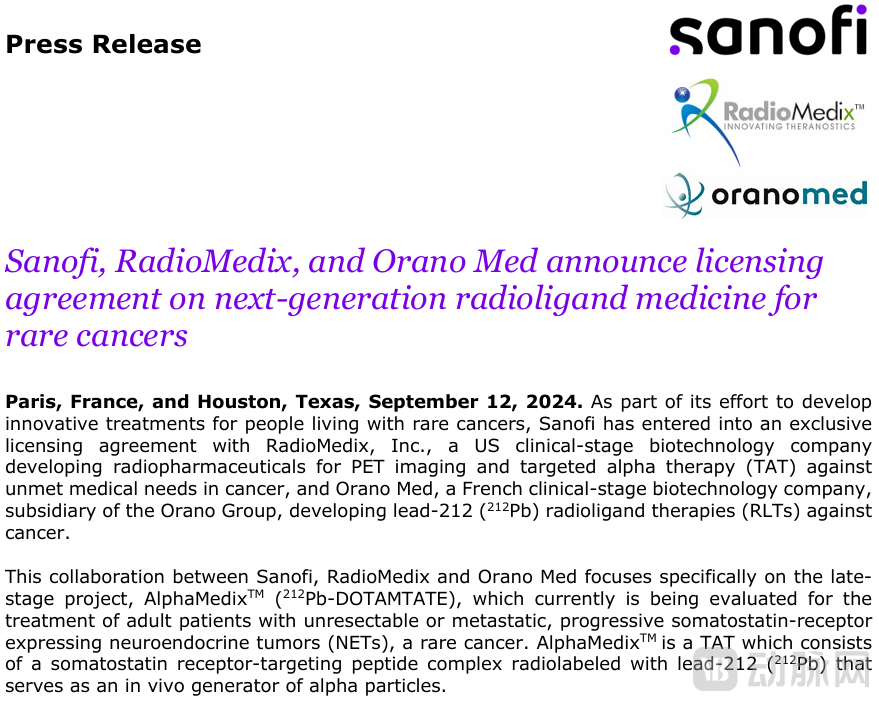 Source: Sanofi official website
AlphaMedix:
FDA-Approved Global Hotspot Radiopharmaceuticals
AlphaMedix(²¹²Pb-DOTAMTATE) is a radiopharmaceutical therapy developed through the collaboration between RadioMedix and Orano Med. It is also one of the globally leading radionuclide drugs, suitable for subjects with unresectable metastatic somatostatin receptor (SSTR)-positive neuroendocrine tumors (NET).
AlphaMedix consists of a peptide complex targeting SSTR labeled with Pb-212, which serves as an in vivo generator of alpha particles. The Pb-212 isotope is particularly suitable for SSTR therapeutic applications due to its half-life, high energy, short decay path length, and irreversible damage to double-stranded DNA. This therapy received Orphan Drug Designation (ODD) from the FDA in 2018 and won the TechConnect Innovation Award in 2020.
In February this year, the FDA also granted AlphaMedix Breakthrough Therapy Designation (BTD) for the treatment of adults with unresectable or metastatic gastroenteropancreatic neuroendocrine tumors (GEP-NETs) expressing somatostatin receptors who are eligible for peptide receptor radionuclide therapy (PRRT).
Its Breakthrough Therapy Designation is based on the results of Phase I and ongoing Phase II clinical trials, which evaluated the safety and efficacy of AlphaMedix.In Phase I study, AlphaMedix was well-tolerated and significantly reduced tumor burden, with a durable response rate (ORR per RECIST 1.1) of 62.5%.
Join the "Nuclear" War, "Challenge" Novartis
Radiopharmaceuticals represent an entirely new area for Sanofi. During the Q2 earnings call, Houman Ashrafian, Sanofi’s R&D head, stated that the company currently has no radiopharmaceutical projects in its pipeline. "We are being cautious in this space and considering approaches that would truly differentiate our therapies."A spokesperson for Sanofi also confirmed that AlphaMedix is the first radioligand therapy in Sanofi's pipeline.
However, in this new field that Sanofi is attempting to explore, there is already a therapeutic radiopharmaceutical targeting SSTR approved globally—Novartis' Lutathera. Once the AlphaMedix therapy is launched, it will quickly compete with Novartis' radiopharmaceutical, Lutathera.
Lutathera is a β-particle radiotherapy based on lutetium-177, which Novartis acquired in 2017 for $3.9 billion through the purchase of Advanced Accelerator Applications. Lutathera, as a peptide receptor radionuclide therapy (PRRT) drug, can be used to treat somatostatin receptor (SSTR)-positive gastroenteropancreatic neuroendocrine tumors (GEP-NETs).
However, compared with β-particle radiopharmaceuticals, α-nuclide radiopharmaceuticals have unique advantages in tumor treatment. Specifically, α-nuclides emit α-particles during decay, and their linear energy transfer (LET) is nearly a hundred times higher than that of β-nuclides, resulting in significantly better tumor-killing effects. On the other hand, β-nuclides damage single-stranded DNA in tumor cells, which can be repaired, potentially leading to tumor recurrence. However, α-nuclides directly damage double-stranded DNA in tumor cells, causing permanent cell death, and are thus known as "radiation therapy with surgical precision."
In addition, clinical trial data also show that alpha nuclides can trigger tumor immune responses while killing cancer cells, which has a mutually reinforcing effect with immunotherapy, achieving a "one plus one greater than two" effect in cancer treatment. In terms of safety: the range of alpha nuclides is short, only a few cells, causing minimal damage to normal tissues and almost no side effects, thus offering higher safety.
This also means that AlphaMedix has potential high efficiency and selectivity in cancer treatment, which may make it more advantageous than β-particle therapy in certain situations. However, the above is only theoretical, and the specific efficacy still depends on AlphaMedix's subsequent actual clinical data.
On the other hand, for AlphaMedix to challenge Lutathera's market position, it faces not only the test of various data such as efficacy and safety but also the currently unshakable position of Novartis, the veteran in nuclear medicine.Besides Lutathera, Novartis also has another blockbuster radiopharmaceutical, Pluvicto, in the nuclear medicine field. In mid-July this year, Novartis released its 2024 H1 financial report, showing that the highly anticipated radiopharmaceutical Pluvicto achieved a 45% growth in the first half of the year, with sales reaching $655 million, while Lutathera's sales amounted to $344 million. The total revenue from the two radiopharmaceuticals was nearly $1 billion.
Novartis' deep cultivation in the field of nuclear medicine and its extensive product portfolio provide it with a strong competitive advantage in the market, making Novartis the undisputed "leader in nuclear medicine." Sanofi needs to demonstrate more advantages in terms of clinical efficacy, market promotion, and product differentiation.
Despite being a "newcomer" in the nuclear medicine field, the collaboration pipeline this time targets the rare disease market that Sanofi "dominates."
AlphaMedix is indicated for patients with unresectable metastatic somatostatin receptor (SSTR)-positive neuroendocrine tumors (NET). Neuroendocrine tumors are a heterogeneous and rare type of cancer originating from neuroendocrine cells.These cancers primarily occur in the gastrointestinal tract and pancreas but can also arise in other tissues, including the thymus, lungs, and other rare sites such as the ovaries, heart, and prostate. Most NETs strongly express somatostatin receptors. In the United States, it is estimated that approximately 12,000 patients are diagnosed with neuroendocrine tumors annually, with an average 5-year survival rate of 60% in the metastatic stage. Although the global incidence of NETs is increasing yearly, it is still considered a rare cancer, with an estimated 35 cases per 100,000 people worldwide.
In the field of rare diseases, Sanofi is undoubtedly a "veteran player." Since acquiring Genzyme, the orphan drug giant, for $20.1 billion in 2011, Sanofi's position in the rare disease drug market has continued to rise, maintaining an absolute dominant status. According to incomplete statistics from the PharmaCube database, Sanofi has been involved in 20 licensing-in deals in the rare disease sector over the past five years, with a cumulative total transaction value exceeding $12.5 billion.
However, Sanofi's dominant position is currently being challenged, one of which is the expiration of product patents, facing the impact of generic drugs. For example, Aubagio, a treatment for multiple sclerosis, was once Sanofi's flagship product, with sales second only to Dupixent, flu vaccines, and Lantus. However, after its patent expired in 2023, Aubagio's sales in 2023 decreased by 52.6% year-on-year.
To strengthen its position in the rare disease market, Sanofi has been actively introducing new pipeline candidates in the hope of finding products with more differentiated advantages.
In January this year, Sanofi announced that it had entered into a definitive agreement with nhibrx. According to the agreement, Aventis, a subsidiary of Sanofi located in Pennsylvania, will acquire all assets and liabilities related to INBRX-101. INBRX-101 is a rare disease therapy used to treat emphysema patients caused by Alpha-1 Antitrypsin Deficiency (AATD).
In May this year, Sanofi and Fulcrum reached a cooperation licensing agreement on the development and commercialization rights of the new drug Losmapimod under research. The indication for Losmapimod is Facioscapulohumeral Muscular Dystrophy (FSHD). FSHD is a hereditary rare disease that mainly affects the face, shoulders, and upper arms, manifesting as muscle weakness and atrophy, and it is the second most common muscular dystrophy.
With this cooperation, it is already Sanofi's third move in the rare disease field this year.
Currently, Sanofi has a total of 11 ongoing R&D pipelines in the rare disease field, with six candidate products in Phase 3 clinical trials. In 2023, Sanofi's revenue was approximately $47.097 billion, representing a year-on-year increase of 5.3%. In terms of sales composition, products in the rare disease sector have become one of its primary sources of income. Notably, three rare disease products—Nexviazyme/Nexviadzyme, Enjaymo, and Xenpozyme—have shown outstanding performance, all maintaining growth rates exceeding 100%.
However, in terms of sales growth, despite the impressive performance of Enjaymo and Xenpozyme, their respective sales have yet to break through the $100 million mark, making it difficult to offset the gap caused by the decline in Aubagio's sales in the short term. Moreover, out of $47.097 billion in revenue, Dupixent generated approximately $11.58 billion in sales, accounting for about one-quarter of Sanofi’s 2023 income. Over-reliance on and heavy investment in a single product may pose development risks for Sanofi. Consequently, Sanofi is undergoing restructuring and optimization to raise funds and accelerate its expansion into areas such as rare diseases and autoimmune disorders, hoping to discover the next blockbuster product with differentiated advantages.
References:
1. VCBeat Biotech, "Sanofi: Joining the 'Nuclear' War"
2. VCBeat, "$110 Million Upfront Payment! Sanofi Enters the Radiopharmaceuticals Arena"