

Fosun's Long-Acting Botulinum Toxin Approved as China's Sixth Entrant; East China Pharma and Others Follow in Heated Market Competition
Fosun Pharmaceutical
Healthcare Industry Group
Huadong Medicine
Large Comprehensive Pharmaceutical Product Developer
Ipsen
Biopharmaceutical Manufacturer
As multiple companies enter the market, China's botulinum toxin industry is now facing a new situation of being divided among various players.
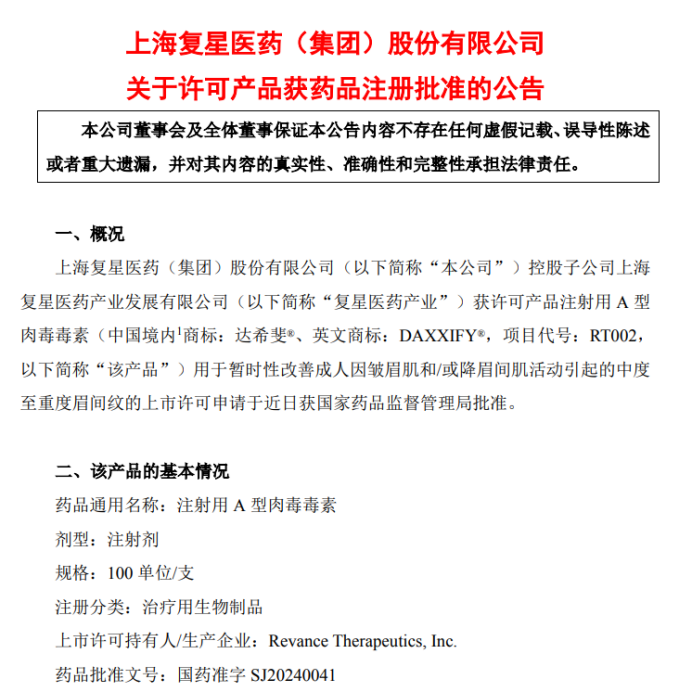
Recently, Fosun Pharmaceutical announced that its imported injectable Type A botulinum toxin (domestic name in China: Daxifil) has been officially approved for marketing. It is used for the temporary improvement of moderate to severe glabellar lines in adults caused by the activity of the corrugator and/or procerus muscles. This product is the world's first patented peptide long-acting Type A botulinum toxin. With this approval, it will become the sixth Type A botulinum toxin product to be marketed in China.
In addition to Fosun Pharmaceutical, Merz Aesthetics' Cymoplast was also approved for marketing in China this March. Earlier, four botulinum toxin products—Hengli by Lanzhou Biotechnique Development Co., Ltd., Botox by Allergan, Dysport by Ipsen, and Letibelle by South Korea's Hugel—had already been successively approved for marketing in China.
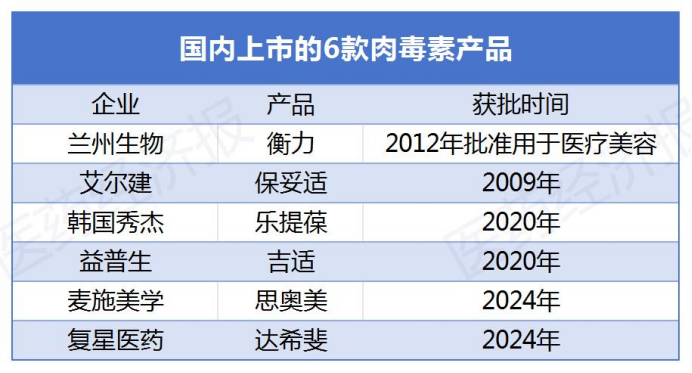
In addition, Huadong Medicine's botulinum toxin product is also actively undergoing registration, with in-development products from Daewoong Pharmaceutical, PPD, Zydus Cadila, and Haohai Biotech following closely behind. As large pharmaceutical companies enter and lay out their strategies in the botulinum toxin market, it may reshape the entire market landscape.
More indications are on the way.
Public information shows that Daxifei is a new generation of type A botulinum toxin product (code-named RT002) introduced by Fosun Pharmaceutical for over 80 million US dollars. Previously, the US FDA has approved its use for treating moderate to severe glabellar lines in adults. This therapy is expected to maintain wrinkle removal throughout the year with only two injections per year.
It is reported that RT002 is a novel, next-generation, long-acting neuromodulator developed based on Revance's proprietary technology platform, with the active pharmaceutical ingredient being daxibotulinumtoxinA. RT002 does not contain any human blood-derived substances or animal-derived proteins in its formulation and can maintain stability for two years without refrigeration. Importantly, the product exhibits prolonged activity, with a median efficacy duration of 6 months, and in some participants, the effects of a single injection can last up to 9 months.
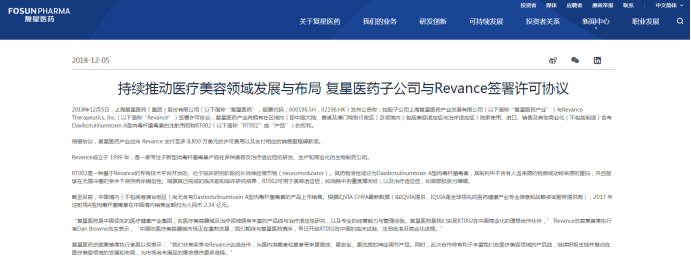
In December 2018, Fosun Pharmaceutical's subsidiary, Fosun Pharmaceutical Industry, signed a licensing agreement with Revance Therapeutics, thereby obtaining exclusive rights for the use, import, sale, and other commercialization (excluding manufacturing) of RT002 in mainland China, Hong Kong, and Macao. Revance Therapeutics remains the rights holder of this new drug within the region. For this, Fosun Pharmaceutical Industry should pay up to 88 million US dollars in licensing fees and corresponding sales milestone payments to the latter.
According to the Chinese Clinical Trial Registry and Information Disclosure Platform, the Phase 3 clinical study in China for RT002 in treating moderate to severe glabellar lines, as well as the China extension study (ASPEN-1-CN) of the international Phase 3 clinical study for treating isolated cervical dystonia, have both been completed. This time, RT002 has been approved for marketing in China and can be used to improve moderate to severe frown lines in adults. The new indication for RT002 for treating adult cervical dystonia is currently under FDA registration review, and the marketing application for the same indication in China was also accepted in July 2023.
Traditional pharmaceutical companies have entered an era of thin profits, and transforming to seek new profit growth points is not only a strategic choice but also a necessary path for survival. Against this backdrop, Fosun Pharmaceutical has diversified its layout in the medical aesthetics field. It is reported that Fosun Pharmaceutical established a controlling subsidiary, Sisram Medical, in 2013 and acquired Alma Laser, an Israeli medical beauty device manufacturer. Since then, it has continuously expanded its presence in the medical aesthetics sector, deeply penetrating various细分 tracks within the industry, covering multiple fields such as outpatient services, plastic surgery hospitals, cosmetic dentistry, and personal care businesses.
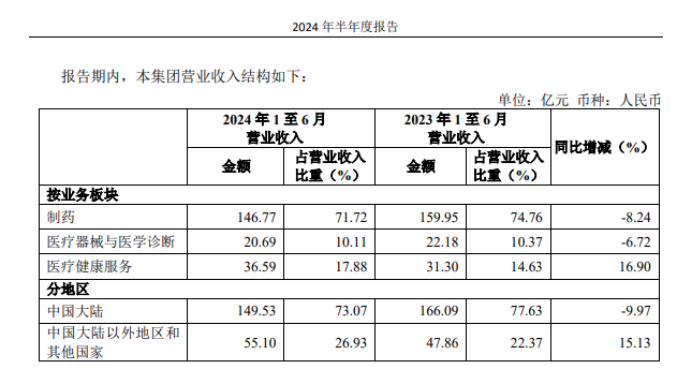
In the first half of 2024, Fosun Pharmaceutical's pharmaceutical business achieved revenue of 14.677 billion yuan, a year-on-year decrease of 8.24%, accounting for 71.72% of total revenue. Among this, Fosun Pharmaceutical’s innovative drugs generated revenue of over 3.7 billion yuan; the medical devices and medical diagnostics business achieved revenue of 2.069 billion yuan, a year-on-year decrease of 6.72%, accounting for 10.11% of total revenue; the healthcare services business achieved revenue of 3.659 billion yuan, a year-on-year increase of 16.9%, accounting for 17.88% of total revenue.
Fosun Pharmaceutical's Important Layout in the Medical Aesthetics Sector: Fosy Medical Technology, which achieved a revenue of $169 million and a net profit of $13 million in the first half of 2024. Previous annual reports showed that while actively expanding its original energy-based medical aesthetics equipment business, Fosy Medical Technology also made strategic business deployments in aesthetic dentistry, injectable fillers, personal care, and promoted integration. Additionally, Fosy Medical Technology participated in the investment of Tianjin Xing Si Yi, to develop silk fibroin sodium hyaluronate composite gel and facial threading products.
However, the transformation of pharmaceutical companies into the medical aesthetics market still requires a process. In the industry's view, due to the characteristics of medical aesthetic products, the specific sales of drugs may be affected by factors (including but not limited to) medication demand, market competition, and sales channels, with significant uncertainty. As the sixth botulinum toxin product in China, it remains to be seen whether the approval of Daxifib can break the previous market pattern of "five powers dividing the market." Meanwhile, botulinum toxin products from other companies such as Huadong Medicine are close behind, and market competition will become even more intense.
The "Era of Botulinum Toxin" Has Arrived
The scientific name of Botulinum Toxin is Botulinum Neurotoxin, also known as Botox, which is a neurotoxin produced by Clostridium botulinum.Botulinum toxin is a protein that can block the release of acetylcholine from nerve endings, thereby inhibiting muscle contraction.As a biopharmaceutical product, botulinum toxin is widely used to treat glabellar lines, blepharospasm, hemifacial spasm, related dystonia, and strabismus.In cosmetic medicine, botulinum toxin is widely used to reduce facial wrinkles. By injecting it into specific muscles, it can temporarily reduce muscle activity, thereby decreasing the formation of wrinkles.
Hyaluronic acid and botulinum toxin have always been two major blockbuster product categories in the medical aesthetics market. According to Frost & Sullivan, the market size of botulinum toxin products for medical aesthetics in China was 3.9 billion yuan in 2020 based on sales revenue (ex-factory price), and it is expected to reach 11.4 billion yuan by 2025.
As more products gain approval from drug regulatory authorities for market entry, the types and price ranges of legitimate products will be greatly enriched. The market share of illegal counterfeit products with safety hazards will be continuously squeezed, and the proportion of legitimate sales is expected to keep rising. By 2025, the scale of China's legitimate botulinum toxin products is projected to increase to over 50%.
Lanzhou Biotechnique Development Co., Ltd., Allergan, and Ipsen, as the main players in China's botulinum toxin market, are also constantly seeking strategies to expand their market share and enhance product competitiveness. Allergan's Botox, the global sales champion, is already approved for 30 different indications including glabellar lines and frown lines. Additionally, Botox adheres to a strict doctor training and certification system in China through the company’s “Allergan Academy.” This initiative conducts year-round "Injection Physician Training" in collaboration with major medical aesthetics institutions, which has also built a strong reputation for the brand.
As a shining example of Chinese products, Hengli by Lanzhou Biotechnique Development Co., Ltd. is the earliest approved botulinum toxin brand in China, offering good value for money. Its retail price is only 1/4 that of Botox, making it more suitable for large-area injections. To date, Hengli has been successfully sold in over 30 countries and enjoys a strong reputation in the international market.
The vast potential market space has prompted multiple companies to compete in the layout of this product. Huadong Medicine, Aimeike, Kangzhe Pharmaceuticals, Haohai Biotech, and Inming Biotechnology are still aggressively preparing to enter the botulinum toxin sector. Based on the current clinical approval progress, it is estimated that nine botulinum toxin products will be launched in the next 3-5 years. At that time, the botulinum toxin industry will also enter the second half of even more intense competition.
Medical aesthetics is a differentiated business segment that Huadong Medicine has been strongly promoting in recent years. In August 2020, Huadong Medicine signed a strategic cooperation agreement with Jetema, a South Korean listed company, to obtain the exclusive agency rights for its Type A botulinum toxin product in China. Jetema applied for the IND of its Type A botulinum toxin product in China in 2021, with an expected approval for market launch in 2024. In 2023, Huadong Medicine introduced the injectable solution "ATGC-110" containing Type A botulinum toxin from ATGC Co., Ltd., a South Korean company, which is currently in Phase 3 clinical trials.
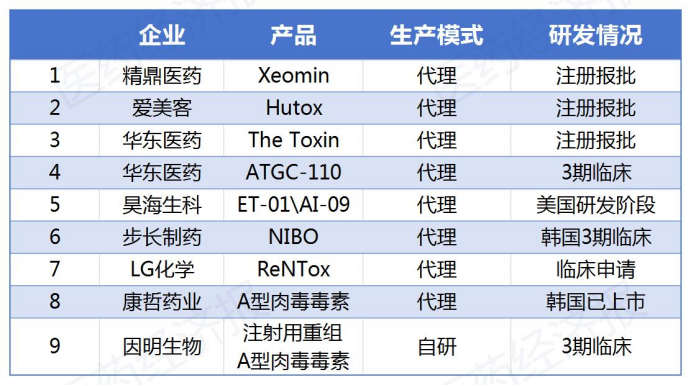
Overall, the botulinum toxin market in China is still in its early stages of development. According to statistics, botulinum toxin accounts for about 33% of non-surgical procedures in China, while in the more mature U.S. market, it accounts for 76%. The gap between the two presents vast room for imagination. The evolution from "four major players" to "six powerful competitors" is not the final answer, but rather a critical milestone in the industry's long developmental journey. With the continuous expansion of the market and the increasing consumer demand, it is expected that more players will enter the domestic botulinum toxin market in the future, leading to even fiercer competition.
Editor: Allen

www.yyjjb.com.cn
Insight into Industry Trends
"Pharmaceutical Economy Herald"
Academic Official Account
Focus on the Frontiers of Oncology Academia

Terminal Official Account