

AstraZeneca’s Imfinzi Plus Imjudo Shows Unprecedented Survival Benefit in Advanced Liver Cancer, Nearly Tripling 5-Year Survival Rate in Phase III HIMALAYA Trial

AstraZeneca
Biopharmaceutical Manufacturer
▎WuXiEdited by Kant Content Team
AstraZeneca announced impressive data for its key immunotherapy Imfinzi (durvalumab) combination therapy at the 2024 European Society for Medical Oncology (ESMO) Congress. In the HIMALAYA Phase 3 clinical trial, the combination of Imfinzi and Imjudo (tremelimumab) demonstrated an improvement in 5-year overall survival rates in patients with advanced hepatocellular carcinoma (HCC) compared to the standard treatment regimen.According to the press release, the combination therapy demonstrated an "unprecedented" overall survival (OS) advantage in this patient population, with nearly 20% of patients surviving beyond five years, whereas previous trial results showed only about 7% of patients lived this long.AstraZeneca also announced positive results from the Phase 3 NIAGARA clinical trial. Imfinzi in combination with chemotherapy demonstrated statistically significant and clinically meaningful improvements in both the primary endpoint of event-free survival (EFS) and the key secondary endpoint of overall survival (OS) compared to neoadjuvant chemotherapy in patients with muscle-invasive bladder cancer (MIBC).According to the press release, this is the first immunotherapy regimen used pre- and post-surgery that has demonstrated statistically and clinically significant improvement in overall survival for this patient population.The trial results were simultaneously published in The New England Journal of Medicine.

Liver cancer is the third leading cause of cancer death, with nearly 900,000 people worldwide diagnosed with liver cancer each year. The incidence of liver cancer is particularly high in some parts of Asia. It is estimated that 80-90% of hepatocellular carcinoma patients have cirrhosis. More than half of liver cancer patients are already at an advanced stage at the time of diagnosis. The prognosis for advanced liver cancer is poor, with a five-year survival rate of only 7%.
Imfinzi is an anti-PD-L1 monoclonal antibody that解除肿瘤细胞对免疫反应的抑制 by blocking the binding of PD-L1 to PD-1 and CD80 proteins. Imjudo is an anti-CTLA-4 monoclonal antibody that promotes T-cell activation and stimulates the immune system's response to cancer by blocking the activity of CTLA-4.Imfinzi in combination with Imjudo has been approved in the United States, the European Union, Japan, and several other countries for the treatment of adult patients with advanced or unresectable hepatocellular carcinoma.

HIMALAYA is a randomized, open-label, multicenter, global Phase III clinical trial designed to evaluate the efficacy and safety of Imfinzi monotherapy and the STRIDE regimen compared with the multikinase inhibitor sorafenib.STRIDE Regimen (Single Tremelimumab Regular Interval Durvalumab) isThe combination therapy of Imfinzi and Imjudo, utilizing an innovative dosing and administration regimen, includes a single initial dose of Imjudo (300 mg) in combination with Imfinzi (1,500 mg), followed by Imfinzi administered every four weeks thereafter. This trial enrolled a total of 1,324 patients with unresectable advanced hepatocellular carcinoma who had not previously received systemic therapy and were ineligible for locoregional treatments.
After five years of follow-up, the latest exploratory analysis of HIMALAYA shows,Compared with the active control drug, the STRIDE regimen reduced the risk of death by 24% (HR=0.76, 95% CI: 0.65-0.89).It is estimated that the five-year survival rate for patients treated with the STRIDE regimen is 19.6%, compared to 9.4% for patients treated with active comparator drugs.According to the press release, this trial represents the longest survival follow-up reported for such immunotherapy.Phase 3 Trial One。

An analysis of the subgroup of patients who achieved disease control (i.e., complete response, partial response, or stable disease) in the trial showed, In the STRIDE regimen treatment group, 28.7% of patients survived within five years, compared to only 12.7% in the active comparator drug treatment group.In addition, the depth of relief (DpR) An exploratory analysis showed that, compared with the active control drug,More patients treated with the STRIDE regimen experienced deep remission, thereby prolonging survival.
Susan Galbraith, PhD, Senior Vice President of Oncology R&D at AstraZeneca, stated: "ContactNearly 20% of advanced liver cancer patients treated with the STRIDE regimen survived for five years, compared to only about 7% historically."This is an important step forward, establishing a new standard for survival."
The safety of the STRIDE regimen is consistent with the known safety profiles of its component drugs, and no new safety signals were observed during longer follow-up. Among patients treated with the STRIDE regimen, 17.5% experienced serious treatment-related adverse events, compared to 9.9% in those treated with the active comparator.
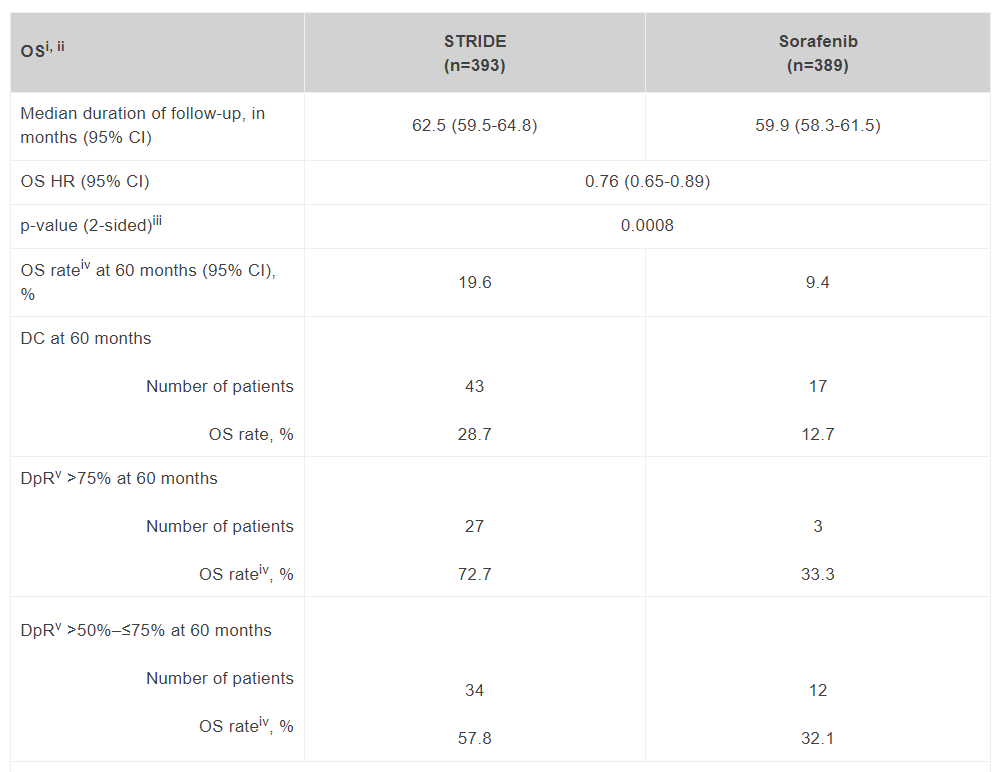
▲Summary of HIMALAYA Trial Results (Source: Reference [1])
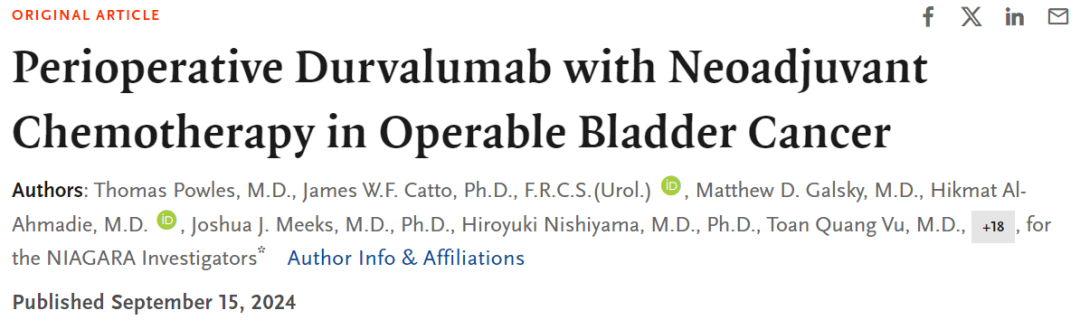
AstraZeneca also announcedNIAGARAClinical3Positive results from the trial period.NIAGARAIs a randomized, open-label, multi-center global3Phase clinical trial, evaluationImfinziTreatment Before and After Radical CystectomyMIBCThe therapeutic effect of the patient.In the trial,1063Patients were randomly assigned to receive treatment before cystectomy surgery.ImfinziCombined chemotherapy or single-agent chemotherapy, followed by postoperativeImfinziOr no further treatment will be performed.
The pre-specified interim analysis showed that the combination therapy of Imfinzi significantly improved EFS and OS in patients.Compared with the control group, patients treated with the Imfinzi perioperative regimen had a 32% reduction in the risk of disease progression, recurrence, inoperability, or death (HR=0.68, 95% CI: 0.56-0.82; p<0.0001).The estimated median EFS in the Imfinzi group has not yet been reached, while it is 46.1 months in the control group.An estimated 67.8% of patients treated with the Imfinzi regimen were event-free at two years, compared to 59.8% in the control group.
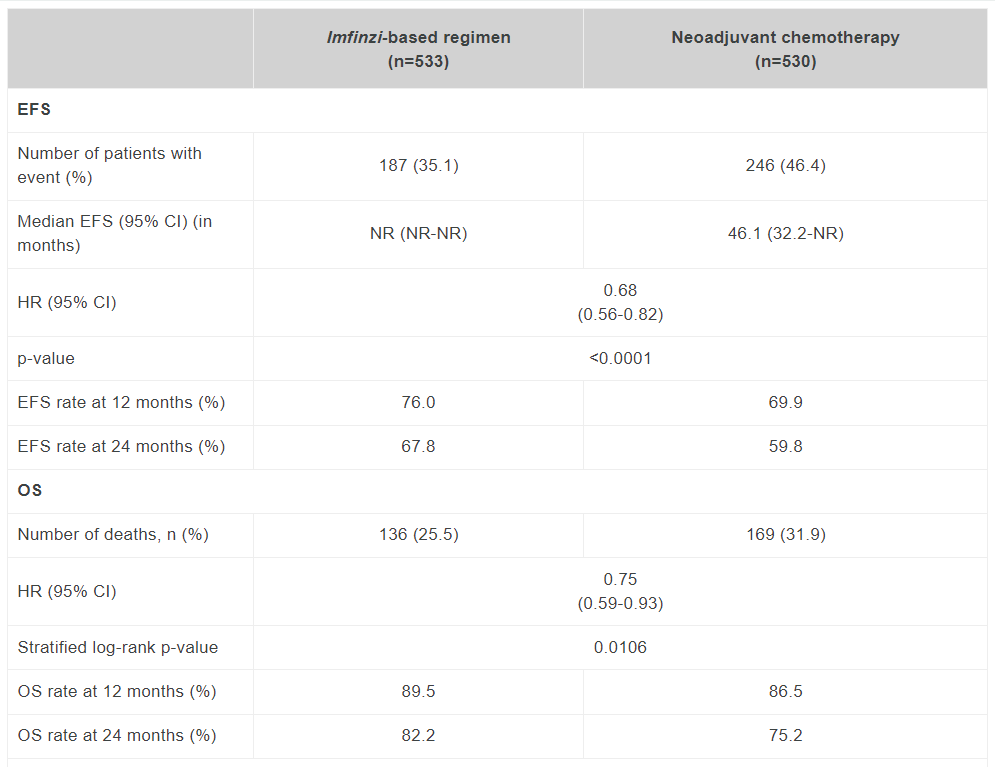
▲NIAGARASummary of Test Results (Image Source: Reference [2])
Susan Galbraith, PhD, said: "The NIAGARA data show significant improvements in event-free survival and overall survival for patients. More than 80% of patients treated with the Imfinzi perioperative regimen were alive at two years."This is the first immunotherapy regimen to significantly extend overall survival in muscle-invasive bladder cancer.”
InESMOAt the conference, AstraZeneca also announced itsB7-H4Targeted Antibody-Drug Conjugates (ADC)AZD8205In clinical1/2aPreliminary results from the treatment of patients with solid tumors in the Phase trial.AZD8205 is an ADC developed internally by AstraZeneca, consisting of a linker developed by the company and a Type I topoisomerase inhibitor payload.The therapy targetsB7-H4It is a receptor expressed in endometrial cancer, ovarian cancer, breast cancer, and cholangiocarcinoma.
The analysis shows,Among 46 heavily pretreated patients with solid tumors, nine achieved partial responses, including those with endometrial cancer, ovarian cancer, and breast cancer.No patients with biliary tract cancer experienced any relief. Some patients had durable responses, with relief and stable disease lasting up to 76 weeks as of the data cutoff. AstraZeneca is studying AZD8205 as a monotherapy in patients with endometrial cancer, ovarian cancer, breast cancer, and biliary tract cancer.

▲To learn more about the application of cutting-edge technologies in the biopharmaceutical industry, please long-press and scan the QR code above to access "WuXi Live Studio" and watch live discussions and exciting replays on related topics.


Share,PointLike,In View, Focusing on Global Biomedical Health Innovation