

Boston Scientific Completes $1.18 Billion Acquisition of Silk Road Medical, Pioneer of TransCarotid Artery Revascularization (TCAR)

Silk Road Medical
Minimally Invasive Medical Device Developer

Boston Scientific
Medical Device Manufacturer
On September 17, Boston Scientific announced the completion of its acquisition of Silk Road Medical (NASDAQ: SILK) for $1.18 billion (approximately RMB 8.37 billion).
The purchase price of this acquisition is $27.50 per share, with a total enterprise value of approximately $1.18 billion. Boston Scientific expects this acquisition to have minimal impact on its adjusted earnings per share for 2024 and 2025, and anticipates it will generate incremental value thereafter. Due to amortization expenses and acquisition-related net costs, the impact on GAAP earnings per share is expected to be less accretive or dilutive.
"Completing this acquisition enables Boston Scientific to leverage our extensive commercial network to bring the innovative TCAR platform to more physicians and their patients, thereby enhancing our vascular technology solutions," said Cat Jennings, President of Boston Scientific's Peripheral Interventions division. "Integrating the TCAR platform into our portfolio means we can offer a treatment option for patients with carotid artery disease that reduces stroke risk and improves patient outcomes."
Headquartered in Sunnyvale, California, Silk Road Medical is dedicated to reducing the risk of stroke during the treatment of carotid artery disease through innovative and minimally invasive technologies. Silk Road Medical pioneered the TransCarotid Artery Revascularization (TCAR) procedure and developed a portfolio of medical device products to support it.
Before the advent of the TCAR procedure, for moderate to severe carotid artery disease, the clinical options generally included Carotid Endarterectomy (CEA) and Transfemoral Carotid Artery Stenting (TFCAS). However, CEA involves significant surgical trauma, requires general anesthesia, has a longer recovery period post-operation, and carries risks of cranial nerve injury, bleeding, and infection. TFCAS involves a longer surgical pathway, and when the catheter passes through the aortic arch and carotid artery, it can easily cause plaque dislodgement, increasing the risk of intraoperative cerebral infarction. For patients with complex vascular anatomy, the procedure is more difficult and carries higher risks.
Silk Road Medical's TransCarotid Artery Revascularization (TCAR) effectively eliminates the drawbacks of traditional surgical methods.
The company has developed the ENROUTE® Transcarotid Neuroprotection System (ENROUTE NPS), which supports the procedure with its patented blood flow reversal technology. As a safe and minimally invasive treatment for carotid artery disease, TCAR combines surgical principles of neuroprotection with minimally invasive endovascular techniques to treat carotid artery blockages that could lead to stroke. Compared with traditional open surgery (CEA), TCAR has demonstrated a lower risk of acute heart attack, a lower incidence of nerve injury, shorter operation time, and reduced hospital stays for patients.
Through TCAR, vascular surgeons can directly access the carotid artery and perform flow reversal during angioplasty and stenting. The TCAR procedure takes approximately 45 minutes to 1 hour and can be performed under general or local anesthesia.
During the surgery, a specialized sheath is placed in the artery to provide access for the procedure. The sheath is first connected to a flow reversal system, which protects the brain throughout the surgery. The flow reversal is provided by the Enroute Transcarotid Neuroprotection System, temporarily diverting arterial blood flow away from the brain, through a filter, and back into a vein in the leg, protecting the brain from harmful debris. Throughout the procedure, the brain continues to receive a constant supply of blood. Then, the Enroute Transcarotid RX Balloon, specifically designed for TCAR, can be used for pre-dilation and preparation of the vessel for stent placement. Next, the Enroute Transcarotid Stent is placed, a flexible metal mesh tube that stabilizes plaque against the arterial wall, helping to prevent potential strokes.
TCAR Adopts a More Minimally Invasive Approach Than CEA, Achieving More Significant Patient Benefits, Including Improved Treatment Outcomes and Reduced Incidence of Adverse Events. Cranial Nerve Injury is the Most Common Neurological Complication of CEA. In Clinical Trials, the Incidence of Cranial Nerve Injury Ranges from 5.1% to 8.6%. Compared with CEA, Transcarotid Artery Revascularization (TCAR) Significantly Reduces Scarring and the Incidence of Cranial Nerve Injury Due to Smaller Incisions. Moreover, TCAR Significantly Reduces Clamping Time and Overall Procedure Time Compared with CEA.
During TransCarotid Artery Revascularization (TCAR), the reverse blood flow technology of TCAR can provide comprehensive neuroprotection for patients. According to published data, the intraoperative stroke rate of TCAR is 0.6%, which is the lowest reported stroke rate among all carotid artery interventions.
In addition, the TCAR procedure requires less time, and patients who undergo TCAR have a 26% lower likelihood of staying in the hospital for more than one day.
In 2015, Silk Road Medical launched the ENROUTE® Transcarotid Retrograde Neuroprotection System in the United States, marking the birth of the TCAR procedure. In terms of products, the TCAR product series mainly includes five major systems:
ENROUTE® Carotid Neuroprotection System prevents embolic debris from flowing to the brain during carotid revascularization by reversing blood flow direction. This reverse-flow method does not rely on distally placed filters to capture emboli before they reach the brain. Instead, the filter in the flow controller collects both small and large debris, and the filtered blood is returned to the body through a sheath in the femoral vein. The device removes both micro and macro emboli throughout the intervention, achieving CEA-like neuroprotection in a less invasive manner.
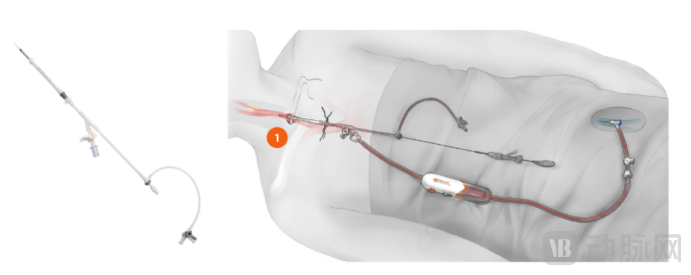
ENROUTE® Transcarotid Neuroprotection System
ENROUTE® Carotid Stent System. According to Silk Road Medical, this is the first and only carotid stent system designed and suitable for transcarotid access. The system is specifically designed for TCAR to achieve long-term plaque stabilization, preventing future strokes. Specifically, the delivery device of the stent system is 57 centimeters in length. The short delivery system design allows for more ergonomic handling by physicians and more precise placement of the stent at the target location. Additionally, the stent’s cell design has been optimized to provide broader coverage compared to other open-cell stent designs and can automatically adapt to various complex anatomical structures.
ENROUTE Enflate® Transcarotid RX Balloon Dilation Catheter is designed to enhance the efficiency and predictability of TCAR procedures. According to Silk Road Medical, this is the only transcarotid RX balloon catheter available on the U.S. market. The Enflate balloon catheter has a shorter working length of 75 cm, making it highly suitable for transcarotid access. Additionally, the Enflate RX balloon catheter is the only one offering balloon lengths of 25 mm and 35 mm, intended to optimally pair with the ENROUTE® stent and minimize contact with healthy carotid artery tissue.
ENHANCE® Transcarotid Peripheral Access Kit is designed to optimize transcarotid access and delivery of interventional devices, making the surgical procedure simpler and more efficient.
On July 30, 2024, Silk Road Medical announced that it had performed more than 100,000 TCAR procedures to date. "Completing the 100,000th TCAR procedure is the culmination of over 15 years of work by the Silk Road Medical team and our collaborating healthcare providers," said Chas McKhann, CEO of Silk Road Medical. "We remain committed to advancing TCAR as the standard of care for treating carotid artery disease."
On April 30, 2024, Silk Road Medical announced its financial results for the three months ended March 31, 2024. Revenue for the first quarter of 2024 was $48.5 million, an increase of $8.4 million, or 21%, compared to the first quarter of 2023. The growth was primarily driven by the increased adoption of TCAR. Silk Road Medical expects full-year 2024 revenue to be between $194 million and $198 million, representing a 10% to 12% increase over the company's revenue from the previous year.
In the first quarter of 2024, China's innovative medical technology company Genesis Medtech signed an exclusive distribution partnership with Silk Road Medical to introduce the innovative "Transcarotid Artery Revascularization (TCAR)" procedure and its related core products to China.
Genius Medical focuses on three major disease areas: minimally invasive surgery, vascular intervention, and structural heart disease. Genius Neurointervention provides a full-process stroke management solution covering all aspects of stroke care. Its product portfolio includes: the Penumbra ACE68/60 series aspiration catheter systems (with ACE60 being the first intracranial thrombus aspiration system approved by NMPA in China), the Reco intracranial thrombectomy stent (the first domestically produced intracranial thrombectomy stent approved by NMPA in China), the Neuron MAX multifunctional long sheath access device, and RapidAI (a globally leading stroke imaging-assisted diagnostic system), among other advanced products.
TCAR Has High Clinical Evaluation Abroad, and Is Also Widely Favored and Accepted by Surgeons in China. Professor Chen Zhong, Director of the Vascular Surgery Department at Beijing Anzhen Hospital, Chairman of the Vascular Surgery Group of the Chinese Medical Association, and President of the Vascular Surgery Physicians Branch of the Chinese Medical Doctor Association, commented: "A large amount of evidence shows that TCAR has significant advantages for patients with symptomatic carotid artery stenosis, as well as for patients with anatomical or surgical risks."
Wang Xin, CEO and Chairman of Genesis MedTech Group, stated that carotid artery intervention is the third largest treatment sub-sector in peripheral interventions, following aortic and lower limb arterial interventions; the introduction of the TCAR procedure and related core products means that Genesis MedTech's peripheral product line has expanded into carotid artery intervention. Subsequently, the company will be able to further explore better treatment options with vascular surgery and vascular intervention experts in China through professional clinical support.