

Novo Nordisk Partners with Korro Bio in $530 Million Deal to Advance RNA Editing Therapies for Cardiometabolic Diseases
Korro Bio
Innovative RNA Editing Therapy Developer
Novo Nordisk
Insulin Developer and Manufacturer
September 16,Korro Bio, Inc. (hereinafter referred to as "Korro"), a biopharmaceutical company, announced a collaboration with Novo Nordisk to advance the discovery and development of novel genetic medicines, with a focus on cardiometabolic diseases.
According to the terms of the agreement,Korro Bio, Inc. is eligible to receive up to $530 million (approximately 3.76 billion RMB) in payments, including upfront payments, development milestones, and commercial milestone payments, as well as tiered royalties and research funding. Korro will advance up to two programs through preclinical development, after which Novo Nordisk A/S will have the option to take over clinical development and commercialization of these programs at its discretion.
Using OPERATMPlatform for Developing Reversible, Transient, and Quantifiable RNA Editing Therapies
Korro Bio, Inc. is an RNA editing therapy development company founded by the well-known venture capital firm Atlas Venture in 2018. It focuses on the discovery and development of novel precision gene medicines. To date, Korro Bio has completed four rounds of financing, totaling $277.5 million.
In July 2023, Korro Bio, Inc. and Frequency Therapeutics, a developer of cell regeneration technologies, announced a definitive merger agreement. Under the agreement, the two companies will merge in an all-stock transaction to form a gene therapy development company to advance Korro Bio's portfolio of RNA editing programs. The new company will operate under the name Korro and trade on the Nasdaq under the ticker symbol "KRRO."
Shareholders of Frequency Therapeutics prior to the merger are expected to hold approximately 8% of the shares in the combined company, while shareholders of Korro Bio prior to the merger are expected to hold about 92% of the shares in the combined company. This merger transaction aims to rapidly advance Korro Bio's lead program, AATD, into the clinical stage and progress the company’s pipeline.
According to its official website,Currently, Korro has built a proprietary modular technology platform — OPERA™ (Oligonucleotide Promoted Editing of RNA). This platform utilizes the human body's natural base editing system to modify protein sequences and functions by catalyzing single-base changes on RNA, achieving precise RNA editing.
Specifically, OPERA™ achieves precise and transient editing of individual RNA bases by providing engineered oligonucleotides that can target specific RNA sequences, recruiting endogenous adenosine deaminase (ADAR) to a specific location, thereby catalyzing single base changes to modify protein sequences and functions.
ADAR enzymes are a class of adenosine deaminases widely expressed in various tissues of the human body. Their mechanism of action involves ADAR binding to RNA and altering the RNA molecular sequence by deaminating adenosine (A) to convert it into inosine (I). During the translation process, inosine (I) is not a typical RNA base, but its structural similarity to guanosine (G) causes it to be read as guanosine (G) by the cell's translational machinery, thereby achieving A→G RNA editing.
Compared with DNA editing, RNA editing methods have obvious safety advantages. This is because it does not require the presence of potentially immunogenic proteins such as CRISPR-Cas9, base editors, or prime editors, thereby avoiding potential toxicity risks associated with them. Secondly, RNA base editing is reversible and its editing effect is dose-dependent. Therefore, this RNA editing method does not permanently alter the genome, minimizing the adverse effects of permanent DNA-based gene editing, such as off-target editing.
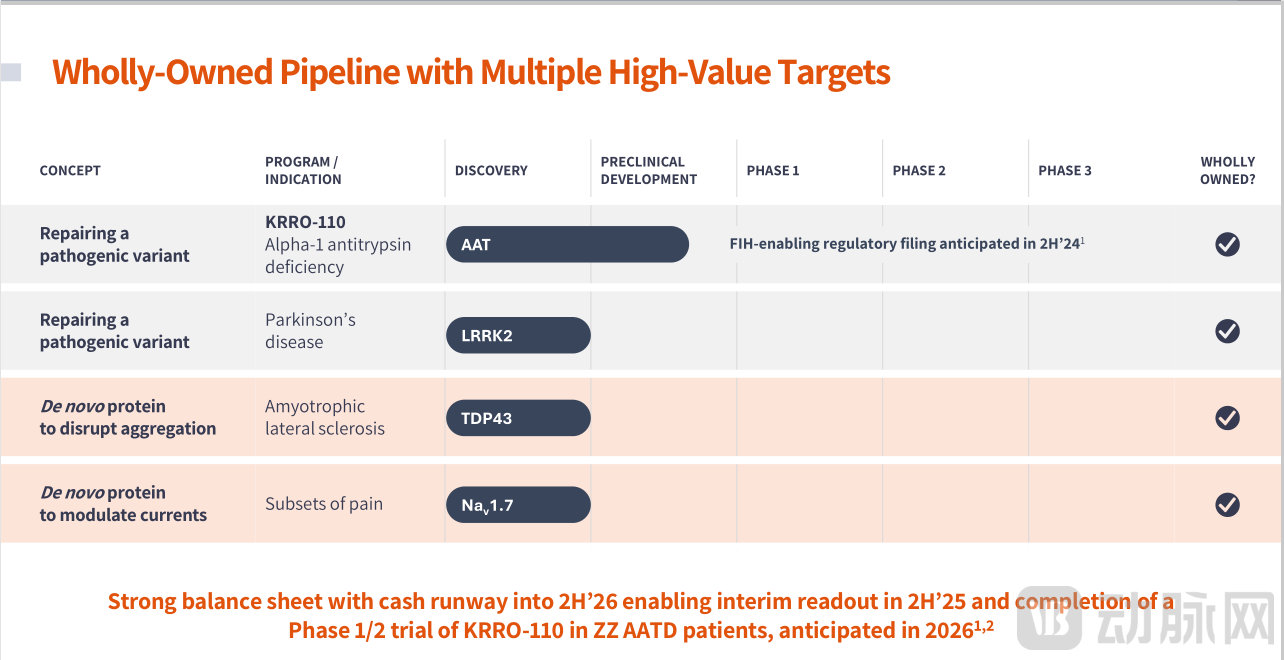
Based on the OPERA™ technology platform, Korro Bio is able to develop reversible, transient, and quantifiable RNA editing therapies. Currently, Korro Bio has four research candidates in its pipeline, targeting indications such as Alpha-1 Antitrypsin Deficiency (AATD), Parkinson's disease, Amyotrophic Lateral Sclerosis (ALS), and pain.
 Source: Korro Bio official website
Among them, the candidate pipeline project KRRO-110 for AATD is the most advanced. AATD is a rare genetic disorder that primarily affects the lungs and liver. This disease is caused by mutations in the gene encoding AATD, leading to a deficiency of the AATD enzyme in the body. When the AATD enzyme is lacking, proteases accumulate in the lungs and liver, causing tissue damage and inflammation.
KRRO-110 is designed to selectively target RNA-editing ADAR, repairing pathogenic single-nucleotide variants (SNVs) on RNA and restoring normal A1AT protein production. According to data released by Korro Bio, the gene editing efficiency of KRRO-110 exceeds 50%.
In addition,KRRO-110 has completed proof-of-concept in preclinical models. In vivo preclinical study data from non-human primates (NHP) showed that normal A1AT protein accounts for 85% of the total A1AT protein in circulation. Meanwhile, based on studies in mice and non-human primates, Korro demonstrated a high conversion rate of RNA editing efficiency for KRRO-110, indicating its potential applicability in humans.
According to Korro, the preclinical development of KRRO-110 is ongoing. The company expects to submit regulatory filings in the second half of 2024 and anticipates disclosing initial clinical study data in the second half of 2025.
As for the return to this cooperation between Korro and Novo Nordisk, the two parties have not yet announced the specific details of the selected candidate project. However, this transaction cooperation verifies the strategic pipeline expansion of Korro's differentiated RNA editing platform, which can be applied to high-incidence diseases such as cardiometabolic diseases.
According to the financial report released by Korro Bio,As of June 30, 2024, Korro's cash, cash equivalents, and marketable securities amounted to $187.8 million. Korro stated that its cash, cash equivalents, and marketable securities would be sufficient to meet the company’s operating expenses and capital expenditure requirements through the second half of 2026.
Novo Nordisk: Continuously Advancing in the Cardiometabolic Disease Field, Searching for the Next "Semaglutide"
In 2017, Novo Nordisk's semaglutide was approved by the FDA for the treatment of type 2 diabetes, marking the opening of Novo Nordisk's century-long main battlefield in the GLP-1 market. Especially since the approval of the injectable weight management formulation Wegovy in 2021 for long-term weight management, sales of semaglutide have soared.
According to the 2024 half-year financial report released by Novo Nordisk,In the first half of 2024, the company achieved revenue of 133.4 billion Danish kroner, a year-on-year increase of 24%. Among this, the strong performance of semaglutide was a key factor in the revenue growth. Data shows that the combined sales of the three semaglutide products reached 88.7 billion Danish kroner, a year-on-year increase of 43%, accounting for two-thirds of Novo Nordisk's total revenue.
The explosive popularity of Semaglutide has propelled Novo Nordisk to become the "new top influencer" in the pharmaceutical industry. However, this success still faces many challenges.
First, there is the issue of production capacity supply. Since the approval of the weight loss indication, Novo Nordisk's semaglutide production capacity has experienced a shortage. Despite Novo Nordisk continuously expanding its existing production facilities and investing in multiple production bases since 2023, according to announcements, these construction projects will not be completed until at least 2028, which cannot resolve Novo Nordisk's current production capacity shortage. Second, there is the increasing pressure from competitors. As Novo Nordisk's "fated rival," Eli Lilly has also been continuously expanding the application areas of Zepbound (tirzepatide) and is ramping up its production capacity with several major investments in manufacturing.
To this end, with the enormous funds brought by semaglutide, Novo Nordisk is continuously adjusting and optimizing its R&D strategy and business layout. However, compared to other large multinational pharmaceutical companies, since its establishment about a hundred years ago, Novo Nordisk's operations have not extended to cover the entire industry chain or multiple disease areas. Instead, it has consistently focused on four core areas: diabetes, obesity, rare diseases, cardiovascular conditions, and other severe chronic diseases.
At the annual media briefing hosted by Novo Nordisk, the company stated, "Novo Nordisk's corporate strategy is rooted in the mission of 'driving change, defeating diabetes, and other serious chronic diseases together.' It will continue to strengthen its leading position in the fields of diabetes and obesity treatment, consolidate its leadership in rare disease treatment, and establish a presence in cardiovascular diseases and other severe chronic conditions."
Among them, Novo Nordisk's layout in the field of cardiometabolic diseases, such as obesity, diabetes, and cardiovascular diseases, has been particularly frequent. In addition to the previously mentioned collaboration with Korro Bio, since the beginning of this year, Novo Nordisk has continuously expanded its product pipeline in the cardiometabolic field through BD deals or acquisitions.
For example, on January 4, 2024, research collaboration agreements were reached with two U.S. biotechnology companies, Omega Therapeutics, Inc. and Cellarity Inc., aiming to develop more therapies for cardiometabolic diseases.
On February 26, 2024, a collaboration and license agreement was signed with Neomorph for the discovery, development, and commercialization of multiple molecular glue degraders in the fields of cardiometabolic and rare diseases;
On March 25, 2024, it acquired Cardior Pharmaceuticals for 1.025 billion euros to strengthen its R&D pipeline in the field of cardiovascular diseases.
At the same time, Novo Nordisk is actively expanding the indications for semaglutide. For example, in March 2024, the FDA approved a new indication for Wegovy injection to reduce the risk of cardiovascular death, heart attack, and stroke in adults with cardiovascular disease and obesity or overweight. According to the FDA press release, semaglutide is the first weight-loss drug approved to help prevent major cardiovascular events in adults with cardiovascular disease and obesity or overweight.
Through a series of collaboration deals and innovative R&D, Novo Nordisk is further solidifying its dominant position in the metabolic weight-loss field. At the same time, the company is actively expanding its product portfolio by leveraging the potential of GLP-1 in the cardiometabolic field and technological innovation, with the aim of developing another blockbuster product following semaglutide.
References:
1. PharmHunter Club. "[Frontier] Pioneering a New Path for RNA Drug Development — A Brief Discussion on ADAR-based RNA Editing"