AstraZeneca Submits IND Application in China for AZD5462, a Novel Class 1 Drug for Heart Failure Treatment

Haisco
New Drug Research and Development, Production, and Sales

AstraZeneca
Biopharmaceutical Manufacturer

Otsuka
Drug Developer
PharmCube Data Selects the Latest Developments in New Drug R&D from Last Week (September 9th to September 15th), Including New Drug R&D Progress, Major Drug Transactions, and More – All in One Quick Read.
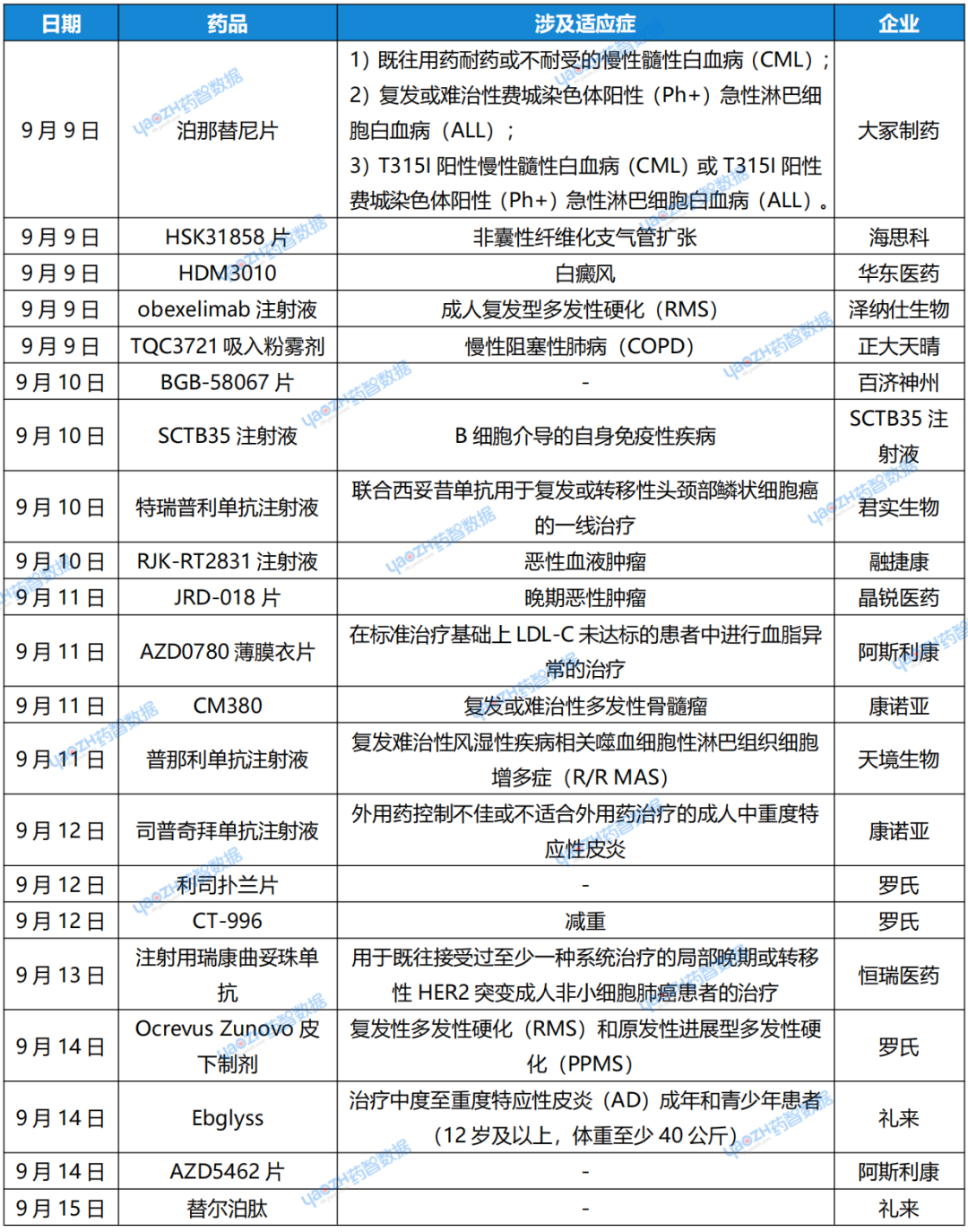
Source: YAOZHI Data Enterprise Edition——Global Drug Analysis System Database, official websites of various enterprises
For more latest progress and detailed information on new drugs worldwide, welcome to subscribe and view on the PharmData -- Global Drug Analysis System.
AstraZeneca:
AZD5462
On September 14, according to the CDE official website, the clinical trial application for AstraZeneca's Class 1.1 chemical drug AZD5462 tablets was accepted. Public data shows that this drug is a relaxin RXFP1 receptor agonist.
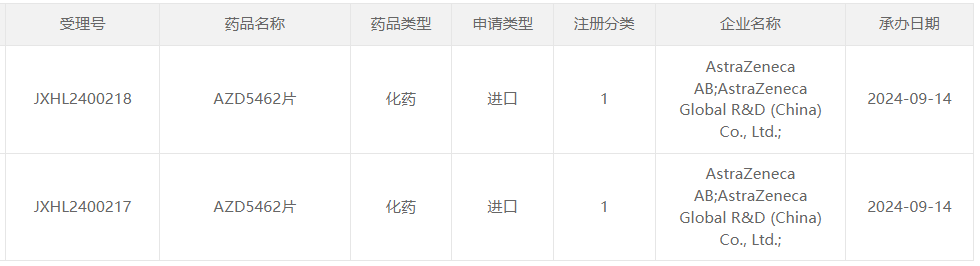
Source of the image: CDE official website
Relaxin, as an agonist of the relaxin-1 receptor (RXFP1), produces unique and diverse biological effects, including pulmonary and systemic vasodilation, tissue remodeling/fibrosis reversal, and reduction of inflammation. Thus, it also has potential significant efficacy in cardiopulmonary diseases. Additionally, this substance is also known as the "pregnancy hormone," which is upregulated during pregnancy to help the cardiovascular system of expectant mothers meet the increasing demands of the developing fetus and remodel tissues and musculoskeletal structures.
AZD5462 is a relaxin RXFP1 receptor agonist developed by AstraZeneca. Preclinical studies on a monkey model of heart failure with reduced ejection fraction (HFrEF) have shown that after 8 weeks of treatment, cardiac systolic function improved without a significant increase in mean arterial blood pressure or heart rate. Currently, multiple studies on AZD5462 are underway, with clinical research for patients with chronic heart failure having progressed to the Phase IIb stage.
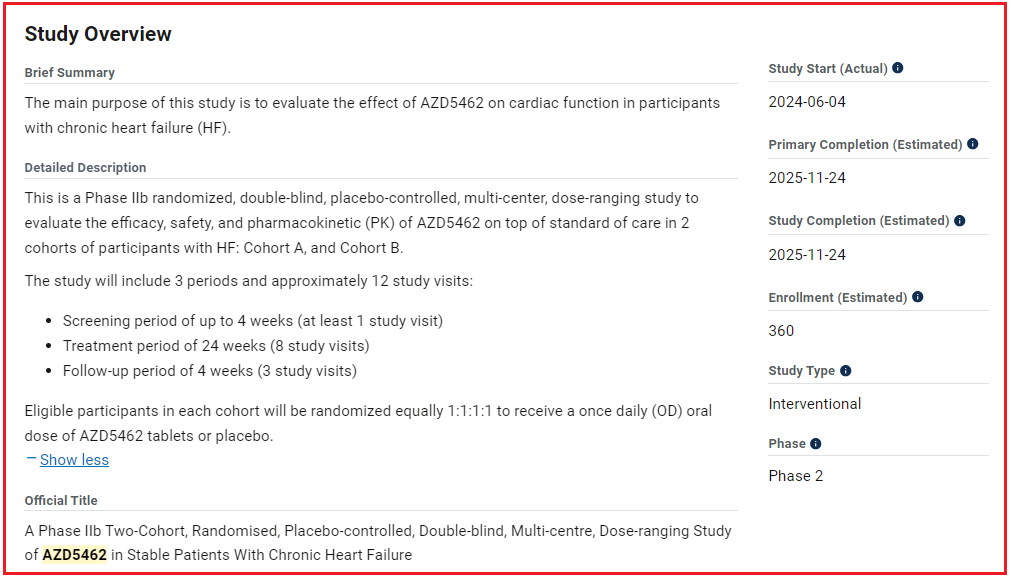
Image Source: clinicaltrials.gov
Once the clinical trial application for AZD5462 tablets successfully gains CDE approval, AstraZeneca may initiate further research on it in China.
Progress in the Development of Other New Drugs
1. Otsuka Pharmaceutical Co., Ltd. "Ponatinib Tablets" Approved for Marketing
On September 9, according to the NMPA official website, Otsuka Pharmaceutical's ponatinib tablets were approved for marketing. Indicated for: 1) Chronic myeloid leukemia (CML) with resistance or intolerance to prior therapy; 2) Relapsed or refractory Philadelphia chromosome-positive (Ph+) acute lymphoblastic leukemia (ALL); 3) T315I-positive chronic myeloid leukemia (CML) or T315I-positive Philadelphia chromosome-positive (Ph+) acute lymphoblastic leukemia (ALL). Ponatinib is a third-generation Bcr-Abl inhibitor that overcomes the T315I mutation and has highly specific inhibitory effects on T315I mutant Bcr-Abl kinase, effectively addressing the widespread issue of drug resistance caused by kinase mutations in existing Bcr-Abl inhibitors.
2. Haisco "HSK31858 Tablets" Intended for Breakthrough Therapy
On September 9, according to the CDE official website, Haisco's Class 1 new chemical drug HSK31858 tablet has been proposed for inclusion in the breakthrough therapy designation, with the indication for non-cystic fibrosis bronchiectasis. HSK31858 tablet is an orally administered, potent, and highly selective DPP1 inhibitor independently developed by Haisco, intended for the treatment of diseases such as non-cystic fibrosis bronchiectasis, bronchial asthma, and chronic obstructive pulmonary disease.
3. Huadong Medicine "HDM3010" Initiates Phase III Clinical Trial
On September 9, according to the Drug Clinical Trial Registration and Information Disclosure Platform, Huadong Medicine launched a Phase III clinical trial in China to evaluate the efficacy and safety of HDM3010 in treating patients with vitiligo. Public information indicates that HDM3010 is a JAK1/JAK2 inhibitor and also the first China-produced JAK inhibitor to initiate a Phase III clinical trial for vitiligo in China.
4. Zenas BioPharma's "Obexelimab Injection" Approved for New Clinical Trials
On September 9, according to the CDE official website, the new indication for the Phase 1 new drug obexelimab injection, submitted by Zenas BioPharma, received tacit approval for clinical trials for the treatment of adult relapsing multiple sclerosis (RMS). Public information indicates that obexelimab is Zenas BioPharma's leading candidate product, a CD19 x FcƳRIIB bifunctional monoclonal antibody currently in the mid-to-late stages of clinical development.
5. China Resources Tianqing "TQC3721 Inhalation Powder" Approved for Clinical Trials
On September 9, according to the CDE official website, TQC3721 Inhalation Powder developed by Zhengda Tianqing was approved for clinical trials. It is intended to be developed for maintenance treatment in patients with chronic obstructive pulmonary disease (COPD). According to publicly available information from Zhengda Tianqing, TQC3721 is a dual PDE3/4 inhibitor. Previously, Zhengda Tianqing developed an inhalable TQC3721 suspension formulation, which is currently undergoing Phase 2 clinical trials in China for the treatment of moderate to severe COPD. This marks the first approval in China for the inhalation powder formulation.
6. BeiGene "BGB-58067 Tablet" Submits for Clinical Trial
On September 10, according to the CDE official website, the clinical trial application for BGB-58067, a Class 1 new drug submitted by BeiGene, was accepted. Public information indicates that BGB-58067 is a PRMT5 inhibitor and part of BeiGene's solid tumor pipeline, with clinical research expected to commence in 2024. BeiGene has previously stated that its MTA-cooperative PRMT5 inhibitors demonstrate high potency and selectivity, as well as brain penetrability, showing potential for use in solid tumors such as non-small cell lung cancer and gastrointestinal tumors.
7. Sinocelltech "SCTB35 Injection" Approved for New Clinical Trial
On September 10, according to the CDE official website, Sinocelltech's Class 1 new drug SCTB35 injection has been approved for clinical trials, with indications for B cell-mediated autoimmune diseases. Public information shows that SCTB35 is a CD20xCD3 bispecific antibody independently developed by Sinocelltech. Previously, this product had already been approved for a clinical trial to treat relapsed/refractory CD20-positive B-cell non-Hodgkin lymphoma.
8. Junshi Biosciences' "Toripalimab Injection" Approved for New Clinical Trials
On September 10, according to the CDE official website, Junshi Biosciences' anti-PD-1 monoclonal antibody "Toripalimab Injection" received a new clinical trial implied permission, intended to be used in combination with Cetuximab for first-line treatment of recurrent or metastatic head and neck squamous cell carcinoma. To date, Toripalimab has been approved for 10 indications in mainland China, covering melanoma, nasopharyngeal carcinoma, urothelial carcinoma, esophageal squamous cell carcinoma, non-small cell lung cancer, renal cell carcinoma, small cell lung cancer, and triple-negative breast cancer. Recently, the new indication marketing applications for first-line treatment of liver cancer and first-line treatment of melanoma were also accepted by the CDE.
9. Rongjie Kang "RJK-RT2831 Injection" Approved for Clinical Trials
On September 10, according to the CDE official website, RJK-RT2831 Injection, a Class 1 new drug developed by Nanjing Rongjiakang Biotechnology Co., Ltd., received tacit approval for clinical trials. The indication is malignant hematological tumors. Public information shows that RJK-RT2831 is a nanobody drug. In July this year, the RT2831 project officially received approval for a new drug clinical trial (IND) application in the United States.
10. Jingrui Pharmaceuticals "JRD-018 Tablet" Approved for Clinical Trials in China
On September 11, according to the CDE official website, JRF Pharma's Class 1 new drug JRD-018 tablets has been approved for clinical trials, intended for the development of treatment for advanced malignant tumors. Public data shows that JRD-018 is a brain-penetrant BET inhibitor capable of effectively inhibiting c-Myc gene expression, achieving tumor growth suppression. Preclinical efficacy studies indicate that JRD-018, when used alone, demonstrated strong anti-tumor activity in models of glioblastoma, small cell lung cancer, non-small cell lung cancer, monocytic leukemia, and breast cancer. Previously, the drug had already received approval from the U.S. FDA to initiate Phase 1 clinical studies.
11. AstraZeneca's "AZD0780 Film-Coated Tablets" Approved for Clinical Use
On September 11, according to the CDE official website, AstraZeneca's Class 1 new drug AZD0780 film-coated tablets received implied permission for clinical trials. It is intended for the treatment of dyslipidemia in patients who have not reached their LDL-C target despite standard treatment. Public data shows that AZD0780 is a small molecule PCSK9 inhibitor. In May this year at the European Atherosclerosis Society (EAS) conference, positive results from the Phase 1 clinical trial of AZD0780 were announced. According to research findings, when used in combination with the statin rosuvastatin, AZD0780 reduced patients' LDL-C levels by nearly 80%.
12. ConnaMed's "CM380" Approved for Clinical Trials
On September 11, according to the CDE official website, CM380, a Class 1 new drug developed by Keymab, received clinical trial implied permission for the indication of relapsed or refractory multiple myeloma. According to publicly available information, CM380 is a bispecific antibody developed by Keymab based on its proprietary nTCE platform, targeting the GPRC5DxCD3.
13. I-Mab "Plonarib Injection" Proposed for Breakthrough Therapy
On September 11, according to the CDE official website, the Class 1 new drug "Plonarlimab Injection" submitted by I-Mab Biopharma was proposed for inclusion in the breakthrough therapy designation. The indication is for relapsed or refractory rheumatic disease-associated hemophagocytic lymphohistiocytosis (R/R MAS). Public information indicates that Plonarlimab Injection is a neutralizing antibody targeting human granulocyte-macrophage colony-stimulating factor (GM-CSF).
14. Connoymab "Sipulimab Injection" Approved for Marketing
On September 12, according to the NMPA official website, Connoymab's Class 1 new drug, Supicimab Injection, was approved for marketing. The approved indication is for the treatment of adult patients with moderate to severe atopic dermatitis who have inadequate response to or are unsuitable for topical medications. Supicimab is a high-affinity, humanized monoclonal antibody targeting the human IL-4 receptor alpha subunit (IL-4Rα) developed by Connoymab. IL-4Rα is a shared receptor subunit for interleukin-4 and interleukin-13 (IL-4 and IL-13). Anti-IL-4Rα monoclonal antibodies can simultaneously inhibit signal transduction of the IL-4/IL-13 pathway by targeting IL-4Rα, achieving an innovative "dual-target" mechanism of action.
15. Roche's "Risdiplam Tablets" Submitted for Marketing Approval in China
On September 12, according to the CDE official website, the listing application for risdiplam tablets submitted by Roche was accepted, with the specific indication yet to be disclosed. Public information indicates that risdiplam is an innovative neuro-rare disease drug developed by Roche for the treatment of Spinal Muscular Atrophy (SMA). The oral solution formulation of this drug has already been approved and launched in China, while the current application seeks approval for a tablet formulation.
16. Roche Announces New Clinical Progress of "CT-996"
On September 12, Roche announced the Phase 1 clinical trial results of its oral glucagon-like peptide-1 (GLP-1) receptor agonist CT-996 at the 2024 EASD Annual Meeting. The latest results showed that CT-996 reduced participants' body weight by 7.3% (approximately 7 kilograms) within 4 weeks in obese individuals without type 2 diabetes. Based on this positive outcome, Roche plans to initiate Phase 2 clinical trials in 2025.
17. Hengrui Medicine "Recombinant Trastuzumab Injection" Submitted for Marketing Approval
On September 13, according to the CDE official website, Jiangsu Hengrui Medicine's Recombinant Trastuzumab Injection (R&D code: SHR-A1811) has been accepted for drug marketing authorization application. Recently, this product has been included in the priority review by the CDE. Recombinant Trastuzumab Injection is an ADC product targeting HER2. According to Hengrui Medicine's announcement, the indication for which the product has received marketing application acceptance is for the treatment of adult patients with locally advanced or metastatic HER2-mutated non-small cell lung cancer who have previously received at least one systemic therapy.
18. Roche's "Ocrevus Zunovo Subcutaneous Formulation" Approved for Marketing
On September 14, Roche announced that the U.S. FDA had approved Ocrevus Zunovo (ocrelizumab & hyaluronidase) subcutaneous formulation for the treatment of relapsing multiple sclerosis (RMS) and primary progressive multiple sclerosis (PPMS). This product has also become the first subcutaneous formulation approved for the treatment of RMS and PPMS. Previously published clinical results showed that Ocrevus Zunovo almost completely suppressed clinical relapses and brain lesions in patients. According to the press release, Ocrevus Zunovo only needs to be injected twice a year, with each injection taking only 10 minutes.
19. Lilly's "Ebglyss" Approved for AD Treatment
On September 14, Eli Lilly announced that the U.S. FDA had approved its IL-13 inhibitor Ebglyss (lebrikizumab) for the treatment of adult and adolescent patients (12 years and older, weighing at least 40 kg) with moderate to severe atopic dermatitis (AD) whose conditions are not adequately controlled by topical therapies. This approval was primarily based on the results of the ADvocate 1, ADvocate 2, and ADhere studies, which included more than 1,000 adults and children (12 years and older) with moderate to severe eczema who could not control their symptoms with topical prescription medications. The primary endpoint of the studies was assessed at 16 weeks, measured as clear or almost clear skin symptoms (IGA 0, 1).
20. Lilly's "Tirzepatide" New Indication Submitted for Marketing Approval in China
On September 15, according to the CDE official website, Eli Lilly's tirzepatide injection new indication marketing application has been accepted, with the specific indication yet to be disclosed. This is understood to be the third marketing application submitted by tirzepatide in China, with the previous two being for type 2 diabetes and weight loss, both of which have already been approved. Previously, Eli Lilly submitted a marketing application to the FDA for the use of tirzepatide in treating moderate to severe OSA in obese patients, with a response expected by the end of the year.
Global Pharmaceutical Transaction Dynamics
1. Sanofi Introduces Radiopharmaceutical Pipeline
On September 12, Sanofi announced a licensing agreement with RadioMedix and Orano Med, a subsidiary of the Orano Group, to develop next-generation radioligand therapies. AlphaMedix, the radiopharmaceutical co-developed by RadioMedix and Orano Med, is an alpha-particle emitting peptide conjugate that targets somatostatin receptors (SSTR). Under the licensing agreement, Sanofi will be responsible for the global commercialization of AlphaMedix, while Orano Med will handle its production. In return, RadioMedix and Orano Med will receive an upfront payment of 100 million euros (approximately $109 million) and potential sales milestone payments of up to 220 million euros (approximately $239 million), along with eligibility for tiered royalties.
2. Organon China introduces a new drug from Baoji Pharmaceutical
On September 12, Baoji Pharmaceuticals and its wholly-owned subsidiary Shengji Pharmaceuticals announced that they had reached a supply and transfer agreement with Organon China for SJ02, an innovative drug in the field of assisted reproduction under research and development. Organon China will obtain exclusive commercial rights to SJ02 in mainland China. According to the terms of the agreement, Baoji Pharmaceuticals and its wholly-owned subsidiary Shengji Pharmaceuticals will receive an upfront payment of 12 million US dollars and additional payments based on the commercialization process. SJ02 is a long-acting recombinant human follicle-stimulating hormone-CTP fusion protein injection (FSH-CTP) independently developed by Shengji Pharmaceuticals, a wholly-owned subsidiary of Baoji Pharmaceuticals, and is currently in the application stage for marketing in China.

Editor: Muyan
Disclaimer: This article is a reprint from Yaozhi.com. All images and text are owned by the original author. The purpose of the reprint is to convey more information and does not represent the views of this platform. If there are any issues regarding content, copyright, or other matters, please leave a message on this platform, and we will address it promptly.