At this year's ESMO Congress, in addition to the disclosure of significant results for several ADCs, bispecific antibodies, and monoclonal antibody drugs, we also noticed three「first-in-class」PROTAC Drug's Early Clinical Results Announced for the First Time, Three Results Selected for Oral Presentation at the Conference, Respectively by AstellasKRAS G12D Protein Degraders, Prelude Therapeutics SMARCA2 Degraders,C4 Therapeutics BRAF V600 MutationProtein degrader. Astellas KRAS G12D Novel Protein Degrader Selected for Oral Presentation Image Source: ESMO Official WebsiteASP3082 isA Potential "First-in-Class" KRAS G12D Selective Protein Degrader. At this year's conference, AstellasOral ReportFormFirst announcement of ASP3082 monotherapy for the treatment of advanced pancreatic cancer (PC), Colorectal Cancer (CRC) and non-small cell lung cancer (NSCLC) Preliminary Safety and Clinical Efficacy Data in Adult Patients。In this Phase 1 dose-escalation first-in-human study, the subjects were adult patients with unresectable or metastatic KRAS G12D-positive solid tumors. Patients received escalating doses of ASP3082 monotherapy once weekly via intravenous infusion over a 21-day cycle.10-600 mg)。The primary endpoint is dose-limiting toxicity (DLT) and adverse events (AE) Incidence。As of the data cutoff date on April 1, 2024, a total of 98 patients were enrolled, includingPancreatic cancer (n=67), colorectal cancer (n=16), non-small cell lung cancer (n=13), or other cancers (n=2). The median age of the patients was 64 years, 56% were male, and the median number of prior systemic treatments was 2 (1-7),
- 68/98 (69.4%) of patients experienced treatment-related adverse events (TRAE)., including 5 patients with grade 3 and 0 patients with grade 4 or 5 events.
- TRAEs occurring in ≥5% of patients included fatigue, infusion-related reactions, pruritus, nausea, urticaria, increased aspartate aminotransferase (AST), increased alanine aminotransferase (ALT), and vomiting.
- In the 450 mg dose group, 2 patients experienced DLT; in the 600 mg dose group, 1 patient experienced DLT.
- The maximum tolerated dose has not been reached. Based on preclinical modeling simulations, the predicted minimum dose for clinical efficacy is >100 mg.
Efficacy evaluation included 65 patients receiving 10-300 mg, and the data showed:- A total of 35 patients received treatment with ≤90 mg., ORR was 0%, DCR was 25.7%.
- 140 mg (n=9),ORR was 11.1%, of which PC patients account for 20%(1/5);DCR is 33.3%, of which PC patients account for 40%(2/5), 25% of CRC patients(1/4 )。
- At 200 mg (n=9), the ORR was 0% and the DCR was 55.6%.(3/7 cases of PC patients, 1/1 case of NSCLC, 1/1 case of CRC).
- At 300 mg (n=12), the ORR was 33.3%., of which PC patients accounted for 42.8%.(3 /7), 25% of patients with NSCLC(1/4), CRC patients account for 0%(0/1 );DCR is 75.0%, of which PC patients accounted for 71.4%.(5/7), 100% for NSCLC patients(4/4), CRC patients account for 0%(0/1 )。
The study suggests that this ongoing research indicates,The novel KRAS G12D degrader ASP3082 demonstrates acceptable safety and favorable anti-tumor activity, particularly in heavily pretreated patients with advanced pancreatic cancer.Based on these results, further research is needed to evaluate the efficacy and safety of ASP3082. Targeted SMARCA2 FIC Degrader Announces Phase I Clinical Results for the First TimeImage Source: ESMO Official Website
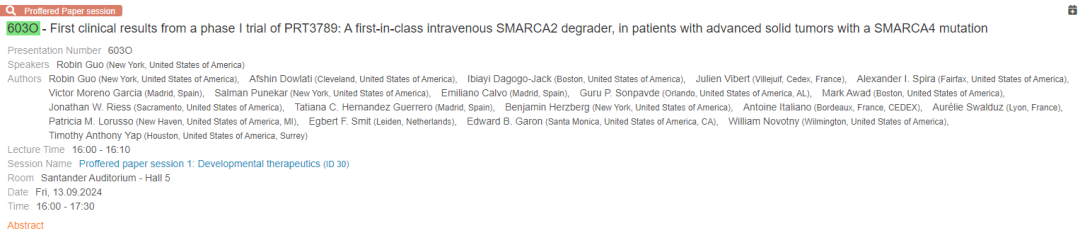
EncodingGenes encoding SWI/SNF chromatin remodeling complex subunits are among the most highly mutated genes in cancer, with a prevalence of 20-24% across all tumors.The SWI/SNF complex contains one of two ATPase subunits, SMARCA2 or SMARCA4, which are functionally interchangeable.PRT3789 is a SMARCA2 degrader developed by Prelude Therapeutics. It exhibits >1000-fold selectivity for SMARCA4-mutant cancer cells compared to normal cells.PRT3789 is designed to treat SMARCA4-mutant tumors by synthetically and lethally degrading SMARCA2 selectively.At this year's ESMO Congress, Prelude Therapeutics presented the Phase I clinical results of PRT3789 in an oral presentation for the first time.This is a Phase 1 dose-escalation study enrolling patients with solid tumors and SMARCA4 mutations (loss-of-function or missense). PRT3789 is administered intravenously once a week. The primary objectives are safety and determination of the recommended Phase 2 dose.As of March 7, 2024, 40 patients have been enrolled, including non-small cell lung cancer (18), Pancreatic Cancer (5), breast cancer (3), esophageal cancer (2), others (12); 55% of patients experienced loss-of-function mutations. Dose escalation has progressed through 6 levels, from 24 mg to 212 mg, with 2 backfill cohorts opened. No DLT or study drug-related SAE has been reported.A dose-related increase in AUC was observed. A dose-dependent decrease in SMARCA2 levels was noted at all doses, with the depth and duration of the decrease trending upward as the dose increased; the impact on SMARCA4 levels was minimal.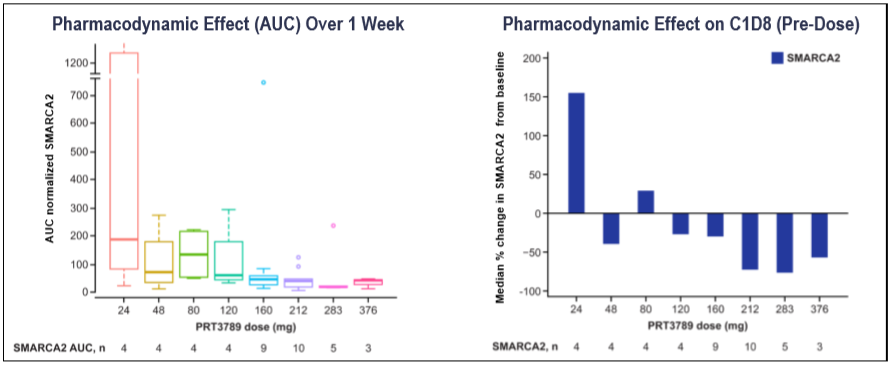
Image Source:Corporate WebsitePreliminary efficacy showed that, among 26 patients with non-small cell lung cancer or esophageal cancer,Seven tumors shrank, with RECIST confirming partial responses in three patients (two with esophageal cancer and one with lung cancer).; Tumor shrinkage was observed in both Class 1 and Class 2 SMARCA4 mutation patients.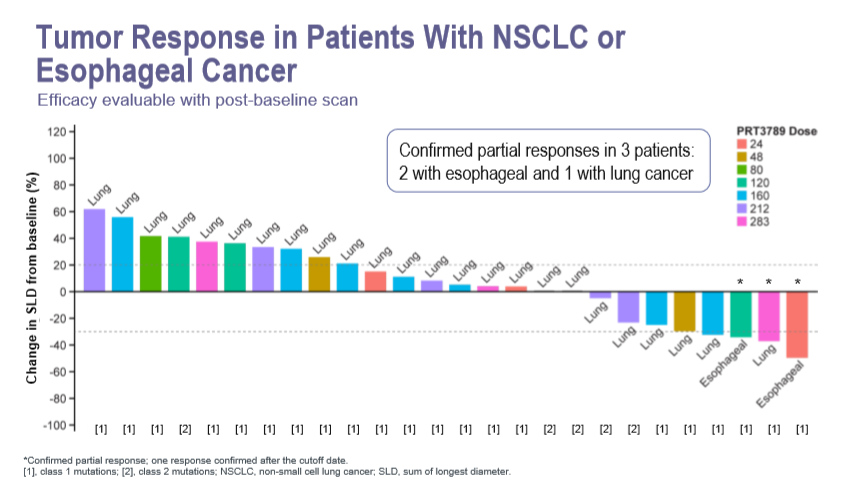
Image Source:Corporate WebsiteIn previously heavily treated patients with SMARCA4 mutations, some patients demonstrated clinical benefit through disease stabilization and confirmed responses.One of the patients has been receiving treatment for over a year and is still currently in the study.。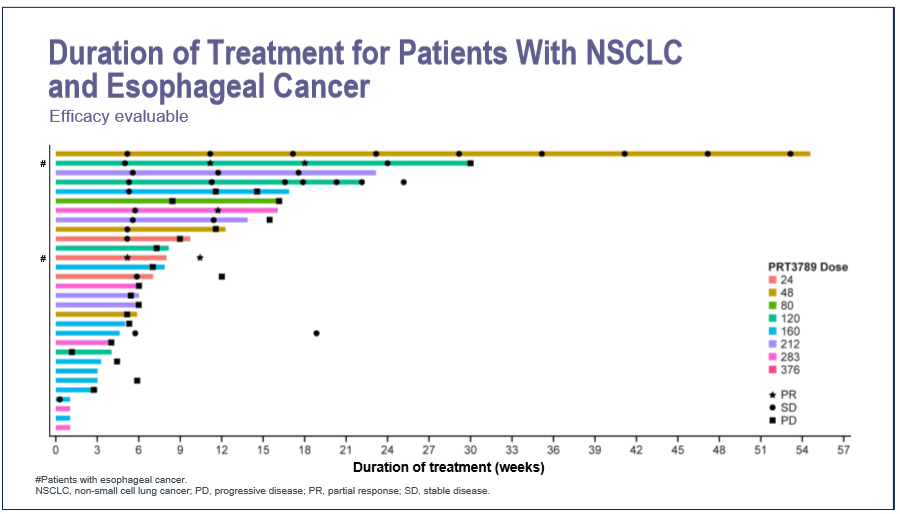
Image Source:Corporate WebsiteIn terms of safety, the most common AEs were nausea (25.0%), constipation and dyspnea (each 17.5%), decreased appetite and fatigue (each 15.0%), and anemia (12.5%).The researchers concluded that, at the studied dose,PRT3789 showed no dose-limiting toxicity or serious adverse events related to the study drug. It demonstrated encouraging anti-tumor activity in patients with non-small cell lung cancer or esophageal cancer., RP2D not reached, dose escalation and backfill recruitment are ongoing. Additionally, the combination regimens of PRT3789 + docetaxel and PRT3789 + pembrolizumab will be explored. First-in-Class BRAF V600E Degrader Announced Phase 1 Clinical Results Image Source:ESMO Official Website
CFT1946 is an orally available BiDAC™ degrader developed by C4 Therapeutics that selectively degrades and inhibits the mutant BRAF V600 protein.Aimed at overcoming RAF dimer-driven resistance and approved BRAF inhibitors(BRAFi)Contradictory Activation。
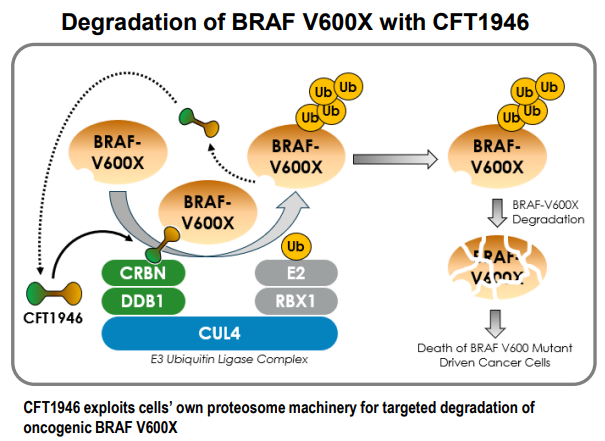
Image Source:Corporate WebsiteCFT1946-1101 (NCT05668585) Is an ongoing multi-center, Phase 1/2 dose escalation and cohort expansion first-in-human trial. The Phase 1 dose escalation monotherapy group of CFT1946 includes refractory BRAF-V600 mutant solid tumors.(Non-Central Nervous System)、Melanoma(MEL), Non-Small Cell Lung Cancer(NSCLC)、Colorectal Cancer (CRC)Patients with poorly differentiated or anaplastic thyroid cancer. The primary endpoints include safety and tolerability. Secondary endpoints include pharmacokinetics, pharmacodynamics, and preliminary efficacy.As of April 12, 2024, 25 patients received CFT1946 monotherapy at doses ranging from 20 to 320 mg BID. Tumor types included melanoma (40%), CRC (40%), others (12%), and NSCLC (8%). 22/25 patients had V600E mutations, 2 had V600K mutations, and 1 had a V600R mutation. 24/25 patients were previously treated with BRAFi and had all received ≥2 prior therapies (median=3).No DLT occurred.8/25 patients experienced ≥ Grade 3 TEAEs, all of which were unrelated to treatment. At the data cutoff,One patient had an unconfirmed partial response (uPR), and the best response of 7 out of 14 evaluable patients (50%) was stable disease or better.。After the data cutoff, 1 recently enrolled patient(Progression of disease PD on BRAFi)uPR occurred, with a 64% reduction in target lesions.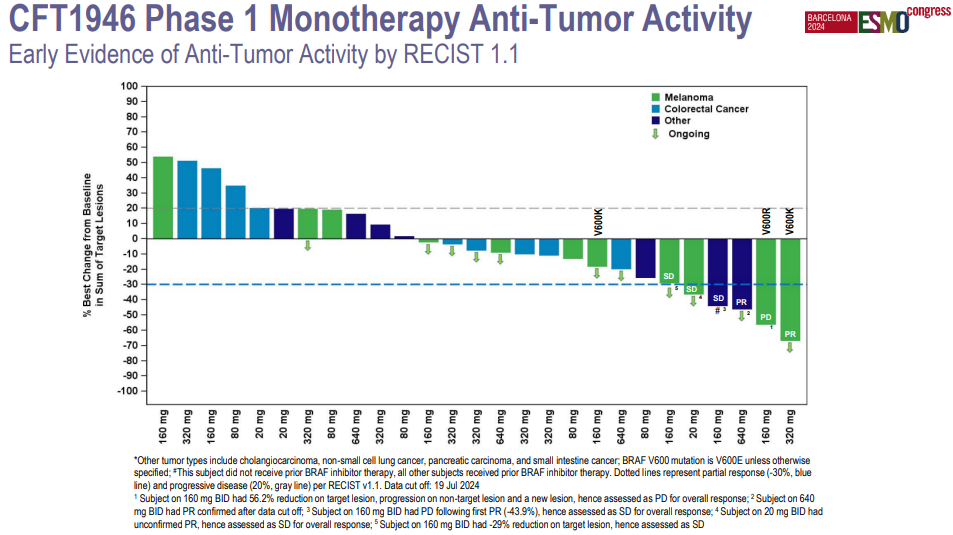
Image Source:Corporate WebsiteCFT1946 Monotherapy Phase I Study Shows Encouraging Results with Good Tolerability and Preliminary Validation of the Drug’s Mechanism. Increased Drug Exposure Was Observed with Dose Escalation, and BRAF V600E Protein Degradation Was Observed in All Post-Treatment Biopsies.Antitumor activity observed in BRAFi-progressed patients treated with CFT1946: according to RECIST1.1 criteria,8/11 melanoma patients showed tumor shrinkage; Anti-tumor activity was observed in patients with BRAF V600E/K/R mutations. These data support the continued investigation of CFT1946 as a new therapy for BRAF V600X solid tumors.
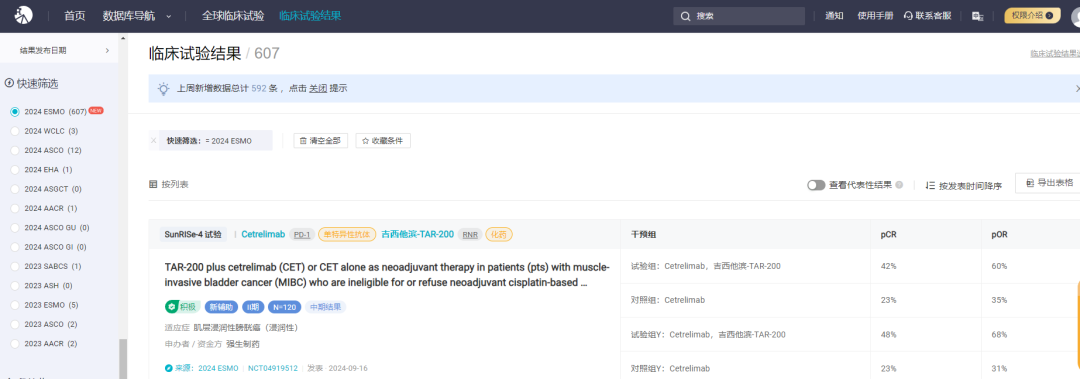
The ESMO Congress has successfully concluded, and the clinical trial results announced at this medical feast have been fully recorded in the Insight database. Readers are welcome to read the original text and claim a free trial query.Image Source:Insight Database
Cover Source:ZCool Hello PlusDisclaimer:This article is for information sharing only, and does not represent the position or viewpoint of Insight. It does not recommend or introduce any treatment plans. If necessary, please consult and contact正规医疗机构.PR Article Coordination: WeChat insightxbSubmissionWeChat: insightxb; Email: insight@dxy.cn
Diversified functions, traceable data……Insight Database Web Version Awaits Your Experience
Click to read the original text,ImmediatelyUnlock!