

FDA Approves Merck’s Keytruda in Combination with Chemotherapy for First-Line Treatment of Unresectable Advanced or Metastatic Malignant Pleural Mesothelioma

MSD
Pharmaceutical R&D and Manufacturer


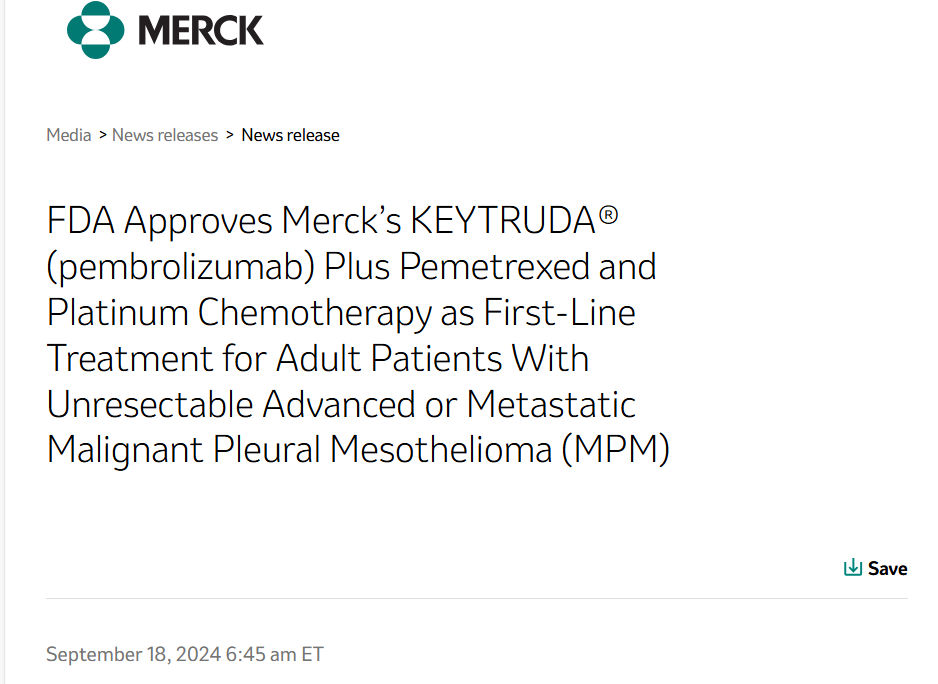
On September 18, the FDA approved a new indication for MSD's重磅 cancer therapy Keytruda (pembrolizumab) in combination with pemetrexed and platinum-based chemotherapy, as a first-line treatment for adult patients with unresectable advanced or metastatic malignant pleural mesothelioma (MPM). This approval marks the first indication for Keytruda in MPM in the United States.
Approval was based on the results of the Phase 3 CCTG IND.227/KEYNOTE-483 study, a multicenter, randomized, open-label, actively controlled Phase 2/3 trial. MSD provided Keytruda and related support for the trial, which investigated the efficacy and safety of Keytruda in combination with pemetrexed and platinum-based chemotherapy. The Phase 3 study enrolled 440 patients with unresectable advanced or metastatic MPM who had not previously received systemic treatment for advanced/metastatic disease.
The trial results showed that, compared with patients in the chemotherapy-alone group, patients in the Keytruda plus chemotherapy group experienced statistically significant improvements in overall survival (OS), progression-free survival (PFS), and overall response rate (ORR).
The specific results of the trial are as follows: The risk of death was reduced by 21% compared to the chemotherapy-alone group (HR=0.79 [95% CI, 0.64-0.98]; p=0.0162). The median overall survival (OS) in the Keytruda plus chemotherapy group was 17.3 months (95% CI, 14.4-21.3), while it was 16.1 months (95% CI, 13.1-18.2) in the chemotherapy-alone group.
Compared with the chemotherapy-alone group, Keytruda combined with chemotherapy also significantly improved progression-free survival (PFS) (HR=0.80 [95% CI, 0.65-0.99], p=0.0194; median PFS was 7.1 months [95% CI, 6.9-8.1] and 7.1 months [95% CI, 6.8-7.7], respectively).
Compared with the chemotherapy-alone group, the overall response rate (ORR) was significantly higher with Keytruda plus chemotherapy (52% [95% CI, 45.5-59.0] vs. 29% [95% CI, 23.0-35.4]; p<0.00001). The adverse reactions occurring in MPM patients were generally similar to those observed in other patients receiving Keytruda in combination with pemetrexed and platinum-based chemotherapy.
MSD has the largest immuno-oncology clinical research program in the industry, with over 1,600 trials currently studying Keytruda's performance across various cancers and treatment settings. The current FDA-approved indications for Keytruda in the United States include:
1. Melanoma
1. For the treatment of patients with unresectable or metastatic melanoma.
2. Adjuvant treatment for adult and pediatric patients (12 years and older) with stage 2B, 2C, or 3 melanoma following complete resection.
2. Non-Small Cell Lung Cancer
1. Keytruda in combination with pemetrexed and platinum-based chemotherapy is indicated for the first-line treatment of patients with metastatic non-squamous non-small cell lung cancer (NSCLC) whose tumors have no EGFR or ALK genomic aberrations.
2. Keytruda in combination with carboplatin and paclitaxel or nab-paclitaxel is indicated for the first-line treatment of patients with metastatic squamous NSCLC.
3. Keytruda, as a single agent, is indicated for the first-line treatment of patients with NSCLC expressing PD-L1 [Tumor Proportion Score (TPS) ≥1%] (as determined by an FDA-approved test), with no EGFR or ALK genomic tumor aberrations, and who are Stage III patients not candidates for surgical resection or definitive chemoradiation, or who have metastatic disease.
4. Keytruda, as a single agent, is indicated for the treatment of metastatic NSCLC patients whose tumors express PD-L1 (TPS≥1%) (as determined by an FDA-approved test) and who have experienced disease progression during or after platinum-containing chemotherapy. Patients with EGFR or ALK genomic tumor aberrations should have disease progression after receiving FDA-approved therapy for these aberrations prior to receiving KEYTRUDA.
5. Indicated for the treatment of resectable (tumor ≥4cm or lymph node-positive) NSCLC patients in combination with platinum-based chemotherapy as neoadjuvant therapy, followed by continued use as monotherapy after surgery.
6. Keytruda, as a single agent, is indicated for the adjuvant treatment of adult patients with stage 1B (T2a≥4cm), stage 2, or stage 3A NSCLC following resection and platinum-based chemotherapy.
3. Squamous Cell Carcinoma of the Head and Neck
1. Keytruda, in combination with platinum and fluorouracil (FU), is indicated for the first-line treatment of patients with metastatic or unresectable recurrent squamous cell carcinoma of the head and neck (HNSCC).
2. Keytruda, as a single agent, is approved for the first-line treatment of patients with metastatic or unresectable recurrent HNSCC whose tumors express PD-L1 [Combined Positive Score (CPS) ≥1].
3. Keytruda, as a single agent, is approved for the treatment of patients with recurrent or metastatic HNSCC whose disease has progressed during or after platinum-containing chemotherapy.
4. Classical Hodgkin Lymphoma
1. Indicated for the treatment of adult patients with relapsed or refractory classical Hodgkin lymphoma (cHL).
2. Indicated for the treatment of pediatric patients with refractory cHL or cHL that has relapsed after two or more lines of therapy.
5. Primary Mediastinal Large B-Cell Lymphoma
Indicated for the treatment of adult and pediatric patients with refractory primary mediastinal large B-cell lymphoma (PMBCL), or patients who have relapsed after receiving two or more prior lines of therapy. Keytruda is not recommended for the treatment of PMBCL patients requiring urgent cytoreductive therapy.
6. Urothelial Carcinoma
1. Keytruda in combination with enfortumab vedotin is used for the treatment of adult patients with locally advanced or metastatic urothelial carcinoma.
2. Keytruda, as a single agent, is applicable for the treatment of patients with locally advanced or metastatic urothelial carcinoma: those who are ineligible for any platinum-based chemotherapy, or those who have experienced disease progression during or after platinum-based chemotherapy or within 12 months following neoadjuvant or adjuvant treatment with platinum-based chemotherapy.
3. Keytruda, as a single agent, is indicated for the treatment of patients with Bacillus Calmette-Guérin (BCG)-unresponsive, high-risk, non-muscle invasive bladder cancer (NMIBC) with carcinoma in situ (CIS) with or without papillary tumors who are ineligible for or have elected not to undergo cystectomy.
7. Microsatellite Instability-High or Mismatch Repair Deficient Cancer
Indicated for the treatment of adult and pediatric patients with unresectable or metastatic high microsatellite instability (MSI-H) or mismatch repair deficiency (dMMR) solid tumors that have progressed following prior treatment and who have no satisfactory alternative treatment options.
8. Colorectal Cancer with High Microsatellite Instability or Mismatch Repair Deficiency
For the treatment of patients with unresectable or metastatic MSI-H or dMMR colorectal cancer (CRC) as determined by an FDA-approved test.
9. Stomach Cancer
1. Keytruda, in combination with trastuzumab, fluoropyrimidine, and platinum chemotherapy, is indicated for the first-line treatment of adult patients with locally advanced unresectable or metastatic HER2-positive gastric or gastroesophageal junction (GEJ) adenocarcinoma whose tumors express PD-L1 (CPS≥1).
2. Keytruda, in combination with fluoropyrimidine and platinum-based chemotherapy, is indicated for the first-line treatment of adult patients with locally advanced unresectable or metastatic HER2-negative gastric adenocarcinoma or gastroesophageal junction (GEJ) adenocarcinoma.
10. Esophageal Cancer
Indicated for the treatment of patients with locally advanced or metastatic esophageal or gastroesophageal junction (GEJ) cancer (tumors with epicenters 1 to 5 cm above the GEJ) who are not candidates for surgical resection or definitive chemoradiotherapy: in combination with platinum- and fluoropyrimidine-based chemotherapy, or as a single agent after one or more prior systemic therapies, for patients with squamous cell histology tumors expressing PD-L1 (CPS≥10).
11. Cervical Cancer
1. Keytruda in combination with chemoradiotherapy (CRT) for the treatment of patients with FIGO 2014 stage 3-4A cervical cancer.
2. Keytruda, in combination with chemotherapy, with or without bevacizumab, is indicated for the treatment of patients with persistent, recurrent, or metastatic cervical cancer whose tumors express PD-L1 (CPS≥1).
3. Keytruda, as a single agent, is indicated for the treatment of patients with recurrent or metastatic cervical cancer whose disease has progressed during or after chemotherapy and whose tumors express PD-L1 (CPS≥1).
12. Liver Cancer
Indicated for the treatment of patients with hepatocellular carcinoma (HCC) secondary to hepatitis B virus (HBV) infection, who have previously received systemic therapy other than a PD-1/PD-L1-containing regimen.
13. Biliary Tract Cancer
Keytruda in combination with gemcitabine and cisplatin for the treatment of patients with locally advanced unresectable or metastatic biliary tract cancer (BTC).
14. Merkel Cell Carcinoma
Indicated for the treatment of adult and pediatric patients with recurrent locally advanced or metastatic Merkel cell carcinoma (MCC).
15. Renal Cell Carcinoma
1. Keytruda in combination with Axitinib is indicated for the first-line treatment of adult patients with advanced renal cell carcinoma (RCC).
2. Adjuvant treatment for RCC patients at high or intermediate risk of recurrence after nephrectomy or nephrectomy and metastasectomy.
16. Endometrial Cancer
1. Keytruda in combination with carboplatin and paclitaxel, followed by Keytruda as a single agent, is indicated for the treatment of adult patients with primary advanced or recurrent endometrial cancer.
2. Keytruda, as a single agent, is approved for the treatment of adult patients with MSI-H or dMMR advanced endometrial cancer.
17. Tumor Mutation Burden-High Cancer
For the treatment of adult and pediatric patients with unresectable or metastatic high tumor mutational burden (TMB-H) [≥10 mutations/megabase (mut/Mb)] solid tumors.
18. Squamous Cell Carcinoma of the Skin
Indicated for the treatment of patients with recurrent or metastatic cutaneous squamous cell carcinoma (cSCC) or locally advanced cSCC that is not curable by surgery or radiation therapy.
19. Triple-Negative Breast Cancer
1. Applicable to high-risk early-stage triple-negative breast cancer (TNBC) patients, in combination with chemotherapy as neoadjuvant therapy, followed by continued use as monotherapy after surgery.
2. Keytruda in combination with chemotherapy is used to treat patients with locally recurrent unresectable or metastatic TNBC whose tumors express PD-L1 (CPS≥10).
Keytruda's Approval for Pleural Mesothelioma Opens Up a Multi-Billion-Dollar Opportunity for MSDAccording to a report by consulting firm IMARC Group in August 2024, the value of the malignant mesothelioma market is estimated to exceed $12 billion by 2034, with a compound annual growth rate (CAGR) expected to reach 6.5% from 2024 to 2034.
Reference: MSD official website
Dear readers, noStar "Kangbailin"Official Account, you will miss daily life and health news,Star "Kangbailin", let's explore and exchange the mysteries of life science together!
Recommended Reading
MSD's Keytruda Another Indication Submitted for Marketing Approval in China
Delayed Retirement Is Not a Problem, "Drug + Compound" Combination Extends Lifespan by 40%!
13 Weeks to Reduce Weight by 12%! Novo Nordisk Announces Phase I Results of Oral Amycretin Therapy
$350 Million! Sanofi Enters the 'Nuclear Medicine' Field
GSK to Halt Development of Herpes Simplex Virus Vaccine
*Disclaimer*
Concentrates on introducing research progress, industry trends, exhibitions, and conferences in the biopharmaceutical field.
This article is for information exchange purposes only and does not represent the platform's position;
This article is intended for healthcare professionals as a reference for learning purposes only and is not responsible for diagnosing diseases, providing prescriptions, etc.;
This article only provides an introduction to drugs related to healthcare and is not a recommendation for treatment plans (if involved). It does not constitute any investment advice or suggestions. Please refer to official/company announcements for accuracy.
If there are any copyright issues involved, please contact us in a timely manner, and we will remove or otherwise handle them.