

Moximed Files for IPO: 16-Year Focus on Single Breakthrough Knee Implant Attracts Over $1.3 Billion in Funding

Moximed
Knee Osteoarthritis Medical Device Developer
The knee joint is like a bearing in precision machinery. Whether standing, walking, running, squatting, or jumping, every movement we make depends on the smooth operation of the knee joint. However, even the smoothest "bearing"...”It is also difficult to escape the erosion of time.
Osteoarthritis (OA) is a degenerative disease and one of the leading causes of joint pain. Its pathological characteristics mainly include articular cartilage degeneration and destruction, subchondral bone sclerosis or cystic changes, osteophyte formation at the joint margins, synovial lesions, joint capsule contracture, ligament laxity or contracture, and muscle atrophy and weakness.
Compared with other types of arthritis such as rheumatoid arthritis, osteoarthritis only affects the joints themselves and does not harm other vital organs of the body. Its progression is slow, so it is often overlooked. Even with meticulous care, the risk of developing knee osteoarthritis remains as we age.
This disease was originally more common in the elderly population, but in recent years, the trend of onset has noticeably become younger. Many middle-aged and young adults, due to excessive obesity or prolonged lack of exercise, have been affected.
Mild osteoarthritis can be alleviated through lifestyle changes, topical or oral medications, physical therapy, intra-articular injections, and other treatment methods. For end-stage knee osteoarthritis, total knee arthroplasty (TKA) is commonly chosen, though it often results in restricted movement post-treatment. For many patients with mild to moderate osteoarthritis, especially younger patients, preserving their natural knee joint and maintaining a high quality of life have become their urgent demands.
To this end, Moximed, Inc., a joint implant manufacturer, has developed a subcutaneous impact absorption device (ISA) — the MISHA Knee Implant — designed to alleviate pain and improve joint function by reducing joint load.
Local time on August 13, Moximed announced the completionLed by Elevage Medical Technologies, a platform under Patient Square Capital$91 million (approximately 650 million RMB) in Series D preferred stock financing, including $61 million and an additional financing option of up to $30 million. The funds will be used to accelerate the commercialization of its core product, the MISHA Knee Implant, in the United States.
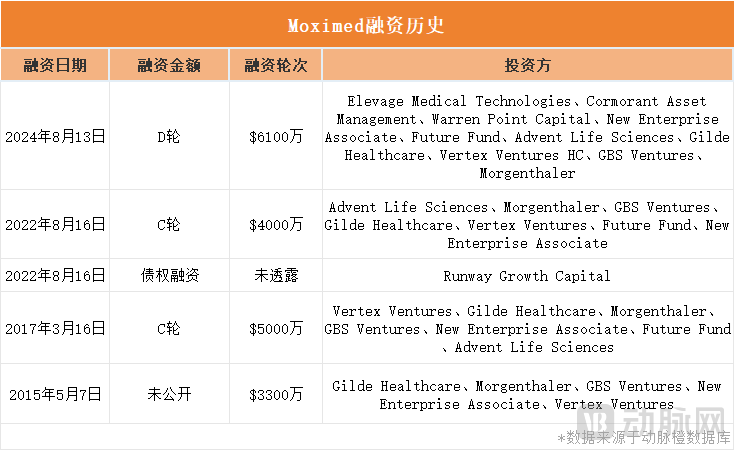
According to publicly available information, Moximed has cumulatively raised over 184 million US dollars since its establishment, equivalent to more than 1.3 billion Chinese yuan.
It is worth mentioning that the MISHA Knee Implant is not the only commercialized product of Moximed. As early as 2015, the predecessor of the MISHA Knee Implant, the Atlas Knee System, received CE certification and was commercially applied in the same year. According to estimates from the data platform Growjo, Moximed's current annual revenue is approximately$1.31 million, approximately 93.01 million RMB.
Without removing bones, muscles, or ligaments, and without altering the joint structure,
Preserving Natural Knee Joints and More Treatment Options for Patients
MISHA Knee Implant Received FDA Approval for Market Launch in March 2023, and Obtained FDA "Breakthrough Device Designation" in October of the Same Year. It Is the First Subcutaneously Implanted Shock Absorber (ISA) to Receive FDA Approval.
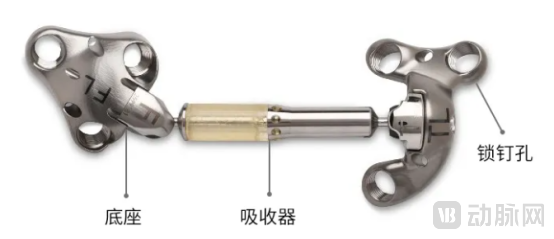
MISHA Knee System Implants
It is developed based on the principle that "reducing the load on arthritic joints can alleviate pain and improve function," suitable for patients with mild to moderate knee osteoarthritis, and after implantation, it can reduce the peak forces on the painful knee during activities such as walking, running, or standing.
There are two points that need special clarification: first, the MISHA knee implant absorbs excess joint load rather than transferring the load to other healthy areas of the joint, similar to a shock absorber; second, MISHA cannot cure arthritis but can only relieve pain, serving as a transitional treatment device.
MISHA Knee Implant consists of two bases, one fixed at the distal femur and the other at the proximal tibia, an insert positioned between the two bases, and six screws for securing the bases. The product is supplied fully assembled and is available in large sizes.SmallDifferentiation between left and right. It is implanted through a single incision in the subcutaneous tissue of the extracapsular medial space, and fixed to the medial cortex of the distal femur and proximal tibia using locking screws. The implant shares the load with the medial knee joint, and the ball-and-socket joint allows the device to adapt to the natural movement of the knee.
Unlike total knee arthroplasty (TKA), the patient's bones, muscles, ligaments, or cartilage do not need to be removed, and the joint capsule is not damaged, thereby maximizing the acceleration of the patient's recovery cycle. After rehabilitation, there are no activity restrictions for the patient, and it does not affect the patient’s normal movement, work, or life. More importantly, the implant is only placed under the skin without structurally altering the joint, preserving future treatment options for the patient.
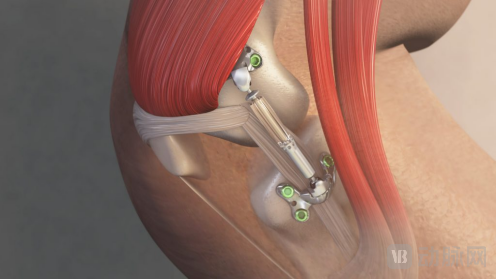
When the implant recipient bends and lifts their knee, the MISHA Knee System implant acts like a car shock absorber, reducing peak forces on the painful knee.
Before the launch of the MISHA Knee System, high tibial osteotomy (HTO) has been a knee-preserving surgical method used in recent years to treat early to mid-stage knee osteoarthritis. However, this procedure requires high-level osteotomy of the tibia, release or even removal of ligaments, and its short-term and long-term outcomes still have significant room for improvement.
In contrast, the clinical advantages of MISHA knee implants are:
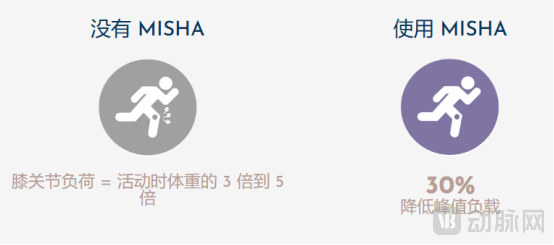
MISHA is placed on the inner side of the knee, moving together with the natural joint. It treats knee OA pain by uniquely absorbing excess load supported by the affected knee joint. After implantation, the peak force on the knee is reduced by over 30% with each step, effectively alleviating pain.
The implant is placed under the skin, outside the joint, and the surgical procedure does not require the removal of any bone, ligaments, or cartilage, preserving options for future treatment.
The surgery can be performed in an outpatient setting, and most of the surgeries for American research participants are outpatient surgeries, with an average time from admission to discharge of approximately nine hours.
No weight-bearing or range of motion restrictions are required after surgery, and there are no device-imposed activity limitations.
Patients can resume sports activities or daily activities after surgery;
Anil Ranawat, M.D., Director of the Hip and Knee Division at the Hospital for Special Surgery's Institute for Sports Medicine, believes it "fills the gap between total knee replacement and arthroscopic knee preservation."[1]
According to a 5-year follow-up study published in the journal *Knee Surgery, Sports Traumatology, Arthroscopy* on March 23, 2023: In younger patients with mild to moderate symptomatic medial compartment knee OA, implantation of the ISA device resulted in a 5-year survival rate of 85% for avoiding joint replacement or TTO. The ISA system may be an effective treatment option for working-age patients with knee OA who are unsuitable for or unwilling to undergo more invasive surgical procedures.[2]
In June of the same year, a 2-year follow-up study was published in CARTILAGE, showing that ISA was highly effective in reducing the progression to joint replacement surgery for at least 2 years post-implantation, even in patients at very high risk of progression. The study also highlighted the utility of the SIFK scoring algorithm in predicting the 2-year risk of conversion to joint replacement. ISA provides a useful load-reduction method that can effectively delay or replace the need for joint replacement surgery in certain patients.[3]
The creation of any major product is a long and challenging process. Since its establishment in 2008, Moximed has been committed to perfecting this shock absorber over the past sixteen years.
The origin of MISHA can be traced back to its first-generation product—KineSpring, whose core components include a buffer composed of two cobalt-chromium alloy springs, and tibial and femoral components made of titanium alloy. KineSpring is implanted subcutaneously along the knee joint, and through a partial load buffering mechanism, it effectively reduces the knee joint's load by up to 13 kilograms.
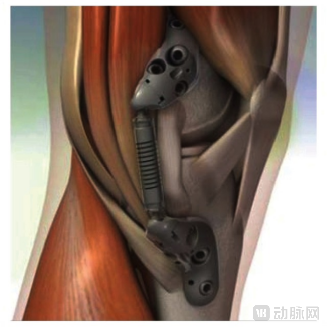
KineSpring Diagram
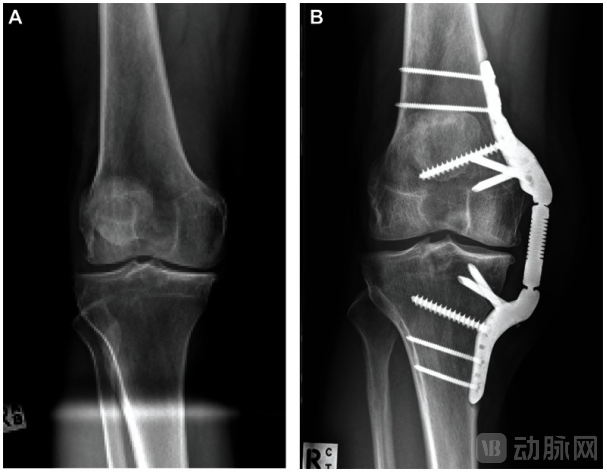
(A) Preoperative anteroposterior X-ray showsMedialCompartmental severe osteoarthritis; (B) KineSpring Knee Implant System at 2 years post-implantation
With the advancement of technology, KineSpring evolved into the Atlas Knee System, which received CE certification and was commercialized in November 2015. A year later, the first group of American knee OA patients received Atlas treatment.
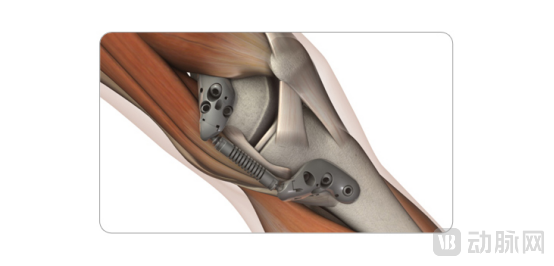
Atlas Knee System
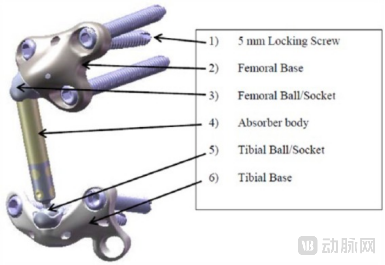
Atlas Knee System Component Diagram
In the following years, Moximed focused on various clinical trials and rarely made public announcements until it successfully completed its Series C financing in August 2022.
The main differences between MISHA and previous versions lie in the implant materials and dimensions. The earlier Atlas Knee System consisted of a titanium alloy femoral and tibial base along with a polycarbonate urethane absorber. Although the product received CE certification in 2015, concerns about metal implants began to surface in the market. Moximed then independently developed a polymer material, PCU (polycarbonate urethane), which not only enhanced the biocompatibility of the product but also reduced the size of the implant, making it more anatomically conforming to the human body, thereby improving patient comfort and treatment outcomes.
In 2022, at the Boston Orthopedic Summit, Moximed announced the first clinical trial results of MISHA. The pivotal study of MISHA, named Calypso, was an Investigational Device Exemption (IDE) study that enrolled 81 participants. The study directly compared MISHA with the gold standard for treating medial compartment osteoarthritis (OA) of the knee—High Tibial Osteotomy (HTO). The results showed that MISHA achieved a comprehensive success rate of 85.6%, significantly higher than HTO's 65.5%. Additionally, MISHA was able to reduce knee load by more than 30%, which is more than double the effect of its predecessor.
The pivotal two-year trial data released in March 2023 was even more encouraging: 95.8% of MISHA participants achieved clinically meaningful pain relief, with a pain reduction of up to 76% and functional improvement reaching 74%.
This series of outstanding clinical performance has won MISHA the favor of the U.S. FDA. In April 2023, MISHA receivedBatchListed.
The rise of a brand is often premised on the rise of a major single product; the breakthrough in the market is often also led by the initial breakout of a major single product.
Across various industries, blockbuster products not only withstand the test of time to become evergreen market leaders but also serve as the core competitive moat for enterprises, delivering long-term value. Coca-Cola has dominated the global carbonated beverage market with its "Happy Fatty Water"; Kangshifu's instant noodles have firmly captured consumers' taste buds with "Braised Beef Noodles"; Bloomage Biotech has solidified its position as the global leader in hyaluronic acid through its strategic use of this key ingredient; Xingqi Eye Drops successfully penetrated the pediatric myopia prevention and control market with atropine sulfate eye drops; and Moximed has spent sixteen years focusing solely on its single product—the subcutaneous implantable shock absorber.
It is these major products that have supported the development and performance of enterprises, enabling them to stand out in fierce market competition and become leaders in their respective fields.
The era of multi-product free-range growth, betting on the probability of success, has become a thing of the past. Corporate product strategy has now entered an era of focused resource cultivation. In this "marathon champion" era, gaining deep insights into market demands and meticulously crafting blockbuster products may be the key for companies to achieve sustainable development and maintain continuous leadership.
[1]<FDA OKs Moximed's MISHA Shock Absorber for Knee OA>
[2]<An implantable shock absorber yields an 85% survival-from-arthroplasty rate through 5 years in working-age patients with medial compartment knee osteoarthritis>,Knee Surgery, Sports Traumatology,Arthroscopy.
[3] <Improved 2-Year Freedom from Arthroplasty in Patients with High-Risk SIFK Scores and Medial Knee Osteoarthritis Treated with an Implantable Shock Absorber versus Non-Operative Care>,CARTILAGE.
[4] Feasibility of the Atlas Unicompartmental Knee System Load Absorber in Improving Pain Relief and Function in Patients Needing Unloading of the Medial Compartment of the Knee: 1-Year Follow-Up of a Prospective, Multicenter, Single-Arm Pilot Study (PHANTOM High Flex Trial)
[5] MISHA Knee Shock Absorber: Interview with Anton Clifford, CEO of Moximed
[6] PRESERVE THE KNEE JOINT WHILE LIVING AN ACTIVE LIFE
[7] Two-Year Results of the PHANTOM High Flex Trial: A Single-Arm Study on the Atlas Unicompartmental Knee System Load Absorber in Patients With Medial Compartment Osteoarthritis of the Knee
[8] Moximed Implants First KineSpring System