

Novo Nordisk Enters $600M Collaboration with NanoVation to Advance Gene Therapies for Cardiometabolic and Rare Diseases
Novo Nordisk
Insulin Developer and Manufacturer
NanoVation Therapeutics
Gene Therapy Developer
September 18,Novo Nordisk and NanoVation Therapeutics (“NanoVation”) have entered into a multi-year collaboration agreement to advance the development of innovative gene therapies targeting cardiometabolic diseases and rare diseases.As part of the agreement,NanoVation Therapeutics will receive research funding and is eligible to obtain up to approximately $600 million (approximately 4.23 billion RMB) in upfront and potential milestone payments over the course of a multi-year collaboration.
According to the terms of the agreement, the two parties will collaborate on the development of two major projects, including the use of base editing technology to treat certain rare genetic diseases, with plans to expand to up to five additional targets for cardiometabolic and rare diseases in the future. Novo Nordisk will obtain the global exclusive license to use NanoVation Therapeutics' LNP technology for these two major projects.
Proprietary lcLNP™ Technology: Developed by the Father of LNP Technology, Capable of Delivering Nucleic Acids to Extrahepatic Cells
NanoVation Therapeutics, Inc. is a pioneer in designing and manufacturing LNP technology for nucleic acid delivery, co-founded by Dr. Pieter Cullis, who is known as the "Father of LNP Technology." Currently, NanoVation owns an extensive and continually expanding library of innovative lipids and LNP components. The company’s toolbox provides a one-stop IP portfolio for the development of LNP-based genetic medicines, offering comprehensive solutions covering novel lipid design, RNA modification, and LNP formulation. Among its capabilities, NanoVation can develop scalable nucleic acid-identifying LNP formulations tailored to specific targets, payloads, and routes of administration.
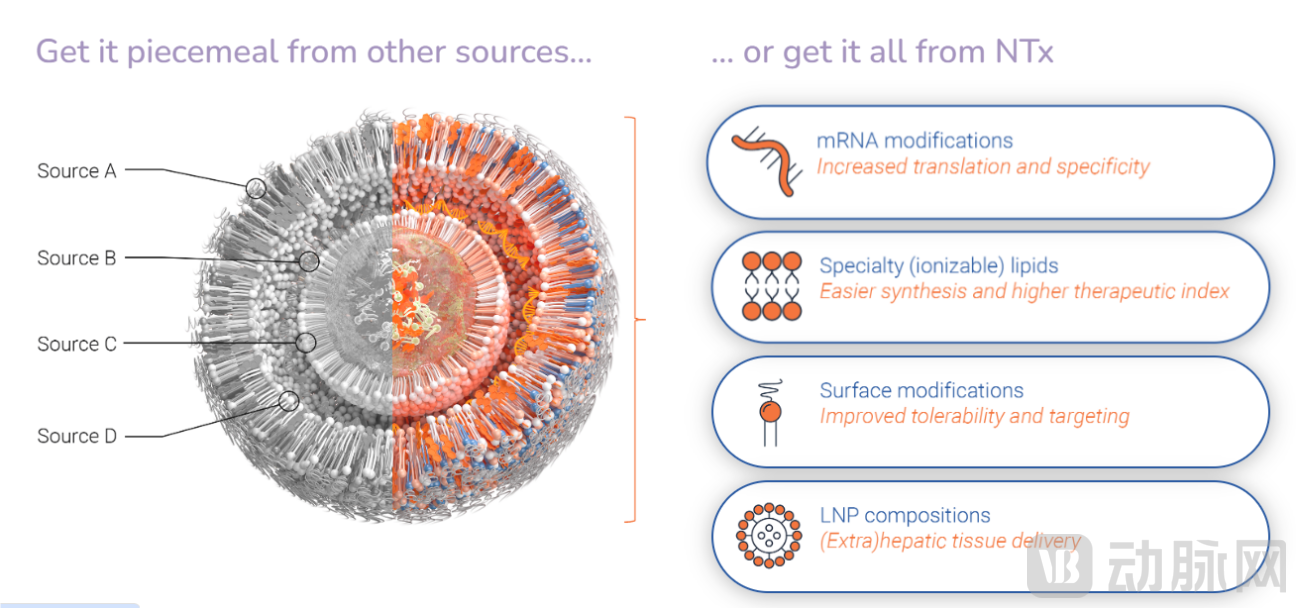 NanoVation's Product Portfolio (Source: NanoVation Official Website)
In terms of core technology, NanoVation Therapeutics has developed the next-generation lipid nanoparticle platform—the lcLNP™ technology. It is reported that,lcLNP™ technology has been proven in preclinical studies to effectively deliver nucleic acids to a variety of cell types beyond the liver, including bone marrow cells, tumor cells, and skin cells, among others.Compared with traditional delivery methods, its effectiveness, safety, and stability have all improved. In addition, to effectively target immune cells, NanoVation Therapeutics has rationally designed and further optimized its lcLNP™ technology. Currently, NanoVation Therapeutics has launched multiple projects involving various RNA modalities.
LNP is a clinically validated carrier for in vivo mRNA delivery and has been widely used in the delivery of small molecule drugs and nucleic acids. However, the accumulation of LNPs in the liver after systemic administration limits their delivery efficiency to other organs.
Currently, the application of mRNA-induced transient protein expression is not limited to the field of vaccines for infectious diseases but also offers new avenues for cancer vaccines, protein replacement therapies, and gene-editing components for rare genetic disorders. To this end, designing LNP technology that can deliver mRNA to extrahepatic organs more efficiently, safely, and with targeting capabilities will further expand the clinical applications of RNA therapeutics.
In this context, NanoVation's lcLNP™ technology will become a significant driving force for the further development of RNA therapies. Currently, this technology is also gradually gaining favor with biopharmaceutical companies.
July 2024,NanoVation Therapeutics, Inc. and ME Therapeutics Holdings Inc. Announce Strategic PartnershipME Therapeutics Aims to Leverage NanoVation’s LNP Technology to Enhance the Precision and Effectiveness of mRNA Therapy Delivery to Myeloid Cells In Vivo, Developing Potential Novel Cancer Treatments.
This collaboration between Novo Nordisk and NanoVation Therapeutics,Combining NanoVation's proprietary long-circulating lipid nanoparticle (lcLNP™) technology with Novo Nordisk's expertise in cardiometabolic and rare disease research and clinical translation will help Novo Nordisk advance the development of gene therapy drug candidates with therapeutic potential.
Five Partnerships Exceeding $4.3 Billion Reached: Novo Nordisk Boosts Development of Genomic Medicines for Cardiometabolic and Rare Diseases
Since the FDA approval of semaglutide in 2017, Novo Nordisk has reaped substantial profits and rapidly ascended to become the "new top influencer" in the pharmaceutical industry.
According to the financial report for the first half of 2024 released by Novo Nordisk, the company achieved a revenue of 133.4 billion Danish kroner in the first half of 2024, representing a year-on-year increase of 24%. Among this, the strong performance of Semaglutide was a key factor in the revenue growth. Data shows that the combined sales of the three Semaglutide products reached 88.7 billion Danish kroner, marking a year-on-year increase of 43%, accounting for two-thirds of Novo Nordisk's total revenue.
With the huge funds brought by semaglutide,Novo Nordisk has been continuously adjusting and optimizing its R&D strategies and business layout in recent years to address issues such as declining sales of semaglutide caused by production capacity shortages and the emergence of competing drugs.
However, compared with other large multinational pharmaceutical companies, Novo Nordisk has not expanded into the entire industry chain or multiple disease areas since its establishment about a hundred years ago. Instead, it has continuously focused on four core areas: diabetes, obesity, rare diseases, cardiovascular and other severe chronic diseases.
For this reason,Through acquisitions, mergers, and collaboration deals, Novo Nordisk has been actively expanding its presence in cardiometabolic and rare disease products, continuously enriching and optimizing its existing R&D pipeline. At the same time, Novo Nordisk is also aggressively exploring and innovating drug modalities. To date, Novo Nordisk's four core areas already encompass a variety of cutting-edge drug formats, including but not limited to antibodies/proteins, siRNA, cell therapy, small molecules, gene therapy, and more.
Currently, Novo Nordisk is exploring new treatments for cardiometabolic diseases such as obesity, diabetes, and cardiovascular diseases, as well as rare diseases. Among these, gene-editing therapy has become one of its key research and development directions. According to incomplete statistics, from 2023 to date, Novo Nordisk has initiated five collaborations in the field of gene-editing therapy, with a total cooperation value amounting to $4.31 billion (approximately 30.4 billion RMB).
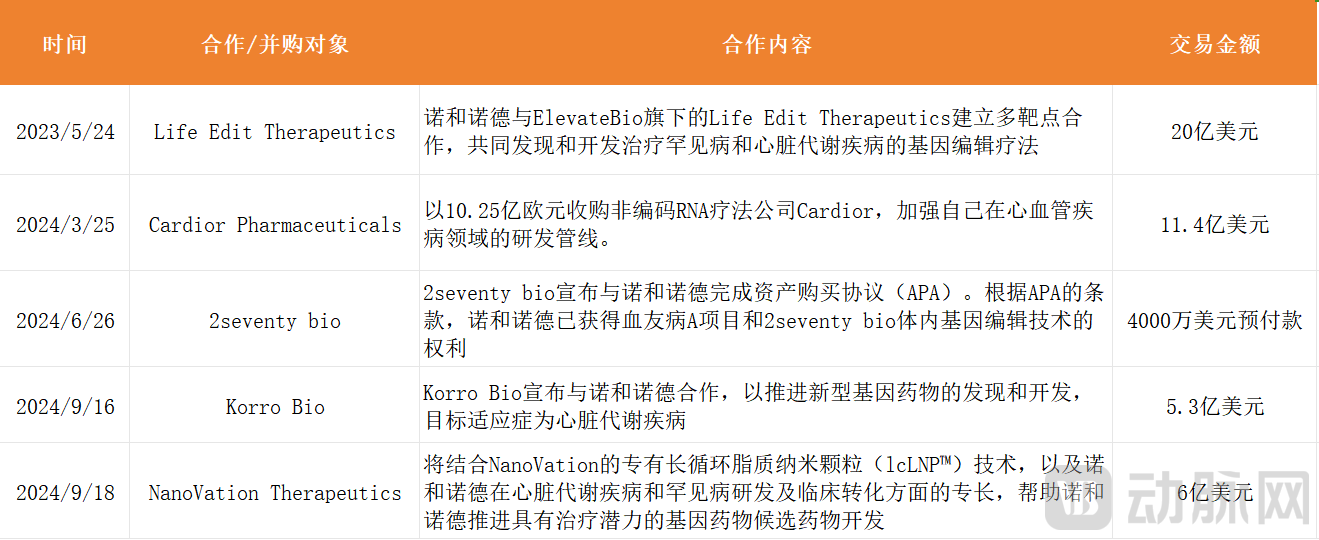
Source: Public data compilation, chart by VCBeat
Moreover, delivery vehicles and delivery technologies are key components of gene-editing therapies, both of which require continuous optimization and innovation. Among them, delivery technology, as the "last mile" in drug development, is one of the key technological fields that Novo Nordisk focuses on. In recent years, Novo Nordisk has been committed to developing efficient and safe delivery technologies through cooperation, acquisitions, and mergers, ultimately improving drug targeting and efficacy while reducing potential side effects. These collaborations have not only enriched its technical reserves but also provided strong support for its drug development across multiple therapeutic areas.
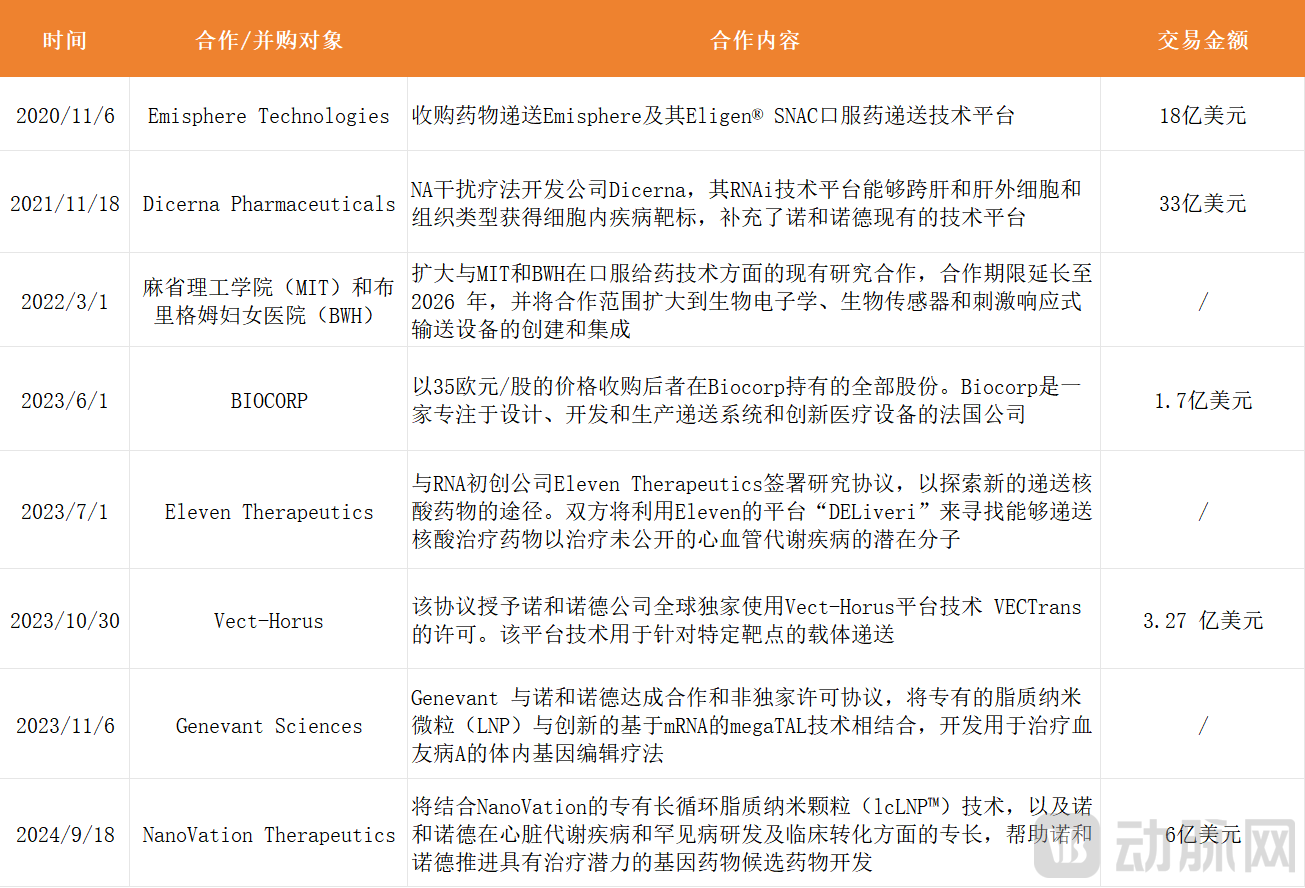
Source: Public data compilation, chart by VCBeat (incomplete statistics)
At the annual media communication meeting held by Novo Nordisk, it stated, "Novo Nordisk's corporate strategy is rooted in the mission of 'driving change and working together to combat diabetes and other serious chronic diseases.' It will continue to strengthen its leading position in the fields of diabetes and obesity treatment, consolidate its leadership in the field of rare disease treatment, and establish a presence in cardiovascular diseases and other serious chronic disease areas."
To this end, Novo Nordisk is continuously exploring the potential of semaglutide to expand its range of indications. In addition, since the beginning of this year, Novo Nordisk has been actively expanding its product pipeline in the cardiometabolic and rare disease fields through BD deals or acquisitions. By adopting multiple strategies, it aims to solidify its dominant position in the metabolic weight loss field. At the same time, Novo Nordisk is constantly leveraging the potential and technological innovations of GLP-1 in the cardiometabolic and rare disease fields to maintain its advantages in the metabolic disease area, with the ultimate goal of developing the next "semaglutide."