

Battle in the Growth Hormone Market: Product Excellence vs. Channel Dominance

GenSci
Gene Engineering Pharmaceutical and Growth Hormone Producer
Novo Nordisk
Insulin Developer and Manufacturer
VISEN
Endocrine-related Disease Treatment Drug Developer
In early September, Novo Nordisk's application for the listing of its once-weekly Pasireotide injection was accepted by the CDE, marking Novo Nordisk's return to the growth hormone market in China with this weekly formulation.
In 2018, the recombinant human growth hormone injection Norditropin®, developed and manufactured by Novo Nordisk, was launched in China. It is also the only imported aqueous growth hormone available in China. In 2020, it was co-promoted in mainland China through a contract sales model with 999 HealthCare, a subsidiary of China Resources Pharmaceutical Group.
However, in October 2023, Novo Nordisk exited the Chinese market five years after its entry. According to estimates from the pharmaceutical database PharmBI by VCBeat, Novo Nordisk's sales in China in 2022 were approximately 14.48 million yuan.
The marketing application of Novo Nordisk's Pasireotide Injection signifies the official start of competition in the long-acting growth hormone field. Previously, the only long-acting growth hormone available in China was GenSci's Jinsai Zeng, which was approved for marketing in January 2014 in China with indications for GHD and ISS. Additionally, there are four new indications currently under review. With extensive coverage and exclusive dominance in the long-acting growth hormone market, Jinsai Zeng has already served more than 100,000 patients.
But for some indications, growth hormone, as a prescription drug with certain consumer attributes, makes channel competition increasingly critical.
According to the "Top 100 Drugs by National Hospital Sales" published by VCBeat, the national in-hospital sales of growth hormone in 2022 amounted to 1.714 billion yuan. Additionally, based on data from Changchun GeneScience Pharmaceutical Co., Ltd., Novo Nordisk, United Biotech, and Weiming Haiji, the total sales of various growth hormone products in China in 2022 were approximately 12.5 billion yuan. It is estimated that the proportion of in-hospital sales of growth hormone in China may now be less than 15%. According to a Frost & Sullivan report, the current ratio of in-hospital to out-of-hospital sales for growth hormone is roughly 30:70.
Competition in growth hormone is becoming increasingly fierce, but the focus will be outside hospitals.
Product Wins
Growth hormone is a strictly controlled prescription drug with standardized indications for use. It should only be injected under the guidance of a professional physician after confirming through examination that there is insufficient secretion of one's own growth hormone, or when diagnosed with idiopathic short stature, Turner syndrome, or dwarfism caused by growth hormone deficiency.
"But a pediatric drug development expert told VCBeat, 'Although growth hormone is a prescription drug, in fact, many parents are influenced by the manufacturer's product education and take the initiative to go to the hospital for inquiries.'"
On social platforms, many parents share their experiences using growth hormones.According to IQVIA's 2020 research report, more than half of the parents of patients seek detailed explanations from doctors before accepting GH treatment, while about a quarter of the parents seek information through communication with other parents or (and) online searches.
The safety of treatment is one of the most concerning issues, including: the risk of inducing tumors, the risk of triggering other endocrine diseases, the risk of causing acromegaly and facial changes, as well as the risk of inducing myopia and other related problems.
Secondly, there is the fear of daily injection treatments and their long-term effects. According to Guojin Medicine, poor long-term treatment adherence is common with daily growth hormone formulations, with some patients using the medication irregularly, administering insufficient doses, or prematurely discontinuing treatment, all of which can impact treatment effectiveness.
Although Norditropin is still on the market as a daily injection, it remains favored by some parents for one key reason: its design significantly enhances compliance. Norditropin comes in a pre-filled mechanical pen that uses histidine as a buffer solution, making it portable while reducing injection pain. After the first use, it can be stored at 25°C for up to three weeks, whereas other aqueous injections generally must be refrigerated at 2-8°C.
In addition, some products improve the injection process through the design of needle-free injectors. Needle-free injectors use the principle of pressure jet to push growth hormone liquid through micro-holes to instantly penetrate the skin. Some parents believe that needle-free injectors help eliminate fear of needles, while others have reported that these injectors are cumbersome to operate, involving steps such as pressurizing, drawing medicine, injecting, and applying pressure with a cotton swab after injection. These steps make them more complex than regular electronic needles, and if not properly pressed, the likelihood of bleeding significantly increases.
It can be seen that in this field, any small difference in products will affect decision-making. Of course, the injectable form is the most concerned factor.
Currently, there are three main types of growth hormone formulations available in the Chinese market: powder, short-acting liquid, and long-acting liquid, with prices increasing progressively. The most expensive weekly formulation, calculated for a user weighing 50kg, requires approximately 40mg per month at a cost of about 14,000 yuan, with annual expenses exceeding 150,000 yuan.
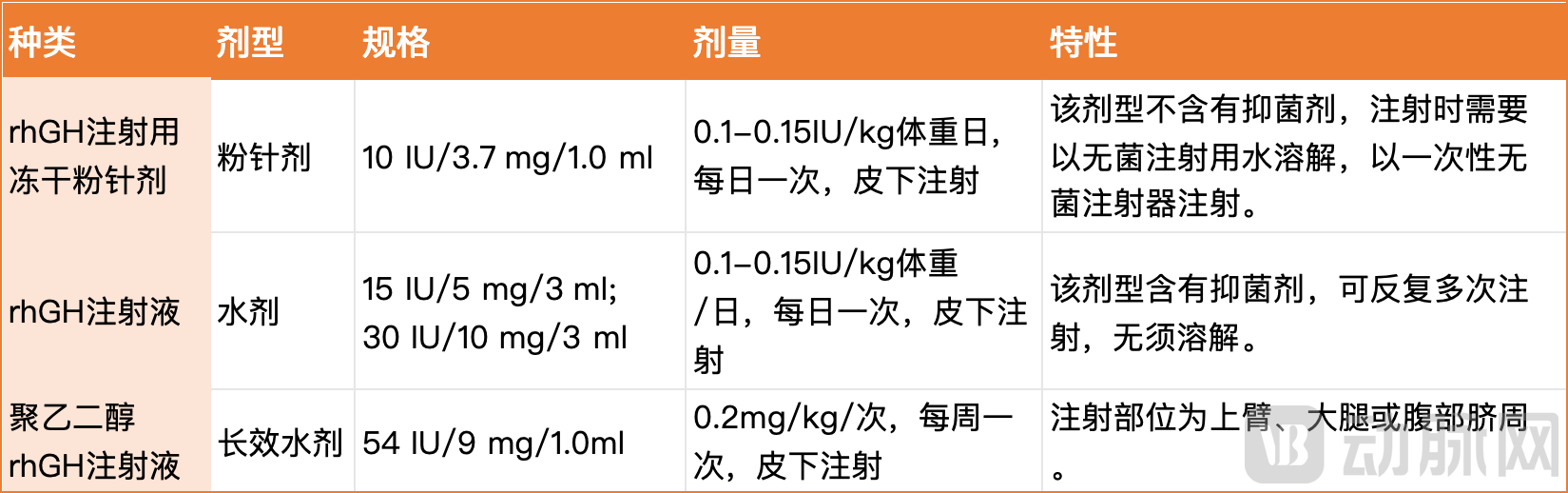
Since powder needs to be prepared before use, it has gradually been replaced by aqueous solutions. The competition in aqueous solutions will surely become the battleground for long-acting formulations in the future. Apart from the already marketed GenSci's Jin Sai Zeng (Genotropin), there are currently three long-acting growth hormone formulations that have applied for marketing approval, coming from Novo Nordisk, VISEN Pharmaceuticals, and Amoytop Biotech.
Particularly noteworthy is VISEN Pharmaceuticals' submission for the listing of Lonapegsomatropin. Key data from the Phase 3 clinical trial in China showed that after 52 weeks of treatment with Lonapegsomatropin or daily growth hormone, the AHV was 10.66 cm/year and 9.75 cm/year, respectively, with a difference of 0.91 cm, demonstrating superiority over the daily formulation. Lonapegsomatropin is manufactured using patented technology that covalently links unmodified 22 kDa recombinant human growth hormone molecules to a PEG carrier via a hydrolysable linker. It has already been launched in multiple developed countries overseas and has the potential to become China’s first unmodified long-acting growth hormone drug.
Channel is King
In China, the reimbursement for growth hormone is mainly out-of-pocket. Given that market demand far exceeds the supply capacity within hospitals, the growth hormone market has adapted to this situation by presenting a pattern of in-hospital prescriptions and out-of-hospital purchases, with the latter taking the lead.
As early as 2013, GenSci invited thousands of experts and media to 180 cities across China for educational campaigns, "creating a strong social atmosphere for the dissemination of knowledge about children's growth and development and the promotion of scientific height-increase concepts."
Foreign pharmaceutical companies did not actively engage in doctor and market education for growth hormone in the early years, leaving a huge opportunity for local enterprises.
In 2015, GenSci's parent company, Changchun High & New Technology Industries (Group) Inc., announced its participation in the establishment of Shanghai Tongxin Hospital Management Company, which would form partnerships with children's hospitals and pediatric clinics through shareholding and cooperation. Similarly, Anke Bio, the manufacturer of AnSumo, began "expanding the sales channels for its leading product, recombinant human growth hormone, by collaborating with hospitals to set up outpatient clinics for short stature treatment."
After several years of development, the basic popularization and channel establishment in the Chinese market have been completed. Now, with the increasing awareness of "chasing growth," how to enhance broader coverage and form a closed loop has become the key to capturing the market.
GenSci launched the Beibei Growth Management Center program in November 2022, aiming to leverage its advantages in this field to create a specialized children's growth management service station cooperation project targeting grassroots healthcare transformation. In its promotion, GenSci describes it as an all-inclusive service: strong channels + supply chain + products & professional operations + digital diagnosis and treatment system.
Last year, Chengcheng Zhong, the founder of Beibei Gao brand, said that this project was suitable for "grassroots medical institutions to promote." Zhong Chengcheng stated that after joining this project, grassroots medical institutions could all achieve growth in the field of children's health management, share the fruits of the rising trend of consumer healthcare, and better seize opportunities under the wave of consumer healthcare in the field of children's health. It is expected to reach 500 institutions by 2024, and the hope for the future is to expand to 3,000 institutions.
VISEN's long-acting growth hormone, although not yet on the market, has already reached a cooperation agreement with United Family Healthcare to jointly explore an innovative development model aimed at improving children's growth and development services in China. VISEN emphasized that its collaboration with United Family Healthcare aims to promote the "development of disease diagnosis and treatment standards in the field of children's growth and development within China’s non-public medical institutions," further meeting the demand for high-quality, diversified, and personalized healthcare services for children in China.
VISEN Pharmaceuticals' long-acting growth hormone, Lonapegsomatropin, branded as Skytrofa, has a relatively high price overseas. For instance, in the United States, a 9.1mg Carton of the long-acting growth hormone Skytrofa is priced at $9,558. The pricing strategy within China remains unknown. However, the collaboration with United Family Healthcare indicates the need for more forward-thinking channel development. Moreover, with the continuous improvement in living standards in China, the high-price, high-value strategy for pharmaceuticals and medical services has a broad consumer base in the country.
After the launch of Novo Nordisk's Pasireotide Injection, it will face a more mature and increasingly competitive growth hormone market, potentially adopting a different marketing strategy than that used for Norditropin. Regardless, distribution channels will remain a critical battleground for growth hormone products.
Market Top?
According to a Frost & Sullivan report, China surpassed the United States in 2021 to become the world's largest human growth hormone market. In 2023, China’s human growth hormone market reached RMB 11.6 billion, with a penetration rate of only 5.3%. The vast Chinese growth hormone market remains largely untapped, holding significant growth potential. Data shows that the compound annual growth rate (CAGR) of China’s growth hormone market from 2018 to 2023 was 23.9%, and it is projected to grow at a rate of 15.1% from 2023 to 2027.
But the performance of GenSci's parent company, Changchun High & New Technology Industries (Group) Inc., in the first half of this year once raised market concerns about the future of growth hormone. In the first half of the year, Changchun High & New Technology Industries recorded revenue of 6.64 billion yuan, a year-on-year increase of 7.63%; net profit attributable to shareholders was 1.72 billion yuan, a year-on-year decrease of 20.4%. The weak performance was mainly due to the weakening of its star subsidiary, GenSci, and its core product, growth hormone. Previously, GenSci made efforts including expanding overseas markets such as the United States and the European Union, increasing the range of indications for growth hormone, optimizing its product mix by increasing the proportion of long-acting products, and strengthening brand and channel advantages through expanded promotion.
One of the biggest concerns stems from the continuous impact of declining birth rates on the market size of growth hormone. However, based on the timeline, there is still some time before the decline in birth rates affects the applicable pediatric population. Zhang Deshen, former Secretary of the Board of Changchun High-Tech, once stated in an interview, "Due to the characteristics of growth hormone products, they can only be used after children are seven or eight years old. China's birth rate has only started to drop significantly in recent years. Considering the time required for medication and the growth process of children, it may take a few more years for the impact of the declining base to affect the product."
Secondly, a low birth rate does not necessarily lead to a decline in the sales of growth hormones.
The latest data from Statistics Korea in 2023 shows that South Korea's total fertility rate dropped to 0.7 in the second quarter, hitting a record low for a single quarter. The number of newborns was 56,087, a year-on-year decrease of 6.8%. This marks the 91st consecutive month of declining newborn numbers in South Korea. However, according to IQVIA, the South Korean growth hormone market has nearly doubled in four years, increasing from 126.2 billion won (US$96.1 million) in 2018 to 237.2 billion won (over US$190 million) in 2022.
Finally, the application of growth hormone in China has not been fully opened.According to the Frost & Sullivan report, patients in developed countries not only start treatment earlier than Chinese patients, but their average treatment duration exceeds 3.5 years, while for Chinese patients it is around 1.7 years.
According to treatment guidelines and consensus recommendations, growth hormone therapy should be initiated as early as possible for children with growth hormone deficiency. However, among Chinese patients actually receiving treatment, 70% are aged 10-13. Considering treatment costs and the growth-promoting effects of the medication, generally speaking, the golden period for treating short stature is between 3-12 years old. This also indicates that a significant number of Chinese patients are either not being treated during the optimal timeframe or experience delays in treatment.
In addition, the population of adults with growth hormone deficiency is also very large. Adults with growth hormone deficiency experience increased fat mass, abnormal blood lipids, cardiac dysfunction, early atherosclerosis, reduced muscle strength and exercise capacity, decreased bone density, insulin resistance, and impaired quality of life. The symptoms are relatively hidden, and the attention to diagnosis and treatment is still insufficient, representing a considerable potential market in the future.
At the same time, just as GLP-1 gained significant market scale after the emergence of weekly formulations, the next wave of growth for growth hormone may come from the competition following the successive launches of weekly formulation products.In addition to the long-acting growth hormone, multiple companies have already entered the market. After approval, corresponding market education is expected to be further promoted, and penetration rates may accelerate.
The Story of Growth Hormone Continues.