Medtronic Appoints Jorie Soskin as New VP and General Manager of TAVR and Congenital Heart Business

Medtronic
Chronic Disease Medical Device and Therapy Developer
Recently, Medtronic, the global leader in medical devices, officially announced that Jorie Soskin has been appointed as the new Vice President and General Manager of the TAVR and Congenital Heart Disease business. According to available information, Jorie Soskin is a highly experienced veteran at Medtronic.
Since the beginning of this year, there have been several reports of personnel changes at Medtronic. As a giant in the medical industry, every decision made by Medtronic may have a profound impact on the entire industry. Personnel changes in core positions especially signify new leadership styles and strategic directions.
15-Year Veteran
Promoting High-Quality Development in the TAVR Field
As mentioned earlier, the new Vice President and General Manager of TAVR and Congenital Heart Disease business, Jorie Soskin, is a seasoned veteran of Medtronic. She currently resides in Minneapolis, Minnesota, USA, holds a Bachelor of Arts in Asian Studies from Boston College, and has also studied international business at Peking University.
Jorie Soskin's connection with Medtronic began with CoreValve. In 2009, after Medtronic acquired CoreValve for $850 million, he joined Medtronic. Since joining Medtronic’s cardiovascular field, 15 years have passed. He has held various positions, including Vice President and General Manager of the Procedure Innovations division, Senior Director and General Manager of Infection Control, and Director of Tachy Strategy.
Regarding Jorie Soskin's new appointment, Nina Goodheart, Senior Vice President of Medtronic and President of Structural Heart and Aortic at Medtronic, stated: "Jorie brings a drive for innovation and a strong track record of improving patient outcomes and access by focusing on executing strategic business opportunities. I look forward to working with Jorie as he advances our team’s excellence in innovation."
Moreover, CoreValve was also highly significant for Medtronic. At that time, CoreValve was a major competitor to Edwards Lifesciences in the TAVR (Transcatheter Aortic Valve Replacement) field. Medtronic began developing its TAVR business starting with the acquisition of CoreValve. Notably, Medtronic’s TAVR products still use the CoreValve name today.
Since the CoreValve system was first approved in Europe in 2007, it has been Medtronic's first-generation TAVR valve. The product has continued to be updated and iterated since then. Currently, the aortic valve replacement system platform is named Evolut, which includes the products Evolut R, Evolut PRO, Evolut PRO+, and Evolut FX. In the United States, these are suitable for symptomatic severe aortic stenosis patients across all risk categories.
In August this year, according to new data published in *Cardiovascular Revascularization Medicine*, the clinical outcomes of CoreValve and its "reassuring" durability after 12 years were highlighted. The data showed that after 12 years, the cardiovascular mortality rate was 23.9% "when non-cardiac death was considered a competing risk." The 12-year risks for structural valve deterioration (SVD), bioprosthetic valve dysfunction (BVD), bioprosthetic valve failure, and severe hemodynamic valve deterioration were 3.6%, 7%, 3.12%, and 1.7%, respectively.
The author of the article stated: "TAVR using the first-generation CoreValve bioprosthesis is an effective method for treating severe aortic stenosis in patients at high surgical risk, and furthermore, the durability of this SE bioprosthesis is reassuring."
9 Personnel Changes
Multiple businesses continue to grow.
Since the beginning of 2024, there have been frequent changes in Medtronic's senior management. According to statistics, there have been at least 9 personnel change announcements, involving various business areas.
Table 1. Medtronic Personnel Changes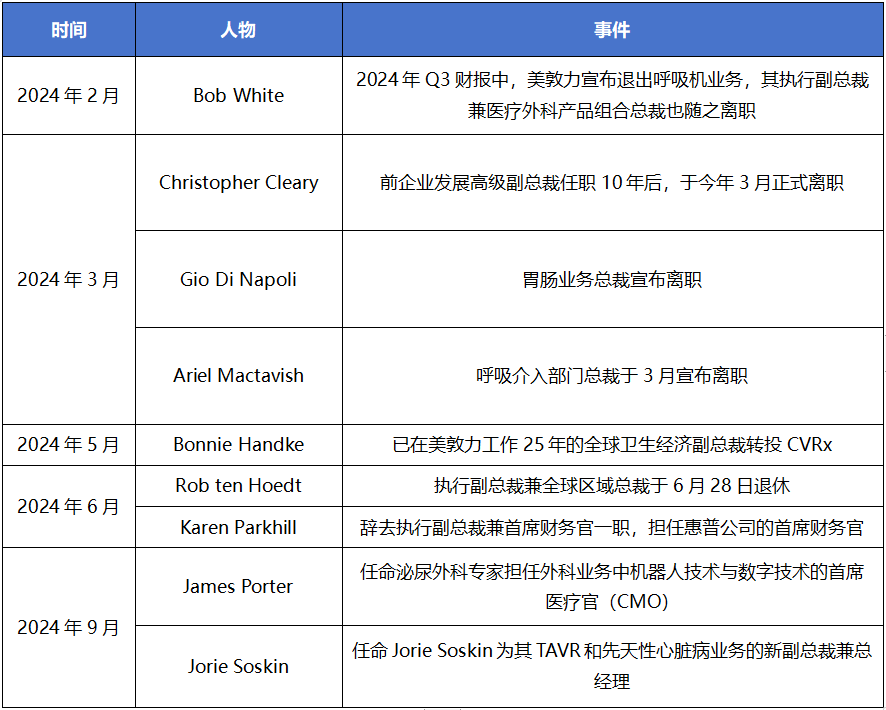
Source: Compiled from public information
Reviewing Medtronic's entire year of 2023, part of the reasons for its frequent high-level changes might be identified. In 2023, Medtronic's total revenue was $31.227 billion, a decrease of 1.45% year-on-year. Among this, the cardiovascular business contributed significantly, shouldering the main revenue load with sales of $11.573 billion, accounting for 37.06%. With this outstanding performance, Medtronic once again ranked first in the global medical device revenue, but it is worth noting that Johnson & Johnson Medical Technology achieved a revenue of $30.4 billion in 2023, an increase of 10.8% year-on-year, only $827 million less than Medtronic.
Moreover, it is not difficult to see from Johnson & Johnson's recent moves that the company is gradually strengthening its layout in the cardiovascular business. Cardiovascular business is also one of Medtronic's main businesses, and the two will "compete" in the cardiovascular field next.
On August 20, Medtronic announced its Q1 financial report for the fiscal year 2025. The report showed that the revenue for the quarter was $7.9 billion (approximately 56.32 billion RMB), with adjusted revenue at $8 billion, representing a year-over-year increase of 2.77%. Net profit reached $1.049 billion, marking a year-over-year growth of 31.62%.
By product category, multiple business segments continue to grow, showing a positive development momentum:
Cardiovascular Products: Revenue of $30.07 billion, a year-over-year increase of 5.5%, with organic growth of 6.9%. Cardiovascular products mainly include heart failure business, structural heart and aortic business, peripheral vascular business, etc.;
Neuroscience Portfolio: Revenue was $2.317 billion, an increase of 4.4%, with organic growth of 5.3%. The neuroscience portfolio mainly includes neuromodulation, pain therapies, cranial and spinal technologies, and specialty therapies.
Medical and Surgical Portfolio: Revenue was $1.996 billion, a year-over-year decrease of 0.4%, with organic growth of 1.0%. Net profit grew in the low single digits. Medical and surgical products include surgical and endoscopy businesses, acute care, and monitoring businesses.
Diabetes Portfolio: Revenue of $647 million, an increase of 11.8% year-over-year, with organic revenue growth of 12.6%.
From Medtronic's perspective, it boasts a full range of product pipelines, currently spanning multiple fields such as cardiovascular, neuroscience, diabetes, and surgical solutions. In the latest financial report, except for a slight decline in its internal and external surgical product portfolio, all other businesses are continuously growing. Among them, the diabetes product portfolio shows the most rapid growth. Moreover, several of Medtronic's key cardiovascular products have been successively launched this year. Whether Medtronic can continue to retain its title as the top medical device company and defend its reputation this year remains to be seen.
Conclusion
The medical device market is highly competitive, with unpredictable changes. Medtronic needs to continuously adapt to these changes and innovate in order to strengthen its position in the market. Under the leadership of Jorie Soskin, the new leader, it is believed that Medtronic will achieve more breakthroughs in technology development, product innovation, and market expansion.
References:
1. "Another Medtronic Executive Takes Office, Hailing from Peking University" Device News
2. Public information, Medtronic official website, etc.

Editor: Muyan
Disclaimer: This article is a reprint from PharmNet. The images and text are the original property of the author, and the purpose of the reprint is to convey more information. It does not represent the views of this platform. If there are any issues regarding the content, copyright, or other aspects, please leave a message on this platform, and we will address it promptly.