AstraZeneca Advances Nine Innovative Class 1 Drugs into Clinical Trials in China, Multiple Candidates Leading Domestic Development

AstraZeneca
Biopharmaceutical Manufacturer

In recent years, an increasing number of multinational pharmaceutical companies have begun to include China in their global development projects for innovative drugs, implementing a strategy of synchronized development in China and overseas to accelerate the launch of innovative drugs in China. AstraZeneca is one of them.
Insight database shows that, since 2024 (As of September 23),AstraZeneca has received clinical approval in China for the first time for 9 novel Class 1 drugs under development.. These new drugsNoneApproved overseas, all have entered the clinical stage in China.And many of them are in the first tier in terms of progress in China.In this article, let's take a look at what new targets these drugs are pointing to and which diseases they are expected to treat?

AZD0780: Oral Small Molecule PCSK9 Inhibitor
September 11, AstraZenecaOral, Small Molecule PCSK9 InhibitorAZD0780 Film-Coated Tablets Approved for Clinical Use in China, Intended for Use on the Basis of Standard TreatmentTreatment of Dyslipidemia in Patients with LDL-C Not at Goal. Overseas, the drug is currently in Phase II clinical trials for the treatment of hyperlipidemia.

Screenshot from: CDE official website
PSCK9 is a well-known and validated target in lipid metabolism, and inhibition of PSCK9 signaling has been shown to effectively reduce LDL cholesterol levels in plasma. Lower LDL-C levels are associated with a reduced risk of long-term cardiovascular disease and major cardiovascular events.Insight database shows,Currently, there are no oral PCSK9 inhibitors approved for marketing at home and abroad.。
AstraZeneca announced positive results from the Phase Ⅰ clinical trial of AZD0780 in May 2024. The trial evaluated the safety, tolerability, pharmacokinetics, and pharmacodynamics of AZD0780 as a monotherapy and in combination with rosuvastatin in lowering LDL-C in plasma. The data showed,On the basis of rosuvastatin treatment, the combined use of AZD0780 reduced patients' LDL-C by more than 50%, with an overall reduction of 78% from baseline.。

AZD7798: CCR9 Monoclonal Antibody
On August 12, AstraZeneca'sCCR9 Monoclonal AntibodyAZD7798 for Injection Approved for Clinical Use in China, Intended for TreatmentModerate to Severe Crohn's Disease. Overseas, the drug is currently in Phase II clinical trials for the treatment of patients with moderate to severe Crohn's disease. According to the Insight database,AZD7798 is currently the only CCR9 monoclonal antibody worldwide to have entered the clinical stage.。

Screenshot from: CDE official website
Crohn's Disease (CD) is a common type of inflammatory bowel disease. Research has found that chemokine receptors and their homologous chemokine ligands can mediate directed cell migration, leading to inflammation. Gut-specific homing molecules, such as CCR9 (CC Chemokine Receptor 9) and its ligand CCL25 (CC Ligand 25), which is the key signaling pathway for recruiting lymphocytes to the small intestine. Developing drugs targeting CCR9 may offer a potential treatment option for Crohn's disease.

AZD9829: CD123-Targeted ADC
On March 5, AstraZeneca'sCD123-Targeted ADCAZD9829 Approved for Clinical Use in China, Intended for TreatmentCD123-Positive Malignant Hematological Diseases. Overseas, the drug is currently in Phase I/II clinical trials for the treatment of myelodysplastic syndromes and acute myeloid leukemia.

Screenshot source: CDE official website
CD123(IL3RA) is a cell surface protein that is overexpressed in various hematologic malignancies, including acute myeloid leukemia (AML) and myelodysplastic syndromes (MDS), while its expression is restricted in normal hematopoietic stem cells.
AZD9829 is a potential first-in-class CD123 ADC, Its main mechanism of action is to deliver the topoisomerase I inhibitor (TOP1i) payload to cancer cells expressing CD123, resulting in DNA damage and apoptosis. In preclinical studies, AZD9829 has demonstrated potential as a monotherapy for AML and provided a basis for combining AZD9829 with standard therapies to improve long-term outcomes for AML patients.
Insight database shows that, in the ADC field targeting IL3RA, only four products globally have entered clinical trials, with AstraZeneca's AZD9829 being one of the fastest progressing products.In China, AZD9829 is the only product in its class to have entered clinical trials.。

ALXN2220 Injection: TTR Monoclonal Antibody
On March 11, AstraZeneca'sAmyloid Depleting AgentALXN2220 Injection Approved for Clinical Use in China, Intended for Treating Confirmed Wild-Type or Hereditary ConditionsAdult cardiomyopathy patients with transthyretin (TTR)-mediated amyloidosis (ATTR amyloidosis)In 2022, Neurimmune entered into an exclusive global collaboration and license agreement with Alexion, a subsidiary of AstraZeneca focusing on rare diseases, for ALXN2220.

Screenshot from: CDE official website
ATTR-CM is a systemic disease that leads to progressive heart failure. Progressive ATTR amyloid deposition is a hallmark of the disease, which can result in heart failure and death. Although therapies have been approved for treating this condition, there remains a significant unmet medical need in the treatment of moderate to severe ATTR-CM, and amyloid depletion may represent an important new mechanism for achieving further efficacy.
ALXN2220(NI006) is an amyloid-depleting agent designed to treat ATTR-CM by depleting amyloid fibrils in the heart.The preliminary results of the Phase 1 clinical study already conducted show that ALXN2220 can act as a depleting agent for cardiac amyloid load.May Improve Cardiac Structure, Function, and Outcomes in ATTR Cardiomyopathy。
Currently, researchers are conducting an international multicenter Phase III clinical trial in multiple countries and regions, including mainland China, to evaluate the efficacy and safety of ALXN2220 in adult subjects with ATTR-CM.

Zibotentan/Dapagliflozin Tablets:
ETA Receptor Antagonist/SGLT2 Inhibitor
On March 11, AstraZeneca's Zibotentan/Dapagliflozin Tablets were approved for clinical use in China, with the indication being:For the treatment of adult patients with chronic kidney disease (CKD) and high proteinuriaTo delay the decline of eGFR; reduce the risk of continuous eGFR decline, ESKD, and renal death; and decrease albuminuria. Zibotentan is an endothelin A (ETA) receptor antagonist, and dapagliflozin is an SGLT2 inhibitor.
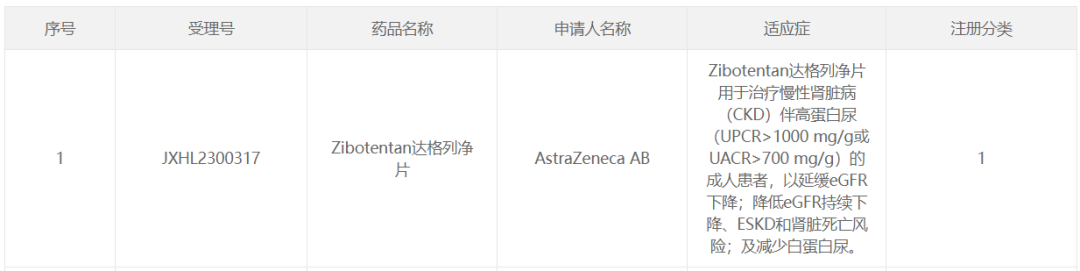
Screenshot source: CDE official website
High proteinuria affects approximately 10% of CKD patients. Elevated albuminuria levels are associated with an increased risk of kidney function loss over time, and by reducing albuminuria levels, the risk of progressing to kidney failure can be decreased.
Phase IIb Study ZENITH-CKD Data Shows That After 12 Weeks of Treatment, the UACR of Zibotentan/Dapagliflozin vs Dapagliflozin Alone (Urinary Albumin-to-Creatinine Ratio, Used to Assess Albuminuria)The difference is in the high-dose group.(1.5 mg Zibotentan/10 mg Dapagliflozin; n=179)For -33.7%,In the low-dose group(0.25 mg/10 mg;n=91)For -27.0%The mean percentage change in UACR from baseline was -52.5% in the high-dose group and -47.7% in the low-dose group.
Currently, researchers are conducting an international multicenter Phase III clinical trial in multiple countries and regions, including mainland China, to evaluate Zibotentan/Dapagliflozin tablets compared with Dapagliflozin monotherapy.Treatment of Chronic Kidney Disease and High Proteinuria in SubjectsEfficacy, safety, and tolerability.

AZD0486: CD3×CD19 Bispecific Antibody
On February 18, AstraZeneca's AZD0486 was approved for clinical use in China, intended for the treatment ofRelapsed or Refractory B-cell Acute Lymphoblastic LeukemiaAZD0486 was acquired by AstraZeneca in 2022 through the acquisition of TeneoTwo for over $1.2 billion.A CD3×CD19 bispecific antibody, mainly used for the treatment of B-cell hematologic malignancies.

Screenshot source: CDE official website
AZD0486 (TNB-486) is a T-cell engager (TCE).T cell engagers are bispecific molecules designed to redirect T cells of the immune system to recognize and kill cancer cells. AZD0486 can activate and recruit T cells to CD19-expressing tumors by binding to the antigen CD19 expressed on B cells and the CD3 receptor on T cells, thereby triggering an immune response.
Overseas, AZD0486 has entered the Phase III clinical stage for first-line treatment of follicular lymphoma. In China, researchers are conducting a Phase I/II study of AZD0486 monotherapy for B-cell acute lymphoblastic leukemia (CTR20243136)。

ALXN1850: Enzyme Replacement Therapy
On February 7, Alexion, a subsidiary of AstraZeneca, filed forEnzyme Replacement TherapyALXN1850 Injection Approved for Clinical Use in China, Intended for TreatmentHypophosphatasiaHypophosphatasia is a rare inherited metabolic disorder caused by insufficient activity of tissue-nonspecific alkaline phosphatase (TNSALP). ALXN1850 (Efzimfotase alfa) isThe Second-Generation TNSALP Enzyme Replacement Therapy, is being developed for the treatment of hypophosphatemia.

Screenshot from: CDE official website
In August 2024, AstraZeneca announced the Phase I clinical trial data of ALXN1850 for the first time in humans. The main purpose of this study was to evaluate safety and tolerability. The data showed,ALXN1850 demonstrated an acceptable safety, tolerability, and pharmacokinetic profile, and was associated with a sustained reduction in biomarkers of disease in adults with hypophosphatasia. Data support further evaluation of ALXN1850 in both adult and pediatric patients.。
Currently, the researchers areIncluding mainland Chinain multiple countries and regions to conduct two international multicenter Phase III clinical trials, respectively evaluating ALXN1850 in patients who have not previously received Asfotase Alfa treatment.Pediatric Subjects with Hypophosphatasia (2 years to <12 years)(CTR20240840) andAdolescent (≥12 years to <18 years) and adult subjects with hypophosphatasia(CTR20240789) Efficacy and Safety.

Baxdrostat: Small Molecule Aldosterone Synthase Inhibitor
On January 31, AstraZeneca's Baxdrostat Tablets were approved for clinical use in China, intended for the treatment ofHypertensive patients with poor blood pressure control after other drug treatments, to reduce blood pressureIn March this year, the drug was approved for a new clinical study in China, with the indication being Baxdrostat combined with Dapagliflozin.Slowing the Decline of Renal Function in Adult Patients with Chronic Kidney Disease and Hypertension。
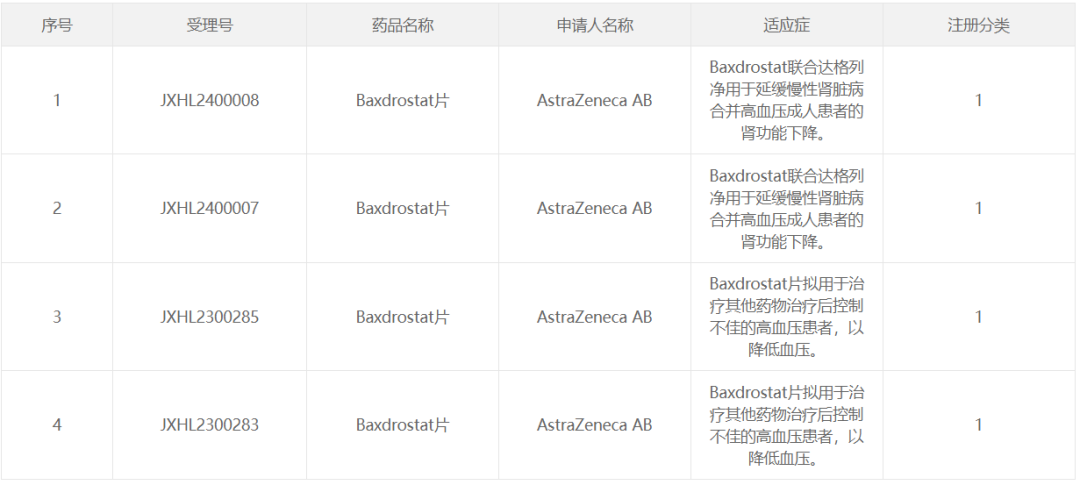
Screenshot from:CDE Official Website
Baxdrostat isA Highly Selective Oral Small-Molecule Aldosterone Synthase Inhibitor, which AstraZeneca acquired through an approximately $1.8 billion purchase of CinCor Pharma. Aldosterone synthase is the enzyme responsible for aldosterone synthesis in the adrenal glands. Baxdrostat can selectively target aldosterone synthase,Intended for the treatment of refractory hypertension, primary aldosteronism, and chronic kidney disease。
Currently, AstraZeneca is conducting two international multicenter Phase III clinical trials in multiple countries and regions, including mainland China: one study (CTR20241008) for patients who have received two or more prior treatments and remain uncontrolledHypertensive subjects (including resistant hypertension)To evaluate the efficacy and safety of Baxdrostat; another study (CTR20241500) Aiming to evaluateBaxdrostat Combined with Dapagliflozin in Slowing CKD Progression in Subjects with CKD and HypertensionEffectiveness, safety, and tolerability.

AZD3470: PRMT5 Inhibitor
On January 25, AstraZeneca reportedPRMT5 InhibitorAZD3470 Film-Coated Tablets Approved for Clinical Use in China, Intended for TreatmentMTAP-Deficient Advanced/Metastatic Solid Tumors。PRMT5 Is a New Target in the Field of "Synthetic Lethal" Drug Development."Synthetic lethality" refers to the phenomenon where the simultaneous inhibition of two non-lethal genes leads to cell death. PARP inhibitors are the first class of "synthetic lethality" drugs to achieve clinical success.

Screenshot source: CDE official website
PRMT5 is an epigenetic enzyme that catalyzes the symmetric dimethylation of arginine on a variety of substrates (SDMA), thereby regulating biological processes including RNA splicing and the cell cycle. PRMT5 has been identified as a "synthetic lethal" target in tumors with homozygous deletions of methylthioadenosine phosphorylase (MTAP).AZD3470 is an MTA-cooperative PRMT5 inhibitor that selectively inhibits PRMT5 in MTAP-deficient tumors.。
Currently, AstraZeneca is conducting a Phase I/II clinical trial in multiple countries and regions, including mainland China (CTR20241176), to evaluateAZD3470 MonotherapyAndCombination therapy with antineoplastic drugsInIn subjects with MTAP-deficient advanced solid tumorsSafety and Tolerability.
Insight database shows that no PRMT5 inhibitor has been approved globally, and AstraZeneca's AZD3470 is in the first tier in terms of the research progress of PRMT5 inhibitors in China.

Summary
According to data disclosed by AstraZeneca at its China R&D Day held in March this year, AstraZeneca’s Global R&D China Center currently has over 200 projects in its R&D pipeline.It is expected that around 100 new drugs or new indications will be approved within 5 years, and the R&D pipeline will add 10-15 new projects each year.。
Among them, in the fields of highly prevalent cancers in China such as gastric cancer, liver cancer, and biliary tract cancer, AstraZeneca China's Global R&D Center has begun to lead global drug development. Zhang Lingyan, Vice President of AstraZeneca China and Head of the Lung Cancer Division of the Oncology Business Unit, recently stated in a press release that in the future, AstraZeneca will expand disruptive innovative therapies, including ADC drugs targeting TROP2 and HER2, immunotherapy combined with targeted therapy, monoclonal antibodies, and bispecific antibodies.By 2030, strive to launch 9 new products and 26 new indications in China.。
Cover Source:Corporate Logo
Disclaimer:This article is for information sharing only,不代表 Insight 立场和观点, and does not recommend or introduce any treatment options. If needed, please consult and contact正规医疗机构.
Editor:Xin Medicine
PR Article Coordination: WeChat insightxb
SubmissionWeChat: insightxb; Email: insight@dxy.cn