Novartis' Two Radiopharmaceuticals—177Lu-PSMA-617 and 68Ga-Gozetotide Kit—Proposed for Priority Review in China

Novartis
Drug Development and Manufacturing
Today (September 24), the CDE is proposing to include Novartis' Lutetium [177Lu] Texiveptide Injection and the radiopharmaceutical Gallium [68Ga] Gozetotide Injection preparation kit for priority review.
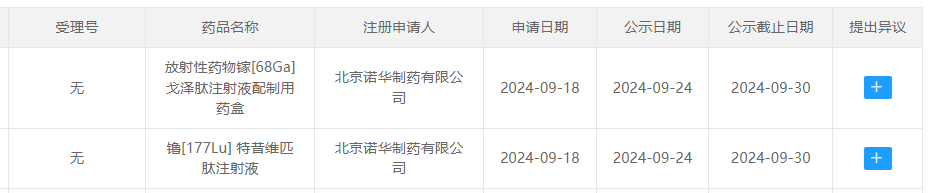
Source of the image: CDE official website
According to the CDE official website, both drugs were reviewed in accordance with the "Opinions of the National Medical Products Administration on Reforming and Improving the Evaluation and Approval Management System for Radiopharmaceuticals" (No. 20 [2023] of the NMPA) and the "Medium- and Long-term Development Plan for Medical Isotopes (2021–2035)." Upon examination, they meet the relevant requirements of the "Measures for Drug Registration" and the "Announcement of the National Medical Products Administration on Issuing Three Documents Including the <Procedures for the Evaluation of Breakthrough Therapies (Trial)>" (No. 82 [2020]). They have been approved for inclusion in the priority review and approval process under the category “(6) Other circumstances specified by the National Medical Products Administration for priority review and approval.”
Lutetium [177Lu] Vipivotide Tetraxetan Injection is intended for the treatment of adult patients with metastatic castration-resistant prostate cancer (mCRPC) that is positive for prostate-specific membrane antigen (PSMA), and who have received androgen receptor pathway inhibitors and taxane chemotherapy. According to publicly available information, Lutetium (177Lu) Vipivotide Tetraxetan Injection (177Lu-PSMA-617) is a PSMA-targeted radioligand therapy that conjugates the small-molecule PSMA-targeting agent PSMA-617 with the radioactive isotope 177Lu. 177Lu-PSMA-617 targets populations of prostate cancer cells via PSMA molecules, delivering radiation precisely to prostate cancer cells without harming surrounding cells. In March 2022, the drug was approved for marketing by the U.S. FDA.
The radiopharmaceutical Gallium [68Ga] Gozetotide Injection, after being radiolabeled with gallium-68, can be used as a radioactive diagnostic agent. It is suitable for identifying prostate-specific membrane antigen (PSMA) positive lesions in adult patients with prostate cancer through positron emission tomography (PET).

Editor: Mu Mian
Disclaimer: This article is a reprint from Pharmacist Network. The images and text are the original property of the author, and the purpose of the reprint is to convey more information. It does not represent the views of this platform. If there are any issues regarding content, copyright, or other problems, please leave a message on this platform, and we will address it promptly.